SUMMARY
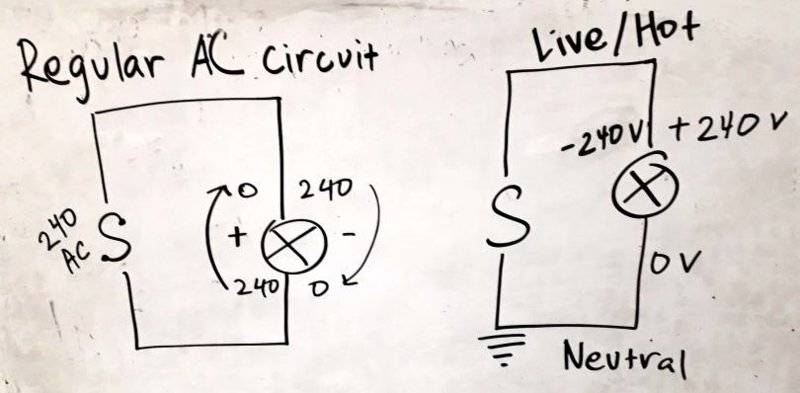
The discussion centers on the concept of voltage transition between live and neutral wires in AC circuits, specifically addressing the relationship between earthing and voltage levels. When a wire is earthed, it is defined as Neutral at 0V, while the live wire oscillates between +240V and -240V, with actual peak voltages reaching approximately +330V and -330V. The conversation emphasizes that the definition of 0V is arbitrary and relative, depending on the reference point chosen, and highlights the importance of understanding RMS voltage in AC systems. The nuances of different domestic mains supply standards and the behavior of voltages during transitions are also discussed.
PREREQUISITES
- Understanding of AC voltage concepts, particularly RMS voltage.
- Knowledge of earthing and its role in electrical circuits.
- Familiarity with voltage definitions and reference points in electrical systems.
- Basic principles of capacitance and its effect on voltage changes.
NEXT STEPS
- Research "RMS voltage in AC systems" to understand its significance and calculations.
- Learn about "earthing techniques and standards" in different countries.
- Explore "capacitive effects in electrical circuits" to grasp how capacitance influences voltage transitions.
- Investigate "domestic mains supply standards" to compare voltage configurations globally.
USEFUL FOR
Electrical engineers, technicians, and students studying AC circuits, as well as anyone interested in understanding the principles of voltage, earthing, and electrical safety standards.