Is This the Correct Method for Calculating the Time of Flight for a Projectile?

Click For Summary
The correct method for calculating the time of flight for a projectile involves using the quadratic formula, especially when the initial velocity is not zero. In this case, with an initial speed of 20 m/s and a downward projection at a 10° angle from a height of 10 m, the equation yields both positive and negative time solutions. The negative solution can be disregarded as it represents a point in time before the projectile was launched. The positive solution indicates the actual time of flight after the projectile is released. This approach accurately reflects the projectile's motion, confirming the method's validity.
so_gr_lo
Messages
69
Reaction score
10
Homework Statement
Find time of flight of particle projected down at 10° to horizontal at initial speed 20 ms^-1 at height 10m.
Relevant Equations
s = ut -1/2at^2
These questions normally have initial velocity = 0, so that one of the t terms cancels. In this case u = 20ms^-1 so I end up with a quadratic. Which is fine if I plug it into the quadratic formula as one result is -ve so can be ignored, while the other gives t as +ve. just wondering if this is the correct way of calculating the time of flight. Attempt at question below
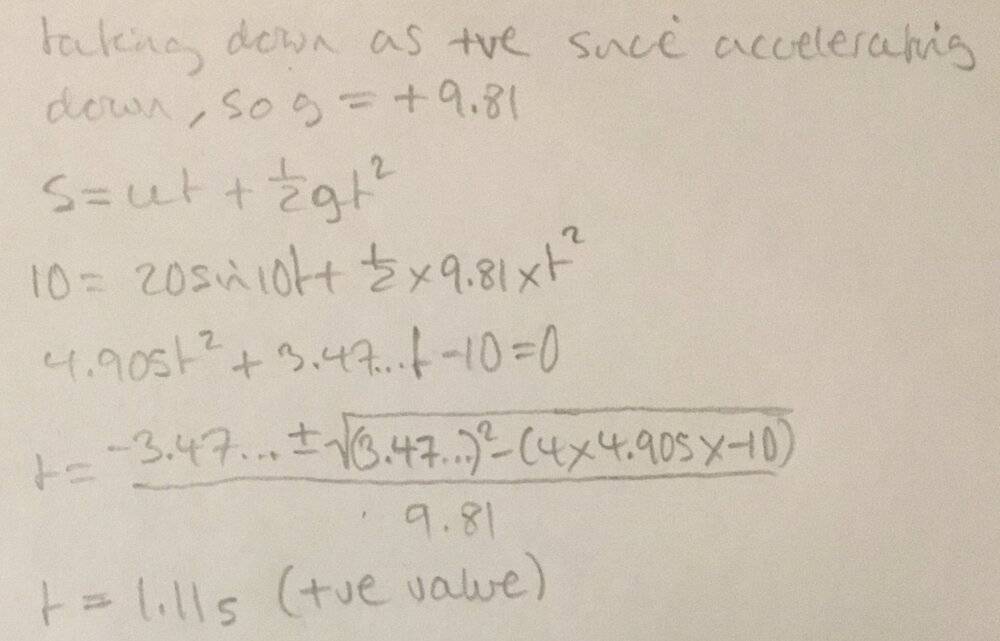
ACC5B820-9B15-4049-8BB7-8EA3868B6E2E.jpeg
 
Physics news on Phys.org
Looks good to me. (All that matters is the vertical motion.)
 
so_gr_lo said:
Homework Statement:: Find time of flight of particle projected down at 10° to horizontal at initial speed 20 ms^-1 at height 10m.
Relevant Equations:: s = ut -1/2at^2

These questions normally have initial velocity = 0, so that one of the t terms cancels. In this case u = 20ms^-1 so I end up with a quadratic. Which is fine if I plug it into the quadratic formula as one result is -ve so can be ignored, while the other gives t as +ve. just wondering if this is the correct way of calculating the time of flight. Attempt at question below

View attachment 274557
Yes, that's the right way.
The reason you also get a negative solution is that your equation represents an entire parabola in which, at t=0, the particle is moving down at the given angle, speed and height. So it will be at the target height twice, once before t=0 and once after.
 
The book claims the answer is that all the magnitudes are the same because "the gravitational force on the penguin is the same". I'm having trouble understanding this. I thought the buoyant force was equal to the weight of the fluid displaced. Weight depends on mass which depends on density. Therefore, due to the differing densities the buoyant force will be different in each case? Is this incorrect?

Similar threads

  • · Replies 4 ·
Replies
4
Views
3K
Replies
4
Views
2K
Replies
6
Views
3K
  • · Replies 8 ·
Replies
8
Views
3K
Replies
2
Views
1K
  • · Replies 1 ·
Replies
1
Views
3K
  • · Replies 11 ·
Replies
11
Views
3K
Replies
40
Views
2K
  • · Replies 2 ·
Replies
2
Views
2K
  • · Replies 7 ·
Replies
7
Views
2K