SUMMARY
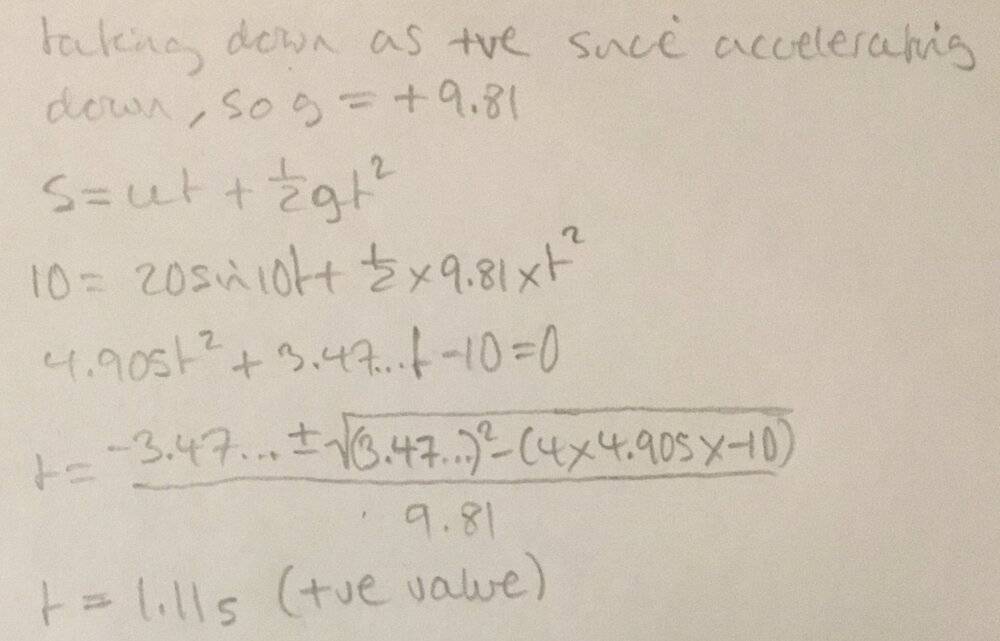
The correct method for calculating the time of flight for a projectile projected downward at a 10° angle with an initial speed of 20 m/s from a height of 10 m involves using the equation s = ut - 1/2at². The quadratic formula is applied to solve for time, yielding two solutions: one negative and one positive. The negative solution is disregarded as it does not apply to the physical scenario. The analysis confirms that the projectile will reach the target height twice, once before t=0 and once after.
PREREQUISITES
- Understanding of projectile motion principles
- Familiarity with quadratic equations and the quadratic formula
- Knowledge of kinematic equations, specifically s = ut - 1/2at²
- Basic trigonometry to resolve angles in projectile motion
NEXT STEPS
- Study the derivation and applications of kinematic equations in projectile motion
- Learn how to analyze projectile motion using vector components
- Explore the effects of different launch angles on projectile trajectories
- Investigate the role of air resistance in real-world projectile motion
USEFUL FOR
Students studying physics, educators teaching projectile motion concepts, and anyone interested in the mathematical modeling of motion in a gravitational field.