Charles Link said:
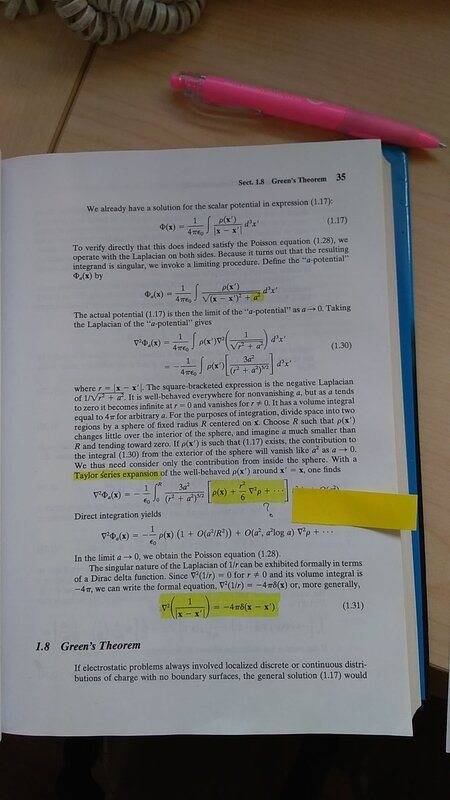
The print isn't real clear, but I worked the next step. (The exponent in the denominator is ## \frac{5}{2} ##. It looks like ## \frac{3}{2} ##, but correctly it should be ## \frac{5}{2} ##).
## \int\limits_{0}^{+\infty} \frac{3 a^2 r^2}{(r^2+a^2)^{5/2}} \, dr ## can be readily solved by letting ## r=a \tan{\theta} ##.
To resolve the handwaving in post 2, ## \nabla^2 \rho =(\frac{\partial^2{\rho}}{\partial{x^2}}) + ## y and z second partial terms at ## \vec{x} ##, so that ## \nabla^2 \rho =3 (\frac{\partial^2{\rho}}{\partial{x^2}}) ## at ## \vec{x} ##. This ## \nabla^2 ## term is a constant when integrating over dr. It also is useful to look at the integrals of ## \int x^2 \, d^3 r ## vs. ## \int r^2 \, d^3 r ##, etc. Upon working through all the details, I agree with his ## \frac{1}{6} ##.
I think that's correct though I find the conclusion by Jackson a bit too quick, but after some detailed analysis, I think it's correct too.
What's behind it is a formal proof of the very important formula
$$-\Delta_x G(\vec{x},\vec{x}')=-\Delta_x \frac{1}{4 \pi |\vec{x}-\vec{x}'|}=\delta^{(3)}(\vec{x}-\vec{x}').$$
The standard proof is to integrate a test function in the sense of distributions
$$\phi(\vec{x})=\int_{\mathbb{R}^3} \mathrm{d}^3 x' G(\vec{x},\vec{x}') \rho(\vec{x}')$$
and then show that indeed
$$-\Delta \phi(\vec{x})=\rho(\vec{x}).$$
The integral is evaluated by integrating not over ##\mathbb{R}^3##, because of the singularity of the Green's function at ##\vec{x}'=\vec{x}## but to leave out a little spherical ball or radius ##\epsilon## around the singular point ##\vec{x}## and then taking the limit ##\epsilon \rightarrow 0##, using the fact that
$$\Delta_x G(\vec{x},\vec{x}')=\Delta_{x'} G(\vec{x},\vec{x}')=0 \quad \text{for} \quad \vec{x}' \neq \vec{x}.$$
Jackson provides the proof in a different way, i.e., he regularized the Green's function and then takes the weak limit.
The advantage is that the original integral over entire ##\mathbb{R}^3## is well defined to begin with, and
$$\Delta \phi_a(\vec{x})=\int_{\mathbb{R}^3} \mathrm{d}^3 \vec{x}' \Delta_x G_a(\vec{x},\vec{x}') \rho(\vec{x}')$$
is well defined.
Now he wants to show that for ##a \rightarrow 0## this integral goes to ##-\rho(\vec{x})##. The first observation is that the only contribution can come from an arbitrarily little region around ##\vec{x}'=\vec{x}##, i.a., for taking the limit you can just evaluate the integral over a sphere of radius ##R## around ##\vec{x}##, because for the rest of the integral you can exchange the limit with the integral, giving ##0##.
So he sets ##\vec{x}'=\vec{x}+\vec{r}## with ##\vec{r}=\vec{x}'-\vec{x}##. Now
$$\Delta G_a(\vec{x},\vec{x}')=-\frac{3 a^2}{(r^2+a^2)^{5/2}}.$$
So the integral is
$$I(\vec{r})=-3 a^2\int_{K_R} \mathrm{d}^3 r \frac{1}{(r^2+a^2)^{5/2}} \rho(\vec{x}+\vec{r}),$$
where ##K_R## is the solid sphere of radius ##R## around the origin ##\vec{r}=0##. Next Jackson expands ##\rho## around ##\vec{r}=0##. Formally
$$\rho(\vec{x}+\vec{r})=\exp(\vec{r} \cdot \vec{\nabla}) \rho(\vec{x}).$$
Now all you need is to evaluate the integrals
$$I_{j_1,\ldots,j_k}=-3 a^2\int_{K_R} \mathrm{d}^3 r \frac{1}{(r^2+a^2)^{5/2}} r_{j_1} \cdots r_{j_k}.$$
Of course one introduces spherical coordinates for ##\vec{r}## to do the integral. Fortunately all that's interesting here is the integral over ##r=|\vec{r}|##. We don't need the complicated integration over the angles for all ##k##. So let's only do the ##r## integral:
$$I_k=-3a^2 \int_0^R \mathrm{d} r \frac{r^{k+2}}{(r^2+a^2)^{5/2}}.$$
Substitution of ##r=a \sinh \lambda## leads to
$$I_k=-3a^k \int_0^{\mathrm{arsinh(R/a)}} \mathrm{d} \lambda \frac{\sinh^{k+2} \lambda}{\cosh^4 \lambda}.$$
Now the integrand is increasing for ##k \geq 4##, i.e., for these ##k##
$$|I_k| \leq \frac{3 a^2 R^{k+2}}{(a^2+R^2)^2}\mathrm{arsinh}(R/a) \rightarrow 0 \quad \text{for} \quad a \rightarrow 0.$$
So we need only the cases ##k=0## and ##k=1##, for which
$$I_0=-\frac{R^3}{(a^2+R^2)^{3/2}} \rightarrow -1 \quad \text{for} \quad a \rightarrow 0$$
and
$$I_1=a \left (-2+\frac{a(2a^2+3R^2)}{(a^2+R^2)^{3/2}} \right) \rightarrow 0 \quad \text{for} \quad a \rightarrow 0.$$
So the only contribution is for ##k=0##, and together with the integral over the angles, which gives ##4 \pi## indeed leads to
$$\lim_{a \rightarrow 0} \Delta \phi_a(\vec{x})=-\rho(\vec{x}),$$
as claimed.