Undergrad Jacobson Radical and Direct Sums - Bland, Proposition 6.1.4

  • Thread starter Thread starter Math Amateur
  • Start date Start date
  • Tags Tags
    Radical Sums
Click For Summary
The discussion revolves around understanding Proposition 6.1.4 from Paul E. Bland's "Rings and Their Modules," specifically how the canonical injections apply to the Jacobson radicals of modules. It is clarified that for any R-homomorphism, the image of the Jacobson radical of a module is contained within the Jacobson radical of the target module. This leads to the conclusion that the Jacobson radicals of the individual modules combine to form a subset of the Jacobson radical of their direct sum. Additionally, there is a query about the scenario where a module has no proper maximal submodules, confirming that in such cases, the Jacobson radical equals the module itself. The conversation emphasizes the importance of Exercise 3 in establishing these relationships.
Math Amateur
Gold Member
MHB
Messages
3,920
Reaction score
48
I am reading Paul E. Bland's book, "Rings and Their Modules".

I am focused on Section 6.1 The Jacobson Radical ... ...

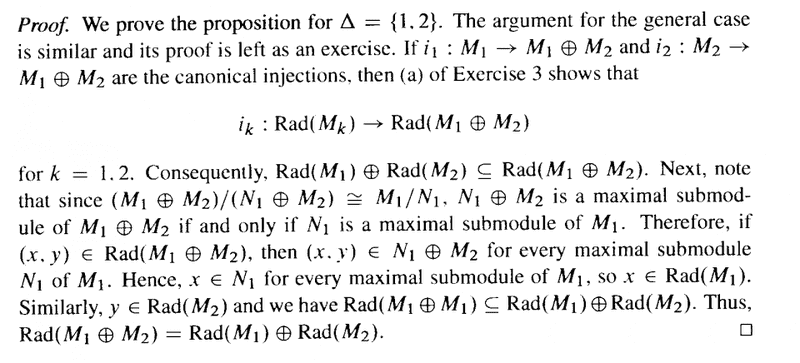
I need help with the proof of Proposition 6.1.4 ...Proposition 6.1.4 and its proof read as follows:

?temp_hash=be393751ff6786a2f6330d129dbba91d.png

?temp_hash=be393751ff6786a2f6330d129dbba91d.png

In the above proof from Bland we read:"... ... If ##i_1 \ : \ M_1 \longrightarrow M_1 \oplus M_2## and ##i_2 \ : \ M_2 \longrightarrow M_1 \oplus M_2## are the canonical injections, then (a) of Exercise 3 shows that

##i_k \ : \ \text{ Rad}(M_k) \longrightarrow \text{ Rad}(M_1 \oplus M_2)## ... ...

... ... ... "
My question/problem/issue is that I cannot understand the meaning of the statement that (a) of Exercise 3 shows that

##i_k \ : \ \text{ Rad}(M_k) \longrightarrow \text{ Rad}(M_1 \oplus M_2)## ... ...How, exactly, do the canonical injections ##i_k## apply to ##\text{ Rad}(M_k)## and ##\text{ Rad}(M_1 \oplus M_2)## ... ...

Is it trivially simple in that ##\text{ Rad}(M_k)## is a set of elements of ##M_k## and so the canonical injection operates as usual? But then... why do we need Exercise 3?

Can someone explain in simple terms ... ... exactly what is going on ...

Peter

=============================================================================
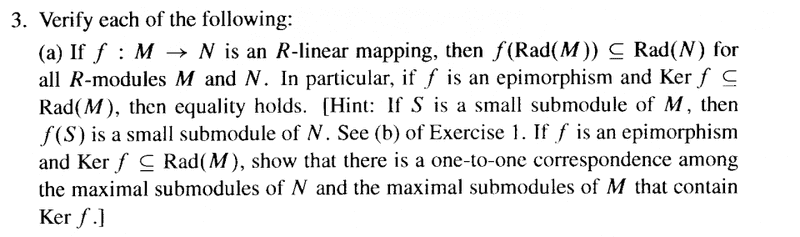
NOTE ... ... The above post refers to Exercise 3 of Bland, Section 6.1 so I am providing the text of that example ... as follows:
?temp_hash=be393751ff6786a2f6330d129dbba91d.png
 

Attachments

  • Bland - 1 - Proposition 6.1.4 and Proof - PART 1 ... ....png
    Bland - 1 - Proposition 6.1.4 and Proof - PART 1 ... ....png
    12.1 KB · Views: 652
  • Bland - 2 - Proposition 6.1.4 and Proof - PART 2 ... ....png
    Bland - 2 - Proposition 6.1.4 and Proof - PART 2 ... ....png
    34.7 KB · Views: 701
  • Bland - Problem 3 - Problems 6-1, page 177 ... ....png
    Bland - Problem 3 - Problems 6-1, page 177 ... ....png
    22.3 KB · Views: 663
Physics news on Phys.org
Math Amateur said:
In the above proof from Bland we read:
"... ... If ##i_1 \ : \ M_1 \longrightarrow M_1 \oplus M_2## and ##i_2 \ : \ M_2 \longrightarrow M_1 \oplus M_2## are the canonical injections, then (a) of Exercise 3 shows that

##i_k \ : \ \text{ Rad}(M_k) \longrightarrow \text{ Rad}(M_1 \oplus M_2)## ... ..."

My question/problem/issue is that I cannot understand the meaning of the statement that (a) of Exercise 3 shows that

##i_k \ : \ \text{ Rad}(M_k) \longrightarrow \text{ Rad}(M_1 \oplus M_2)## ... ...

How, exactly, do the canonical injections ##i_k## apply to ##\text{ Rad}(M_k)## and ##\text{ Rad}(M_1 \oplus M_2)## ... ...
Hi Peter,

it is a direct application of the statement in exercise 3.
For any ##R-##homomorphism ##f\, : \,M \rightarrow N## of ##R-##modules we have ##f(rad(M)) \subseteq rad(N)##.

Now chose ##M:=M_1\, , \,N:=M_1\oplus M_2\, , \,f := \iota_1 \, , \,M_1 \subseteq M_1\oplus M_2## and ex.3 says ##\iota_1(rad(M_1)) = rad(M_1) \subseteq rad(M_1\oplus M_2)##
The same goes of course for ##M_2## and ##\iota_2(rad(M_2)) = rad(M_2) \subseteq rad(M_1\oplus M_2)##
Therefore ##rad(M_1) \oplus rad (M_2) \subseteq rad(M_1\oplus M_2)##.

For the proof of exercise 3 with ##f## an ##R-##homomorphism ##f\, : \,M \rightarrow N## of ##R-##modules we consider an arbitrary maximal submodule ##N' \subsetneq N## and the projection ##\pi\, : \,N \twoheadrightarrow N/N'## onto the simple module ##N/N'## and the map ##\varphi := \pi \circ f\, : \, M \rightarrow N/N'\,.## Then we must show that ##M':=ker \varphi## is a maximal submodule of ##M## and thus contains ##rad(M)\,.## If you haven't done it already you should try to prove it and fill the gaps in my outline.
 
  • Like
Likes Math Amateur
just a guess, in the next to last line, did you mean: "kerphi is either a maximal (proper) submodule of M or the whole module M" ?by the way, just curious, if a module M has no proper maximal submodules, is the jacobson radical equal to M?
 
Last edited:
mathwonk said:
just a guess, in the next to last line, did you mean: "kerphi is either a maximal (proper) submodule of M or the whole module M" ?
I did not mention this special case, yes.
##rad (M) \subseteq M = ker \varphi \Rightarrow \varphi =0 \Rightarrow \varphi(rad(M)) = \{0\} \Rightarrow f(rad(M)) \subseteq ker(\pi) = N'\,.##
and the rest of the argument is the same as in the case ##M'\subsetneq M\,.##
by the way, just curious, if a module M has no proper maximal submodules, is the jacobson radical equal to M?
Yes, by convention. We've had an interesting discussion of this case here:
https://www.physicsforums.com/threads/jacobson-radical-and-rad-m-bland-corollary-6-1-3.898836/
 
  • Like
Likes Math Amateur
I am studying the mathematical formalism behind non-commutative geometry approach to quantum gravity. I was reading about Hopf algebras and their Drinfeld twist with a specific example of the Moyal-Weyl twist defined as F=exp(-iλ/2θ^(μν)∂_μ⊗∂_ν) where λ is a constant parametar and θ antisymmetric constant tensor. {∂_μ} is the basis of the tangent vector space over the underlying spacetime Now, from my understanding the enveloping algebra which appears in the definition of the Hopf algebra...

Similar threads

  • · Replies 4 ·
Replies
4
Views
2K
  • · Replies 12 ·
Replies
12
Views
3K
  • · Replies 25 ·
Replies
25
Views
4K
Replies
2
Views
2K
  • · Replies 10 ·
Replies
10
Views
2K
  • · Replies 13 ·
Replies
13
Views
3K
  • · Replies 7 ·
Replies
7
Views
3K
  • · Replies 4 ·
Replies
4
Views
1K
Replies
2
Views
2K
  • · Replies 3 ·
Replies
3
Views
2K