Math Amateur
Gold Member
MHB
- 3,920
- 48
I am reading Paul E. Bland's book, "Rings and Their Modules".
I am focused on Section 6.1 The Jacobson Radical ... ...
I need help with the proof of Proposition 6.1.4 ...Proposition 6.1.4 and its proof read as follows:

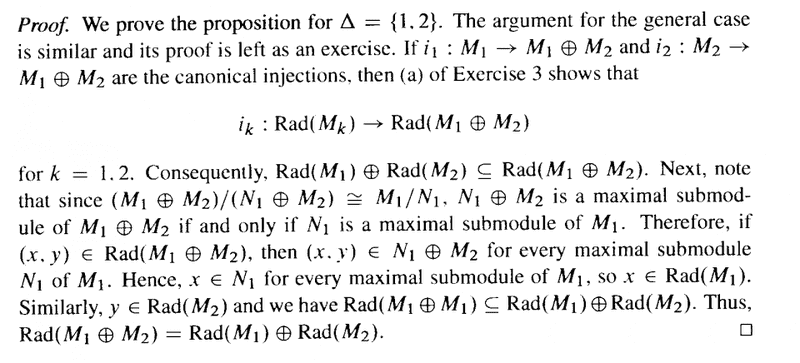
In the above proof from Bland we read:"... ... If ##i_1 \ : \ M_1 \longrightarrow M_1 \oplus M_2## and ##i_2 \ : \ M_2 \longrightarrow M_1 \oplus M_2## are the canonical injections, then (a) of Exercise 3 shows that
##i_k \ : \ \text{ Rad}(M_k) \longrightarrow \text{ Rad}(M_1 \oplus M_2)## ... ...
... ... ... "
My question/problem/issue is that I cannot understand the meaning of the statement that (a) of Exercise 3 shows that
##i_k \ : \ \text{ Rad}(M_k) \longrightarrow \text{ Rad}(M_1 \oplus M_2)## ... ...How, exactly, do the canonical injections ##i_k## apply to ##\text{ Rad}(M_k)## and ##\text{ Rad}(M_1 \oplus M_2)## ... ...
Is it trivially simple in that ##\text{ Rad}(M_k)## is a set of elements of ##M_k## and so the canonical injection operates as usual? But then... why do we need Exercise 3?
Can someone explain in simple terms ... ... exactly what is going on ...
Peter
=============================================================================
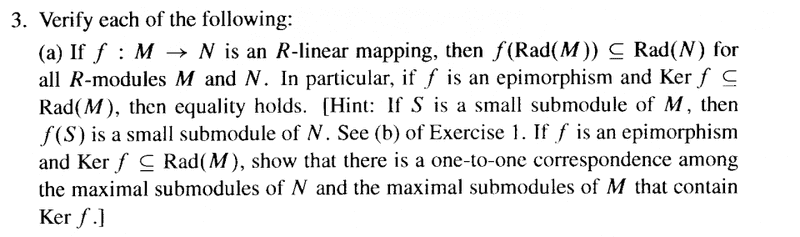
NOTE ... ... The above post refers to Exercise 3 of Bland, Section 6.1 so I am providing the text of that example ... as follows:
I am focused on Section 6.1 The Jacobson Radical ... ...
I need help with the proof of Proposition 6.1.4 ...Proposition 6.1.4 and its proof read as follows:
In the above proof from Bland we read:"... ... If ##i_1 \ : \ M_1 \longrightarrow M_1 \oplus M_2## and ##i_2 \ : \ M_2 \longrightarrow M_1 \oplus M_2## are the canonical injections, then (a) of Exercise 3 shows that
##i_k \ : \ \text{ Rad}(M_k) \longrightarrow \text{ Rad}(M_1 \oplus M_2)## ... ...
... ... ... "
My question/problem/issue is that I cannot understand the meaning of the statement that (a) of Exercise 3 shows that
##i_k \ : \ \text{ Rad}(M_k) \longrightarrow \text{ Rad}(M_1 \oplus M_2)## ... ...How, exactly, do the canonical injections ##i_k## apply to ##\text{ Rad}(M_k)## and ##\text{ Rad}(M_1 \oplus M_2)## ... ...
Is it trivially simple in that ##\text{ Rad}(M_k)## is a set of elements of ##M_k## and so the canonical injection operates as usual? But then... why do we need Exercise 3?
Can someone explain in simple terms ... ... exactly what is going on ...
Peter
=============================================================================
NOTE ... ... The above post refers to Exercise 3 of Bland, Section 6.1 so I am providing the text of that example ... as follows:


