Phy6boii
- 1
- 0
a) Kepler's first law states that a planet like Earth displays an elliptical orbit with the sun in focus. Using M = dL/dt, prove that a planet cannot leave its plane of orbit. Note: M here is an externally applied torque that the sun exerts on the planet.
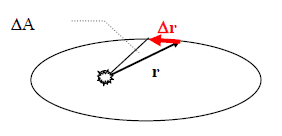
diagram of the situation described
b) From the above law of angular momentum, it follows that the angular momentum for the planet is conserved. Use this to prove Kepler's second law, which states that at equal time intervals Δt, the traveling beam of a planet covers equal areas ΔA.
Hint: use the representation: 2ΔA = |r x Δr| (proof?), where the origin lies at the focal point of the ellipse.
c) By what percentage do the orbital velocities of the Earth differ approximately at the closest point to the sun (perihelion, rP = 147.1 million km) and at the most remote point (aphelion, rA = 152.1 Million km)
Can someone guide me through these questions please? I'm lost and don't know where to begin with the thought process here. I really want to figure this out
diagram of the situation described
b) From the above law of angular momentum, it follows that the angular momentum for the planet is conserved. Use this to prove Kepler's second law, which states that at equal time intervals Δt, the traveling beam of a planet covers equal areas ΔA.
Hint: use the representation: 2ΔA = |r x Δr| (proof?), where the origin lies at the focal point of the ellipse.
c) By what percentage do the orbital velocities of the Earth differ approximately at the closest point to the sun (perihelion, rP = 147.1 million km) and at the most remote point (aphelion, rA = 152.1 Million km)
Can someone guide me through these questions please? I'm lost and don't know where to begin with the thought process here. I really want to figure this out