Kinetic energy problem -- What am I doing wrong?

Click For Summary

Homework Help Overview

The discussion revolves around a kinetic energy problem involving a block sliding on a frictionless surface. The block initially moves at a speed of 20 m/s and encounters a 20 N force acting to the left when it reaches the 1 cm mark. Participants are examining the block's speed as it crosses the 0 cm mark, questioning the application of kinetic energy principles and the interpretation of the problem setup.

Discussion Character

  • Exploratory, Conceptual clarification, Assumption checking

Approaches and Questions Raised

  • Participants discuss the calculation of change in kinetic energy and the work done by the force. There are questions about the correctness of the formulas used and the interpretation of the block's motion, particularly regarding whether it stops or simply changes direction. Some suggest focusing on the displacement from the 1 cm mark to the 0 cm mark rather than the entire motion until stopping.

Discussion Status

The discussion is ongoing, with various interpretations of the problem being explored. Some participants have offered guidance on considering the signs in calculations and the nature of the force acting on the block. There is recognition of the potential ambiguity in the problem's setup, particularly regarding the direction of motion and the interpretation of stopping.

Contextual Notes

Participants note that the problem may be open to interpretation, particularly concerning the positioning of the 1 cm and 0 cm marks. There is also mention of the need for clarity in the problem statement and any accompanying diagrams to avoid confusion.

sp3sp2sp
Messages
100
Reaction score
4
<Moderator's note: Moved from a technical forum and thus no template.>

kinetic energy problem
I just want to know what is wrong with how I am solving this problem
A block slides to the right on frictionless surface at speed of 20m/s and encounters a 20N force to left when it is at the 1cm point. What is the speed of the block when it crosses the 0cm mark?

Change in KE is KE_f - KE_i, so I just looked at problem as change in KE from point of encountering 20N force til it stops.
Then I calculated change in KE from that point til it crosses the 0cm mark.
Then I got the velocity:
For some reason my answer doesn't match the solution.

from point it encounters force til it stops = -0.5(0.5kg)(20m/s^2) = 100J
that equals work, which equals F*d.
So d = 100J/20N = 5m
So amount of energy to get to the 0cm mark would be 5.01m * 20N = 100.2J
so final velocity would be sqrt [100.2J/(0.5(0.5kg)] = 20.02m/s

Is
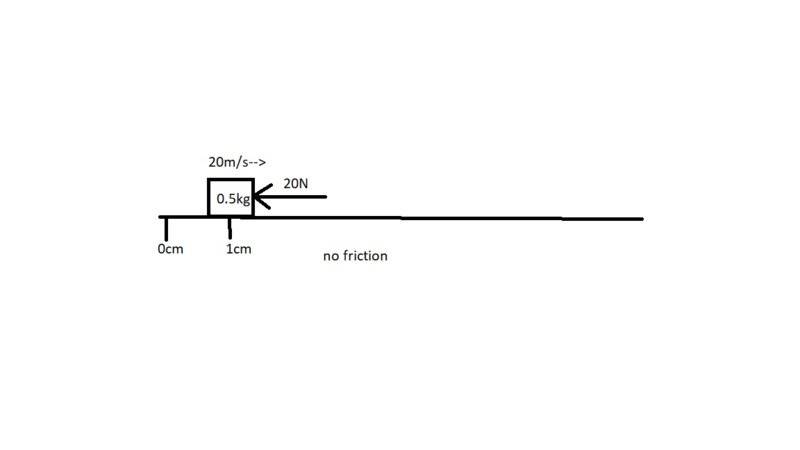
BLOCK ON SURFACE.jpg
this correct or am i doing something wrong? thanks for any help
 

Attachments

  • BLOCK ON SURFACE.jpg
    BLOCK ON SURFACE.jpg
    6.1 KB · Views: 608
Last edited by a moderator:
Physics news on Phys.org
sp3sp2sp said:
from point it encounters force til it stops = -0.5(0.5kg)(20m/s^2) = 100J
What makes you think that this is the correct formula?
 
Change in KE is KE_f - KE_i
v_f = 0m/s because it stops at that point so
change in KE is = 0J - KE_i
= 0J - 0.5mv^2
= -0.5(0.5kg)(20m/s^2) = -100J
thanks for any more help
 
but actually couldn't i just ignore the distance it goes til it stops and turns around, and just use the displacement from 1cm mark to 0cm mark? Because work is calculated using the diplacement not the distance right?
 
  • Like
Likes   Reactions: CWatters
sp3sp2sp said:
v_f = 0m/s because it stops at that point so
First of all, nothing is stating that it should stop anywhere. Second, you forgot to square the velocity on the left side.

sp3sp2sp said:
but actually couldn't i just ignore the distance it goes til it stops and turns around, and just use the displacement from 1cm mark to 0cm mark? Because work is calculated using the diplacement not the distance right?
Yes, the force is constant and therefore conservative. Just make sure you get the correct sign for the work done on the object.
 
Orodruin said:
First of all, nothing is stating that it should stop anywhere.

That's a bit confusing. The velocity will pass through 0 when it changes direction. I guess strictly speaking that doesn't count as "stopping" but it's what the OP means.
 
CWatters said:
That's a bit confusing. The velocity will pass through 0 when it changes direction. I guess strictly speaking that doesn't count as "stopping" but it's what the OP means.
No, the original question is what the speed is when the block crosses the 0 cm mark, i.e., when it has been displaced by 1 cm in the direction of the force. This has nothing to do with when the velocity is zero.
 
As I read the original problem, the drawing is incorrectly imagined. The 1 cm mark should be to the left of the 0 cm mark.
A block slides to the right on frictionless surface at speed of 20m/s and encounters a 20N force to left when it is at the 1cm point. What is the speed of the block when it crosses the 0cm mark?
That's a leftward force on an initially rightward moving block that first encounters the 1 cm mark and later encounters the 0 cm mark. i.e. the x-axis is numbered right to left, not left to right.
 
jbriggs444 said:
As I read the original problem, the drawing is incorrectly imagined. The 1 cm mark should be to the left of the 0 cm mark.

That's a leftward force on an initially rightward moving block that first encounters the 1 cm mark and later encounters the 0 cm mark. i.e. the x-axis is numbered right to left, not left to right.
I disagree, the drawing is fine. Horizontal axes usually have lower numbers to the left. Of course, the block has to first turn around due to the action of the force to get back to the 0 cm mark, but given enough time this is going to happen although it is first going to encounter the 1 cm mark again before doing so.
 
  • Like
Likes   Reactions: jbriggs444
  • #10
sp3sp2sp said:
Change in KE is KE_f - KE_i, so I just looked at problem as change in KE from point of encountering 20N force til it stops.
Then I calculated change in KE from that point til it crosses the 0cm mark.
Then I got the velocity:
For some reason my answer doesn't match the solution.

from point it encounters force til it stops = -0.5(0.5kg)(20m/s^2) = 100J
that equals work, which equals F*d.
So d = 100J/20N = 5m
So amount of energy to get to the 0cm mark would be 5.01m * 20N = 100.2J
so final velocity would be sqrt [100.2J/(0.5(0.5kg)] = 20.02m/s

I believe your method is fine (if not the best). You just need to think about the sign. If it starts moving to the right at +20m/s then moving to the left is -ve.

Edit: The problem is similar to throwing a ball up in the air from your hand at height h and asking for the velocity when it hits the ground.
 
  • Like
Likes   Reactions: jbriggs444
  • #11
jbriggs444 said:
As I read the original problem, the drawing is incorrectly imagined. The 1 cm mark should be to the left of the 0 cm mark.

Initially I thought the same but now I see no reason why it can't be correct.

Edit: If the drawing is incorrect then it's a bad question in my opinion as it's open to interpretation. Perhaps we should get the OP to post it exactly as written word for word with any diagrams supplied.
 
  • #12
Orodruin said:
No, the original question is what the speed is when the block crosses the 0 cm mark, i.e., when it has been displaced by 1 cm in the direction of the force. This has nothing to do with when the velocity is zero.
Sure, but all the OP was doing was (unnecessarily) breaking the motion into two phases, a rightward motion and a leftward motion. The reference to stopping was in relation to coming instantaneously to rest between these two motions.

If the problem has been stated correctly, I see nothing wrong with the OP method nor with the answer. The question asks for the speed, so the sign should be positive.

Edit: The choice of data in the problem is rather strange. I wonder whether the starting point is supposed to be at 1m from the origin, not 1cm.
 
Last edited:
  • Like
Likes   Reactions: CWatters
  • #13
haruspex said:
Sure, but all the OP was doing was (unnecessarily) breaking the motion into two phases, a rightward motion and a leftward motion. The reference to stopping was in relation to coming instantaneously to rest between these two motions.

If the problem has been stated correctly, I see nothing wrong with the OP method nor with the answer. The question asks for the speed, so the sign should be positive.
I agree, I just understood what he was trying to do. I had the easy solution so clear that I guess I could not see the difficult one ...
 
  • #14
sp3sp2sp said:
<Moderator's note: Moved from a technical forum and thus no template.>

kinetic energy problem
I just want to know what is wrong with how I am solving this problem
A block slides to the right on frictionless surface at speed of 20m/s and encounters a 20N force to left when it is at the 1cm point. What is the speed of the block when it crosses the 0cm mark?

Change in KE is KE_f - KE_i, so I just looked at problem as change in KE from point of encountering 20N force til it stops.
Then I calculated change in KE from that point til it crosses the 0cm mark.
Then I got the velocity:
For some reason my answer doesn't match the solution.

from point it encounters force til it stops = -0.5(0.5kg)(20m/s^2) = 100J
that equals work, which equals F*d.
So d = 100J/20N = 5m
So amount of energy to get to the 0cm mark would be 5.01m * 20N = 100.2J
so final velocity would be sqrt [100.2J/(0.5(0.5kg)] = 20.02m/s

Is View attachment 233939 this correct or am i doing something wrong? thanks for any help

This looks like a standard ballistics problem of tossing a ball upwards (from a point near the ground) and figuring its velocity when it falls back to earth. The difference here is that "up" in the usual ball-throwing problem corresponds to motion to the right in this problem, and gravity points to the left with strength given by the force and mass posited in the problem statement. We can think of it as like a ballistics problem in which the object is launched upward from an altitude of 1 cm. So, it is like a problem in which a particle is launched up, falls back to the initial altitude and then continuous down to the ground.

One issue in this problem is: what happens to the 20N force when the crate slides back past the 1 cm point? If this were really like a "gravity" problem, the force would keep acting even when the crate passes the 1 cm mark, but in this problem we are not told if that happens. If the force stops acting to the left of the 1 cm point, it is like a ballistics problem in which gravity switches off below a certain altitude. If you are unsure, it is a relatively minor extension to work out the answer under both scenarios.
 

Similar threads

Replies
1
Views
2K
  • · Replies 7 ·
Replies
7
Views
2K
  • · Replies 6 ·
Replies
6
Views
5K
  • · Replies 3 ·
Replies
3
Views
3K
  • · Replies 22 ·
Replies
22
Views
4K
  • · Replies 3 ·
Replies
3
Views
2K
Replies
3
Views
2K
  • · Replies 1 ·
Replies
1
Views
1K
  • · Replies 12 ·
Replies
12
Views
2K
Replies
1
Views
2K