Geometrical Test for Immersion of Klein Bottle in Higher Dimensional Manifold

  • Context: High School 
  • Thread starter Thread starter kent davidge
  • Start date Start date
  • Tags Tags
    Klein Test
Click For Summary
SUMMARY

The discussion centers on the geometrical test for the immersion of the Klein Bottle in higher-dimensional manifolds. Participants clarify that an immersion requires smoothness and well-defined tangent planes, emphasizing that the tangent planes at self-intersections can be the same. The mapping of the Klein Bottle in ##\mathbb{R}^3## is confirmed as an immersion, with the existence of distinct tangent planes at certain points being crucial. The conversation also touches on the immersion of other manifolds, such as the immersion of ##\mathbb{R}^2## into ##\mathbb{R}^4## onto the flat torus.

PREREQUISITES
  • Understanding of manifold theory, specifically 2-dimensional manifolds.
  • Familiarity with immersion and embedding concepts in differential geometry.
  • Knowledge of tangent spaces and their properties in smooth mappings.
  • Basic comprehension of mappings in higher-dimensional spaces, such as ##\mathbb{R}^4##.
NEXT STEPS
  • Study the properties of immersions and embeddings in differential geometry.
  • Explore examples of immersions of various manifolds, particularly the Klein Bottle.
  • Learn about tangent spaces and their significance in determining immersion.
  • Investigate the immersion of ##\mathbb{R}^2## into higher-dimensional spaces, focusing on practical applications.
USEFUL FOR

This discussion is beneficial for mathematicians, particularly those specializing in topology and differential geometry, as well as students and researchers interested in the properties of manifolds and their immersions.

kent davidge
Messages
931
Reaction score
56
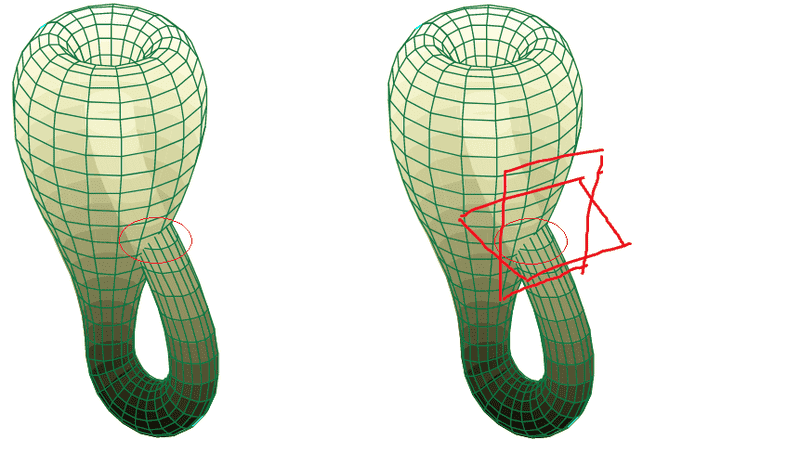
I know that there exists non-geometrical proofs that the usual mapping of the Klein Bottle in ##\mathbb{R}^3## is an immersion. But I would like to see an actual geometrical 'test'. I was thinking if saying that on the self intersection, which I circled in red below, the map being injective can be justified by saying that it's because there are two distinct tangent spaces, which is drawn in the right picture?
59jKZVe.png
 

Attachments

  • 59jKZVe.png
    59jKZVe.png
    46.8 KB · Views: 1,717
Physics news on Phys.org
kent davidge said:
I know that there exists non-geometrical proofs that the usual mapping of the Klein Bottle in ##\mathbb{R}^3## is an immersion. But I would like to see an actual geometrical 'test'. I was thinking if saying that on the self intersection, which I circled in red below, the map being injective can be justified by saying that it's because there are two distinct tangent spaces, which is drawn in the right picture?
View attachment 227447
The tangent planes do not need to be distinct in an immersion. An immersion must be smooth so that there must be a well defined tangent plane in the image of any point.

The picture of the Klein bottle above is an immersion because along every part of the tube there is a tangent plane. At the intersection of the tube with itself there are two planes each coming from another part of the Klein bottle. But in theory these planes could be the same.

If the map had a crease or a cusp or crushed a line to a point then it would not be an immersion
 
Last edited:
  • Like
Likes   Reactions: Klystron and FactChecker
lavinia said:
in theory these planes could be the same
do you mean we can rotate one of those planes I have drawn to the other's direction so that they become same? But wouldn't that make your statement
At the intersection of the tube with itself there are two planes each coming from another part of the Klein bottle
meaningless?
 
kent davidge said:
do you mean we can rotate one of those planes I have drawn to the other's direction so that they become same? But wouldn't that make your statement

meaningless?
The two parts of the tube could kiss for a while before parting directions. At the points where they kiss the tangent planes would be the same. Since it must at some point pass through itself I imagine that the tangent planes must be distinct at some point along the intersection circle - but not sure.

The map ##x→e^{ix}## is an immersion of the real line into the complex plane onto the unit circle. Each point on the circle is hit infinitely many times ,each time with the same tangent line.
 
Last edited:
Kent, may be you are being confused about immersion and embedding.
 
martinbn said:
Kent, may be you are being confused about immersion and embedding.
No, I'm really considering the immersion.
lavinia said:
Since it must at some point pass through itself I imagine that the tangent planes must be distinct at some point along the intersection circle - but not sure.
Yes, but I think this always happens, so cannot be used as a way to see if it's an immersion. The tangent planes being different after the intersection is a consequence of the end of the self intersection, i.e. the map is injective again, correct?
lavinia said:
The map ##x→e^{ix}## is an immersion of the real line into the complex plane onto the unit circle. Each point on the circle is hit infinitely many times ,each time with the same tangent line.
Unfortunately, I do not think this is a good example, because as far as I know anyone dimensional manifold can be immersed in a higher dimensional manifold. Also, any point of ##\mathbb{R}## has the same trivial tangent space, which is ##\mathbb{R}## itself. So the only way is the circle being hit infinitely many times by the same tangent line. :frown:

On the other hand, the Klein bottle is a 2-dimensional manifold, so I guess we would need a 2-dimensional known case to use as an example.
 
kent davidge said:
Yes, but I think this always happens, so cannot be used as a way to see if it's an immersion. The tangent planes being different after the intersection is a consequence of the end of the self intersection, i.e. the map is injective again, correct?

It is the existence of tangent planes that makes it an immersion.

Unfortunately, I do not think this is a good example, because as far as I know anyone dimensional manifold can be immersed in a higher dimensional manifold. Also, any point of ##\mathbb{R}## has the same trivial tangent space, which is ##\mathbb{R}## itself. So the only way is the circle being hit infinitely many times by the same tangent line. :frown:

On the other hand, the Klein bottle is a 2-dimensional manifold, so I guess we would need a 2-dimensional known case to use as an example.
It is a good example. If you insist on a higher dimensional example consider the immersion of ##R^2## into ##R^4## onto the flat torus ##(x,y)→(e^{ix},e^{iy})##

BTW:
Any manifold can be immersed in some higher dimensional manifold.

Any covering transformation is an immersion. So there is an immersion of ##R^2## onto the Klein bottle. Each point on the Klein bottle is hit infinitely many times and always with the same tangent plane.
 
Last edited:
  • Like
Likes   Reactions: kent davidge

Similar threads

  • · Replies 38 ·
2
Replies
38
Views
7K
  • · Replies 5 ·
Replies
5
Views
1K
  • · Replies 29 ·
Replies
29
Views
6K
  • · Replies 3 ·
Replies
3
Views
6K
  • · Replies 2 ·
Replies
2
Views
6K
  • · Replies 2 ·
Replies
2
Views
3K
  • · Replies 10 ·
Replies
10
Views
3K
  • · Replies 4 ·
Replies
4
Views
4K
  • · Replies 1 ·
Replies
1
Views
3K
  • · Replies 25 ·
Replies
25
Views
3K