Knot Tie-ing: Adjustable loop and knot that gets more secure as its pulled

  • Thread starter Thread starter KingNothing
  • Start date Start date
  • Tags Tags
    Loop
Click For Summary
SUMMARY

The discussion centers on the need for a knot that can create a loop around an infinitely long pole, tightening as the rope is pulled, with access to only one end of the rope. Participants suggest the bowline knot as a secure option, but clarify that it does not tighten around the pole. The taut-line hitch is recommended as a potential solution for creating an adjustable loop. Additionally, the prusik and klemheist knots are mentioned for scenarios where both ends of the rope are accessible.

PREREQUISITES
  • Understanding of basic knot-tying techniques
  • Familiarity with climbing knots such as bowline, taut-line hitch, prusik, and klemheist
  • Knowledge of rope mechanics and tension principles
  • Experience in scenarios requiring secure loops for climbing or rigging
NEXT STEPS
  • Research the properties and applications of the taut-line hitch
  • Learn how to tie the bowline knot and its variations
  • Explore the prusik and klemheist knots for friction-based applications
  • Investigate advanced knot-tying techniques for climbing and rigging
USEFUL FOR

Climbers, outdoor enthusiasts, and anyone involved in activities requiring secure and adjustable knots for safety and efficiency.

KingNothing
Messages
880
Reaction score
4
I do some rock climbing, and the most common knot you see is the double-figure 8:
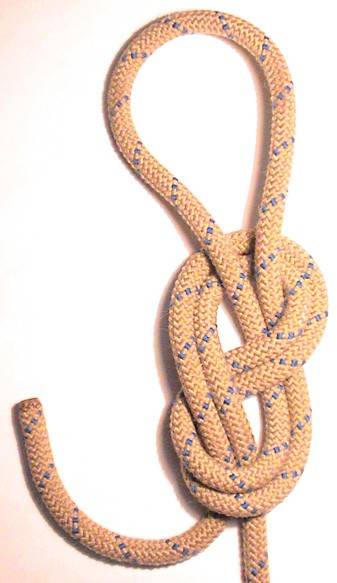
BunnyEar1l.JPG


That's because you can tie it at any point in the rope to create a loop for other climbers to latch into. It also gets tighter as you pull from any direction: the loop or either of the two single ropes coming out.

However, I am often faced with a different problem:

Say you have an infinitely long pole that you need to tie a rope around. You have to make a loop that will grip the pole tighter as the rope is pulled. You have access to one end of the rope, not both. You also need a knot that has this property of getting tighter as the rope is pulled.

Is there any such knot that fits this description?
 
Engineering news on Phys.org
KingNothing said:
I do some rock climbing, and the most common knot you see is the double-figure 8:
BunnyEar1l.JPG


That's because you can tie it at any point in the rope to create a loop for other climbers to latch into. It also gets tighter as you pull from any direction: the loop or either of the two single ropes coming out.

However, I am often faced with a different problem:

Say you have an infinitely long pole that you need to tie a rope around. You have to make a loop that will grip the pole tighter as the rope is pulled. You have access to one end of the rope, not both. You also need a knot that has this property of getting tighter as the rope is pulled.

Is there any such knot that fits this description?

I think I know the knot you are talking about, but I can't draw or remember the name :(

Its basically a situation where you have the main line (rope going to you) sandwiched inbetween two other pieces of rope, and a knot is formed with these two pieces near the pole.

I'd be easy to video conference and show you a crappy demo, but I don't think I can do that. It might be easier if I just told you to ask the guy with the face for some advice ;)
 
KingNothing said:
However, I am often faced with a different problem:

Say you have an infinitely long pole that you need to tie a rope around. You have to make a loop that will grip the pole tighter as the rope is pulled. You have access to one end of the rope, not both. You also need a knot that has this property of getting tighter as the rope is pulled.

Is there any such knot that fits this description?
It might help if you described the actual situation where you'd need such a knot, but I suspect the thing you are looking for may be a taut-line hitch (or adjustable hitch). The bowline is a very secure way to tie into a pole with access to one rope-end, but the loop does not tighten on the pole. With access to both ends of the rope, you could tie a prusik or klemheist or other similar friction hitch.
 

Similar threads

  • · Replies 4 ·
Replies
4
Views
2K
  • · Replies 3 ·
Replies
3
Views
3K
  • · Replies 1 ·
Replies
1
Views
18K
  • · Replies 3 ·
Replies
3
Views
2K
  • · Replies 14 ·
Replies
14
Views
6K
  • · Replies 2 ·
Replies
2
Views
2K
  • · Replies 7 ·
Replies
7
Views
5K
Replies
17
Views
8K
Replies
6
Views
3K
Replies
4
Views
2K