Koenigsegg Regera - acceleration

Click For Summary

Discussion Overview

The discussion revolves around the acceleration capabilities of the Koenigsegg Regera, particularly focusing on the vehicle's propulsion system, torque figures, and the implications of its design on performance metrics such as 0-60 mph times. Participants explore theoretical calculations and interpretations of the manufacturer's claims regarding power and torque delivery.

Discussion Character

  • Exploratory
  • Technical explanation
  • Debate/contested
  • Mathematical reasoning

Main Points Raised

  • One participant notes the Regera's specifications, including its 1500 hp output and unique propulsion system, questioning how the combined torque figures lead to the claimed acceleration times.
  • Another participant provides a calculation suggesting that accelerating to 50 km/h would require about 150 kJ of energy, which at the given power output would take over 1 second, raising concerns about potential wheel slip.
  • A different participant reiterates the torque figures and discusses the implications of the engine being disengaged at lower speeds, emphasizing the scaling of power output with engine RPM.
  • One participant proposes that the hydraulic clutch functions similarly to a torque converter, potentially multiplying torque significantly, which could reconcile the discrepancies in acceleration figures.
  • Another participant calculates the tractive force and weight distribution, suggesting that the required coefficient of friction for the claimed performance might be unrealistically high.

Areas of Agreement / Disagreement

Participants express differing views on the operation of the Regera's propulsion system, particularly regarding the role of the hydraulic clutch and the accuracy of the torque figures. There is no consensus on the calculations or the implications of the torque delivery on acceleration performance.

Contextual Notes

Participants acknowledge limitations in their calculations, such as assumptions about torque multipliers, wheel sizes, and the effects of weight distribution on performance metrics. The discussion remains open-ended with unresolved mathematical steps and varying interpretations of the vehicle's specifications.

jnnx
Messages
28
Reaction score
1
hi guys
did you noticed announcement of new koenigsegg regera?
http://jalopnik.com/how-the-1-500-hp-koenigsegg-regera-hits-248-mph-without-1689181377
1500hp, two electric motors driving wheels, and one connected to engine. no transmission, only hydraulic clutch and final drive.
interesting thing is, that they said the engine engages at ~50kmh, and at lower speeds, electricity is moving the vehicle. they also published a graph of power and torque figures of whole propulsion system. 0-60mph at 2.8sec, 0-250mph at sub 20 seconds.
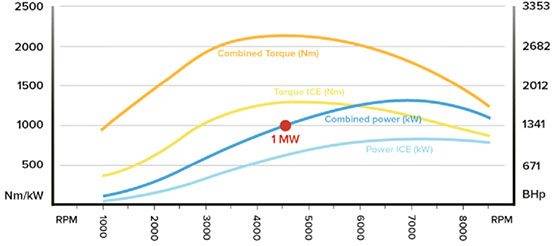
kiiw5ej11e0vvre4xxev.jpg


my problem is this. if you look at the combined torque figure ( at 1000rpm) there is around 600Nm of electric torque. we can assume, that that is torque of two electric motors. there is final drive (2.85:1) between engine and motors, so that two motors would produce aprox (600nm*2.85) 1710Nm going to the wheels. and that is actually very very little. 2l petrol engine with transmission (lets say 4:1 for first gear and 4:1 final drive) sending to the wheels like (200nm*4*4) 3200Nm

I put it all (weight, aprox torque curve, gear, tyres, aero coefficient...) in my excel sheet which can calculate thinks like this and with this torque, it calculated that 0-50kmh would take almost 5 seconds and 0-100kmh something like 7seconds that is more than twice more than official time. other acceleration figures (90-150mph and 30-250mph) it calculated very close to official figures.

so help me here. did I make somewhere a mistake? because unless the published power/torque curves are wrong, I can't understand how it could achieve that 0-60mph acceleration time.
 
Engineering news on Phys.org
Combined torque is given as 900 Nm for 1000 rpm. I don't know the size of the wheels so it is tricky to convert that to a speed.

Accelerating to 50 km/h takes about 150 kJ, at the given power value of 110 kW (at 1000 rpm) this would just take a bit over 1 second - the wheels might slip if you try that.
 
mfb said:
Combined torque is given as 900 Nm for 1000 rpm. I don't know the size of the wheels so it is tricky to convert that to a speed.

Accelerating to 50 km/h takes about 150 kJ, at the given power value of 110 kW (at 1000 rpm) this would just take a bit over 1 second - the wheels might slip if you try that.
we know that it reaches 400kmh at 8250rpm with final gear of 2.85:1. from that we can calculate wheel radius of aprox 0.367m
thing is, that until 45-50kmh the engine should be disengaged from powering the wheels. so we have only 600Nm of electric motors, and the power output scales with revs. 600Nm at 1000rpm produces 62kW, at 500rpm it is 31kW etc
 
I think they have it wrong in their explanation in this article.

The electric motor/engine combination is used at any speed in conjunction with the 2 other electric motors. When they talk about an «hydraulic coupling that acts like a clutch, [...] This sounds similar in concept to a torque converter», it is in fact a torque converter. A torque converter also multiplies torque when it is slipping at low rpm. The typical multiplier effect is 1.8:1 to 2.5:1 and can be up to 5:1. Let's assume it is 2:1 for now.

The engine looks like it can produce about 500 N.m of torque at a stall rpm of about 1600 rpm. Let's assume the electric motor makes 300 N.m like the other two. That is a combined torque of 800 N.m. After the torque converter, it becomes 1600 N.m and after the gear reducer it becomes 4560 N.m.

Then you add the 2 other motors producing an extra 600 N.m for a total of 5160 N.m.

The tractive force with a 0.367 m tire radius is 14 060 N.

The car weights 3589 lb (1628 kg). Add a 70 kg driver and you get a total of 1698 kg. It is pretty safe to assume the car has a 50/50 weight distribution, so that is 849 kg on the rear wheels or a normal force of 8329 N acting on the rear tires.

The tire coefficient of friction to support such a tractive force needs to be 14 060 / 8329 = 1.7. That is about the largest tire coefficient of friction that you can find on a tire (apart from drag racing tires).

I may have overestimated stall rpm, torque multiplier and/or some torque rating, but then again 1.7 is also a pretty high number for a CoF.
 
yes, explanation that hydraulic clutch is actually torque converter and the engine is powering the car from (almost) standstill would make lots of sense, and solve this problem.
 

Similar threads

Replies
0
Views
2K
  • · Replies 3 ·
Replies
3
Views
4K
  • · Replies 8 ·
Replies
8
Views
7K
  • · Replies 12 ·
Replies
12
Views
3K
  • · Replies 18 ·
Replies
18
Views
3K
  • · Replies 18 ·
Replies
18
Views
8K
  • · Replies 10 ·
Replies
10
Views
4K
Replies
3
Views
2K
  • · Replies 7 ·
Replies
7
Views
2K
Replies
2
Views
4K