Discussion Overview
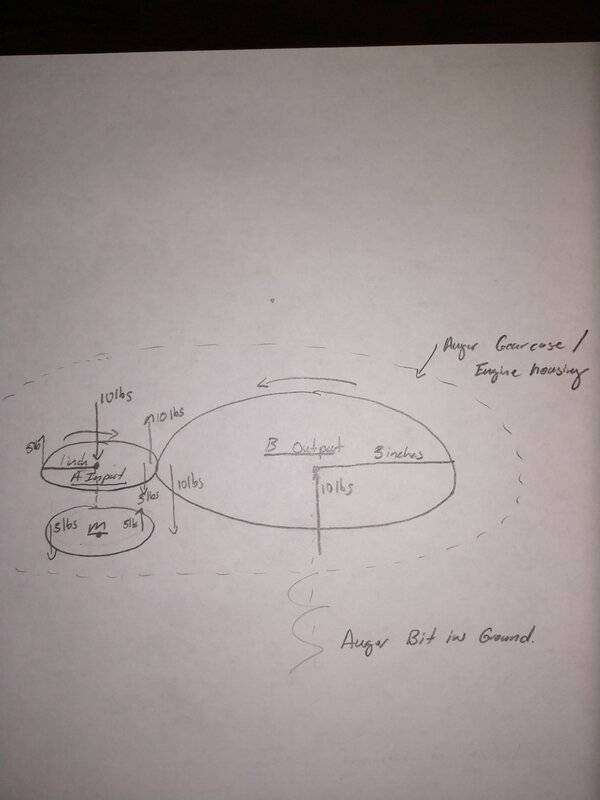
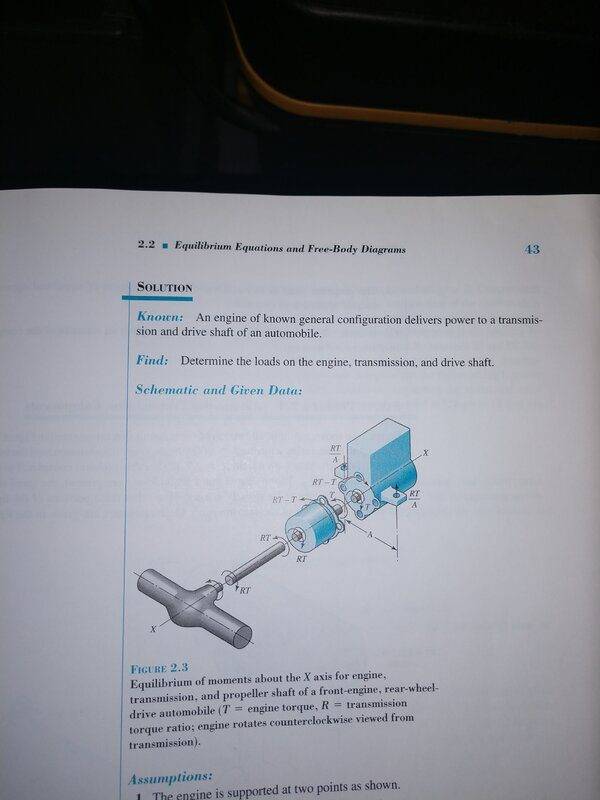
The discussion revolves around the torque balance in a gearbox, specifically in the context of a car transmission and an offset gear drive system used in an auger machine. Participants explore the relationships between input torque, output torque, and the reactions experienced by the system components, examining both theoretical and practical implications.
Discussion Character
- Technical explanation
- Debate/contested
- Mathematical reasoning
Main Points Raised
- One participant notes that the relationship RT-T (output torque minus input torque) applies in a standard transmission setup but questions its validity in the context of an offset gear drive.
- Another participant suggests that the torques must be considered along different axes, indicating that both RT-T and the total torque reaction must be balanced by the user.
- Some participants propose that the direction of the torques affects the application of the RT-T relationship, leading to a potential misunderstanding of the torque balance.
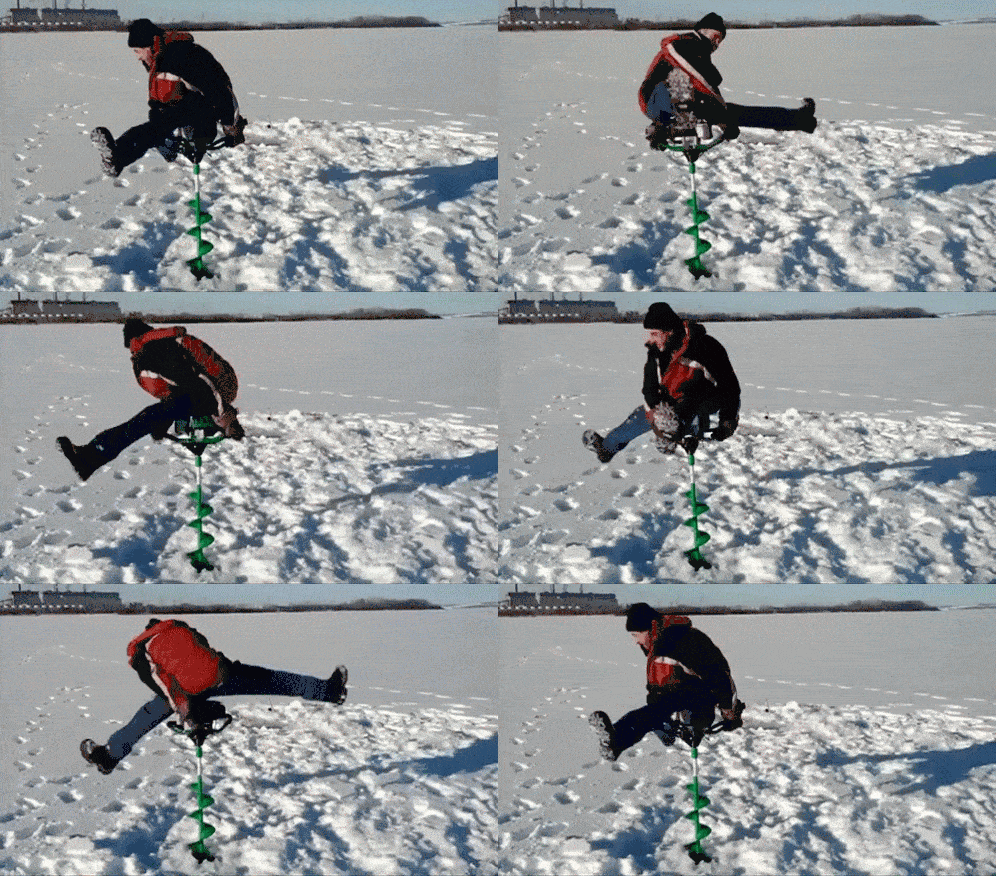
- There is a discussion about how the internal reaction torques in the gearbox relate to the external forces applied by the operator, with emphasis on the need for balance to prevent the machine from spinning uncontrollably.
- Several participants agree that the reactive torque from the auger bit and the motor's reaction torque must be accounted for to understand the overall torque experienced by the operator.
- One participant emphasizes that the internal forces within the mechanism do not affect the overall input-output relationship of forces and torques.
Areas of Agreement / Disagreement
Participants express differing views on the applicability of the RT-T relationship in specific setups, particularly regarding the offset gear drive. While some agree on the necessity of balancing torques and forces, the discussion remains unresolved on the exact nature of these relationships in different configurations.
Contextual Notes
Participants highlight the importance of sign conventions for direction of rotation and the need to consider internal versus external forces in torque calculations. There are references to specific numerical examples that illustrate the complexities of the torque balance but do not resolve the overarching questions raised.
Who May Find This Useful
Individuals interested in mechanical engineering, particularly those studying gear systems, torque dynamics, and the practical applications of these concepts in machinery design and operation.