Kramers-Kronig relation for refractive index

Click For Summary
SUMMARY

The discussion centers on the Kramers-Kronig relations and their application to negative refractive index media, specifically referencing the papers "Kramers-Kronig relations and sum rules of negative refractive index media," "A Differential Form of the Kramers-Kronig Relation for Determining a Lorentz-Type of Refractive Index," and "Comparison Among Several Numerical Integration Methods for Kramers-Kronig Transformation." Key points include the distinction between Δn(ω), n(ω) - 1, and n(ω) - n∞, as well as the use of subtracted dispersion relations derived from retarded Green's functions. The discussion emphasizes the analytic properties of these functions in the upper complex frequency half-plane and their relevance to the refractive index.

PREREQUISITES
  • Kramers-Kronig relations
  • Retarded Green's functions
  • Complex frequency analysis
  • Subtracted dispersion relations
NEXT STEPS
  • Study the derivation of Kramers-Kronig relations in detail
  • Explore the properties of retarded Green's functions in quantum mechanics
  • Investigate numerical integration methods for Kramers-Kronig transformations
  • Examine the relationship between the refractive index and permittivity (ε(ω))
USEFUL FOR

Physicists, optical engineers, and researchers in material science focusing on the properties of negative refractive index materials and the application of Kramers-Kronig relations in their work.

Another
Messages
104
Reaction score
5
I don't understand why sometime
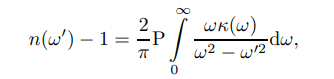
kk 1.png
for paper : Kramers-Kronig relations and sum rules of negative refractive index media
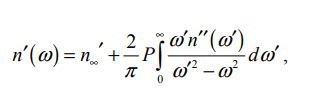
kk 2.png
for paper : A Differential Form of the Kramers-Kronig Relation for Determining a Lorentz-Type of Refractive Index*
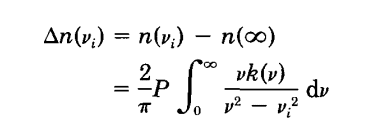
kk 3.png
for paper : Comparison Among Several Numerical Integration Methods for Kramers-Kronig Transformation

I know maybe ##\omega = \nu ##

What different between ##Δn(\omega)##, ##n(\omega) - 1## and ## n(\omega)-n_{∞} ##
 
Science news on Phys.org
Where is this from?

The formulae given are all socalled "subtracted dispersion relations". It's making use of the spectral theorem aka. Kramers-Kronig relations which are very general relations resulting from retarded Green's functions and causality.

The retardation condition for a Green's function means that it's Fourier transform wrt. time leads to a function that is analytic in the upper complex frequency half-plane and from this you can derive the relations between real and imaginary part of ##\tilde{G}_{\text{ret}}(\omega)##.

If you have a function, for which the integral is not convergent, because the imaginary part doesn't vanish at infinity quickly enough you can derive subtracted dispersion relations. In your example that's applied to the refractive index, which usually goes to a constant for ##\omega \rightarrow \infty##. In this case of the refractive index (though I'm a bit puzzled, because the KK relations refer to ##\epsilon(\omega)## rather than ##n(\omega)##).
 

Similar threads

  • · Replies 4 ·
Replies
4
Views
3K
  • · Replies 11 ·
Replies
11
Views
2K
  • · Replies 4 ·
Replies
4
Views
2K
  • · Replies 12 ·
Replies
12
Views
7K
Replies
3
Views
4K
  • · Replies 1 ·
Replies
1
Views
2K
  • · Replies 7 ·
Replies
7
Views
4K
  • · Replies 6 ·
Replies
6
Views
18K
  • · Replies 4 ·
Replies
4
Views
16K
  • · Replies 1 ·
Replies
1
Views
2K