Undergrad Kronecker Delta and Gradient Operator

Click For Summary
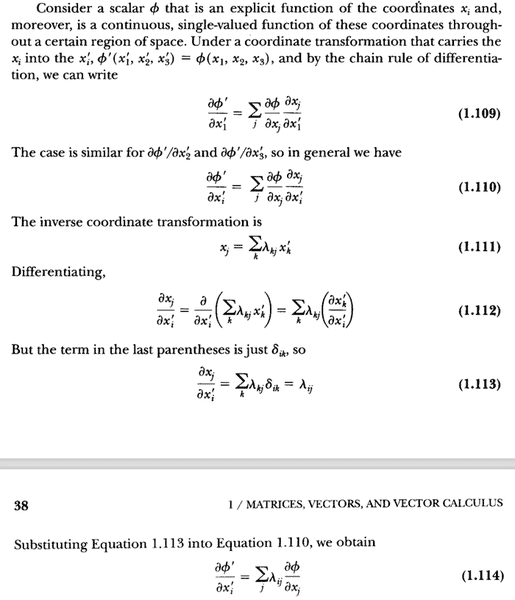
The discussion centers on the gradient operator's application to a scalar function and the equivalence of the partial derivative ## \frac{\partial x'_k}{\partial x'_i} ## to the Kronecker delta. It is clarified that the Kronecker delta equals 1 when the indices are equal (i=k) and 0 when they are not, reflecting the nature of Cartesian coordinates. The example of ## \frac{\partial x}{\partial y} ## is used to illustrate that the derivative is zero when the variables are independent. This highlights the fundamental concept that the Kronecker delta serves as a mathematical representation of this independence in multi-dimensional space. Understanding this relationship is crucial for grasping the gradient operator's behavior in vector calculus.
maxhersch
Messages
20
Reaction score
0
I am looking at an explanation of the gradient operator acting on a scalar function ## \phi ##. This is what is written:
H5da2LH.png


In the steps 1.112 and 1.113 it is written that ## \frac {\partial x'_k} {\partial x'_i} ## is equivalent to the Kronecker delta. It makes sense to me that if i=k, then the expression is equal to 1 but why would it be 0 if they are not equal? Perhaps I'm not looking at it the right way but any explanation would be appreciated.

Thanks.
 
Physics news on Phys.org
Just think about Cartesian coordinates. What is ## \frac{\partial x}{\partial y} ## equal to?
 

Similar threads

  • · Replies 3 ·
Replies
3
Views
2K
  • · Replies 3 ·
Replies
3
Views
3K
  • · Replies 2 ·
Replies
2
Views
2K
  • · Replies 4 ·
Replies
4
Views
2K
  • · Replies 9 ·
Replies
9
Views
5K
Replies
5
Views
4K
Replies
3
Views
2K
  • · Replies 2 ·
Replies
2
Views
2K
  • · Replies 14 ·
Replies
14
Views
3K
  • · Replies 4 ·
Replies
4
Views
1K