Undergrad Kronecker delta by using creation/annihilation operators

  • Thread starter Thread starter Faust90
  • Start date Start date
  • Tags Tags
    Delta Operators
Click For Summary
The discussion centers on the use of the Kronecker delta in relation to creation and annihilation operators. A participant questions how the expression simplifies using the Kronecker delta, noting that the summation is over the index i rather than r_i. Another contributor clarifies that the index i refers to a subscript in the expression, while the Kronecker delta effectively eliminates the exponential term. The conversation highlights confusion regarding the summation limits and the implications of the chosen indices. Ultimately, the focus remains on understanding the mathematical manipulation involving the Kronecker delta and its role in the expression.
Faust90
Messages
19
Reaction score
0
Hey all,

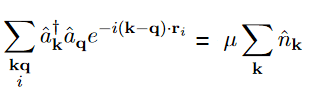
i've found the following expression:
yeKNHjC.png


How do they get that? They somehow used the kronecker delta Sum_k exp(i k (m-n))=delta_mn. But in the expression above, they're summing over i and not over r_i??

Best
 
Physics news on Phys.org
Do you need more background or is the question not precise enough? :-)
 
Hi Faust90

The index ##i## under the sum refers to the subscript ##i## under the ##r##. The other i is the imaginary number. The Kronecker delta gets rid of the exponential and thus the sum on ##i## anyway. Try this website and see if it clears any confusion you are having. http://www.physicspages.com/2014/11/09/discrete-fourier-transforms/
 
Hi Mr-R,

thanks for your answer. Yes, but my problem is that the sum is not running over r_i but over i.
Let's assume the r_i are an set of positions, for example always the same position, i.e. r_i={1,1,1,1,1,1,...}. Then in the end, that's just a product
prod_n=0^\infity e^{i(k-q)}

 
Time reversal invariant Hamiltonians must satisfy ##[H,\Theta]=0## where ##\Theta## is time reversal operator. However, in some texts (for example see Many-body Quantum Theory in Condensed Matter Physics an introduction, HENRIK BRUUS and KARSTEN FLENSBERG, Corrected version: 14 January 2016, section 7.1.4) the time reversal invariant condition is introduced as ##H=H^*##. How these two conditions are identical?

Similar threads

Replies
0
Views
789
  • · Replies 5 ·
Replies
5
Views
2K
  • · Replies 2 ·
Replies
2
Views
2K
  • · Replies 9 ·
Replies
9
Views
3K
  • · Replies 3 ·
Replies
3
Views
1K
  • · Replies 14 ·
Replies
14
Views
3K
  • · Replies 2 ·
Replies
2
Views
2K
  • · Replies 3 ·
Replies
3
Views
1K
  • · Replies 19 ·
Replies
19
Views
4K
  • · Replies 0 ·
Replies
0
Views
1K