Lagrangian Equation with Generalized Force term

Click For Summary
SUMMARY

The discussion centers on the Lagrangian Equation in classical mechanics, specifically the role of generalized forces (Qi) that include both conservative and non-conservative forces. Generalized forces can be derived from the total work done on a system, which is expressed as W = W_{cons} + W_{non-cons}. Conservative forces, such as gravitational and spring forces, have associated potential functions, while non-conservative forces, like friction and air resistance, do not store energy in the field. Understanding the distinction between these forces is crucial for applying the Lagrangian framework effectively.

PREREQUISITES
  • Understanding of classical mechanics principles
  • Familiarity with the Lagrangian formulation of mechanics
  • Knowledge of conservative and non-conservative forces
  • Basic grasp of potential energy concepts
NEXT STEPS
  • Study the derivation of the Lagrangian Equation in detail
  • Explore the concept of generalized forces in depth
  • Learn about conservative vs. non-conservative forces with practical examples
  • Investigate the application of Lagrangian mechanics in complex systems
USEFUL FOR

Students and professionals in physics, particularly those focusing on classical mechanics, as well as engineers and researchers interested in the application of Lagrangian dynamics in various fields.

KT KIM
Messages
24
Reaction score
0
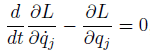
In basic level classical mechanics I've known so far
The Lagrangian Equation is
Like this
lag2.png


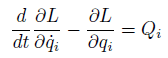
But in the little deeper references, they covers Lagrangian Equation is
Like this
Lag1.png


Qi is Generalized force, and Qi also contains frictions that's what reference says
But I still can't grasp.

What is the difference between these two equation, and What Is "Generalized Force" ?
 
Physics news on Phys.org
The generalized forces can be both conservative and non-conservative. The gravitational force of attraction, the buoyancy force, the spring force, the electric and magnetic forces (and electromagnetic time invariant forces) are conservative and they also have the potential function associated with the vector field \vec F : - \nabla \Phi = \vec F. The non-conservative are the forces that do not store the energy in the field. The examples of these forces are the friction force, the air resistance, the damping force, the viscous force, the drag force, the time-varying electromagnetic fields, etc. The total work done on a system will be W=W_{cons}+W_{non-cons} = KE_{f} - KE_{i} = -\delta PE. The generalized force can be found as: f_{i}=f_{cons}+f_{non-cons}. If you have already included the conservative forces in your Lagrangian expression, for example, you found the potentials of the given vector fields, your generalized forces will be the non-conservative forces.
 
  • Like
Likes   Reactions: KT KIM

Similar threads

  • · Replies 13 ·
Replies
13
Views
2K
  • · Replies 4 ·
Replies
4
Views
2K
  • · Replies 1 ·
Replies
1
Views
613
  • · Replies 0 ·
Replies
0
Views
1K
  • · Replies 14 ·
Replies
14
Views
2K
  • · Replies 1 ·
Replies
1
Views
1K
  • · Replies 3 ·
Replies
3
Views
2K
  • · Replies 3 ·
Replies
3
Views
2K
  • · Replies 5 ·
Replies
5
Views
2K
  • · Replies 25 ·
Replies
25
Views
3K