Lambda96
- 233
- 77
- Homework Statement
- Find a stationary solution
- Relevant Equations
- Lagrangian ##L=x\dot{x}(2\alpha - \dot{x})##
Hi
the text is unfortunately a bit longer, but I have included it anyway to provide all the information.
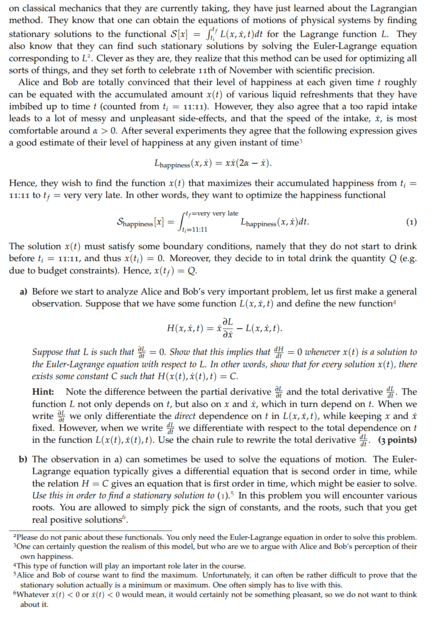
I am not sure if I understood the task b correctly, but I understood it as follows: using the equation ##H(x,\dot{x},t)##, solve the differential equation for ##x(t)##.
Once you have found ##x(t)##, you have to use it to find the statin solutions, i.e. form the first derivative of ##x(t)## and set it to 0.
I then first formed ##H(x,\dot{x},t)## and got the following ##H(x,\dot{x},t)=-x\dot{x}^2##
And ##H(x,\dot{x},t)=c## which leads to ##c=-x\dot{x}^2##
After that, I did the separation of variables,
$$\sqrt{x}dx=-\sqrt{c}dt$$
Then I integrated both sides and solved for ##x(t)## and got the following.
$$x(t)=\sqrt[3]{\frac{9}{4}(a-\sqrt{c}*t)^2}$$
##a## is the constant of integration.
Now, to get the stationary solution, I have to form ##\frac{dx(t)}{dt}=0##.
Have I done everything right up to this point, or have I completely misunderstood the task?
the text is unfortunately a bit longer, but I have included it anyway to provide all the information.
I am not sure if I understood the task b correctly, but I understood it as follows: using the equation ##H(x,\dot{x},t)##, solve the differential equation for ##x(t)##.
Once you have found ##x(t)##, you have to use it to find the statin solutions, i.e. form the first derivative of ##x(t)## and set it to 0.
I then first formed ##H(x,\dot{x},t)## and got the following ##H(x,\dot{x},t)=-x\dot{x}^2##
And ##H(x,\dot{x},t)=c## which leads to ##c=-x\dot{x}^2##
After that, I did the separation of variables,
$$\sqrt{x}dx=-\sqrt{c}dt$$
Then I integrated both sides and solved for ##x(t)## and got the following.
$$x(t)=\sqrt[3]{\frac{9}{4}(a-\sqrt{c}*t)^2}$$
##a## is the constant of integration.
Now, to get the stationary solution, I have to form ##\frac{dx(t)}{dt}=0##.
Have I done everything right up to this point, or have I completely misunderstood the task?
Last edited:
