Landau vol.1 Mechanics: Expansion of L' and Dependence on Velocity

Click For Summary
SUMMARY

The discussion focuses on the expansion of the Lagrangian in Landau's "Mechanics" using Taylor series to analyze the relationship between two inertial frames, K and K', with K moving at an infinitesimal velocity relative to K'. The key conclusion is that the Lagrangian's dependence on velocity can be expressed as a total derivative, leading to the assertion that the term involving the derivative of the Lagrangian with respect to velocity squared does not depend on velocity. This analysis is foundational for understanding Noether's theorem and the invariance principles underlying classical mechanics.

PREREQUISITES
  • Understanding of Lagrangian mechanics
  • Familiarity with Taylor series expansion
  • Knowledge of Noether's theorem
  • Basic concepts of Galilean invariance
NEXT STEPS
  • Study the application of Taylor series in physics, specifically in Lagrangian mechanics
  • Explore Noether's theorem and its implications for conservation laws in classical mechanics
  • Investigate Galilean transformations and their role in classical mechanics
  • Review the derivation of the Lagrangian for a free particle and its connection to Newton's laws
USEFUL FOR

This discussion is beneficial for physics students, particularly those studying classical mechanics, as well as educators and researchers interested in the foundational principles of Lagrangian dynamics and symmetry in physics.

zhuang382
Messages
9
Reaction score
2
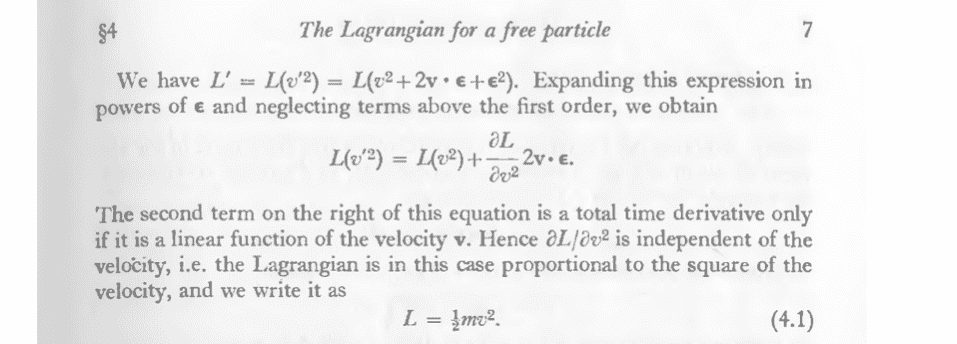
Let ##K## and ##K'## be two inertial frame, If K is moving with infinitesimal velocity relative to ##K'## , then ##v' = v + \epsilon##.
Note that ##L(v^2) - L(v'^2)## is only a total derivative of a function of coordinate and time. (I understand this part)
Because ##L' = L(v'^2) = L(v^2 + 2v\cdot\epsilon + \epsilon^2)##, then we use power series of ##\epsilon## to expand the equation and neglect the second order term:
$$L(v'^2) = L(v^2) + 2\frac {\partial f} {\partial v^2}v\cdot\epsilon$$
Then the author argues that it is only when the second term on the right hand side is a linear function of ##\vec{v}##, it is a total derivative of time; therefore ##\frac{\partial f} {\partial v^2}## does not depend on velocity. Can someone help me on the detail of ##\epsilon## series expansion and how the conclusion drawn from this?
Screen Shot 2020-08-19 at 2.53.57 PM.png
 
  • Like
Likes   Reactions: etotheipi
Physics news on Phys.org
Has Landau covered Noether's theorem and, in particular, the concept of divergence invariance?
 
Actually, this is chapter one, so I don't know yet. I am just beginning using this book to review the content I learned last semester. I am mainly confused about the mathematical technique he uses, ( expand the Lagrangian as a power series of ##\epsilon##) when he analyze the difference of two Lagrangian functions.
 
zhuang382 said:
Actually, this is chapter one, so I don't know yet. I am just beginning using this book to review the content I learned last semester. I am mainly confused about the mathematical technique he uses, ( expand the Lagrangian as a power series of ##\epsilon##) when he analyze the difference of two Lagrangian functions.
That's just a Taylor series expansion to first order in ##\vec \epsilon##.

The rest of what he does needs some knowledge of Noether's theorem.
 
  • Like
Likes   Reactions: zhuang382
PS Can you explain what he's actually trying to achieve with that calculation? That's the really important thing.
 
The ingenious feature of this book is that he starts from the fundamental content of Newtonian mechanics, i.e., invariance under the full Galilei group and derives why the laws look as they look. For a free particle you get uniquely ##L=m v^2/2##.

From tranlation invariance in space and time and rotation symmetry you get that ##L=L(\vec{v}^2)##. That's all trivial, because under this part of the group ##L## transforms as a simple scalar. For the invariance under Galilei boosts you need a non-trivial term, i.e.,
$$\tilde{L}(\tilde{v}^2)=L(\tilde{v}^2)+\mathrm{d}_t \Omega(\vec{x},t).$$
As a general analysis of Noether's theorem shows, you need it only for "infinitesimal transformations", i.e.,
$$\tilde{\vec{x}}=\vec{x}-\vec{\epsilon} t \; \Rightarrow \; \tilde{\vec{v}}=\vec{v}-\vec{\epsilon}.$$
Then you get
$$L(v^{\prime s})=\vec{\nabla}_{\epsilon} \vec{v}^{2} L'(v^2)=-2 \vec{\epsilon} t \cdot \vec{v} L'(\vec{v}^2) \stackrel{!}{=}-\mathrm{d}_t \Omega(\vec{x},t).$$
Now
$$\mathrm{d}_t \Omega (\vec{x},t)=\vec{v} \cdot \vec{\nabla}_x \Omega + \partial_t \Omega.$$
Comparing the left and the right-hand side shows that
$$\vec{\nabla}_x \Omega = 2 L'(\vec{v}^2) \vec{\epsilon} t, \quad \partial_t \Omega=0.$$
Since the left-hand side doesn't depend on ##\vec{v}## and the right-hand side doesn't depend on ##\vec{x}## we must have
$$L'(\vec{v}^2)=\frac{m}{2}=\text{const}, \quad \Omega=m \vec{\epsilon} \cdot \vec{x}.$$
This implies that the Lagrangian is Galilei-boost invariant in addition to the other symmetries of Galilei-Newton spacetime if and only if ##L## is equivalent to
$$L=\frac{m}{2} \vec{v}^2=\frac{m}{2} \dot{\vec{x}}^2.$$
This implies Newton's Lex II, according to which a free particle moves with constant velocity.

Noether's theorem tells us that the generators for boosts is
$$\vec{K}=m \vec{x}-m t \vec{v}.$$
Since this is the conserved quantity indeed it follows again that ##\vec{v}=\text{const}## along the trajectory of the particle.
 
Last edited:
  • Like
  • Informative
Likes   Reactions: bhobba, zhuang382, PeroK and 1 other person

Similar threads

  • · Replies 24 ·
Replies
24
Views
2K
Replies
6
Views
2K
  • · Replies 1 ·
Replies
1
Views
1K
  • · Replies 3 ·
Replies
3
Views
2K
  • · Replies 3 ·
Replies
3
Views
1K
  • · Replies 2 ·
Replies
2
Views
695
  • · Replies 16 ·
Replies
16
Views
3K
  • · Replies 1 ·
Replies
1
Views
1K
Replies
4
Views
2K
Replies
9
Views
1K