Laplace Transformation Help: Simplifying Denominators and Finding Solutions

Click For Summary

Discussion Overview

The discussion revolves around solving a circuit problem using Laplace transformations, specifically focusing on deriving the current i0(t) from given equations and simplifying the resulting expressions. Participants explore the conversion from the Laplace domain back to the time domain, addressing challenges in matching forms and correcting earlier mistakes.

Discussion Character

  • Homework-related
  • Mathematical reasoning
  • Technical explanation

Main Points Raised

  • One participant expresses their initial result for i0 as (s + 4)/(3*s^2 + 4*s + 1) and seeks guidance on simplifying it to a specific form.
  • Another participant requests the initial loop equations, indicating a discrepancy in the results.
  • A participant revises their equations and arrives at a different expression for i0, which they confirm with another participant.
  • There is a discussion about converting the Laplace result back to the time domain, with one participant noting that their solution does not match expected forms.
  • One participant identifies the need for an inverse Laplace transformation and proposes a breakdown of the expression into partial fractions.
  • Another participant suggests that a constant should replace the variable s in the time domain result, emphasizing the need for clarity in the transformation process.
  • Participants engage in correcting and refining their expressions, with one noting a mistake involving an extra s in their final solution.
  • Final expressions are discussed, with one participant confirming the correctness of a proposed solution.

Areas of Agreement / Disagreement

Participants generally agree on the final form of the time domain solution, though earlier discrepancies in the Laplace domain results and transformations indicate some unresolved issues in the derivation process.

Contextual Notes

Participants express uncertainty about specific steps in the transformation process, particularly regarding the treatment of constants and the handling of the unit step function u(t). There are also indications of earlier mistakes that were corrected during the discussion.

stef6987
Messages
31
Reaction score
0
1. Homework Statement [/b]
NruJm.png

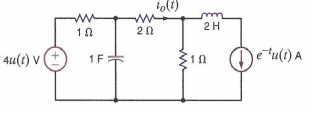
I'm required to find the current i0(t), i wrote KVL equations for each loop, I0 can be expressed interms of i1 and i3, i3 being the current source on the right. i managed to get the solution down to the following :

i0 = (s + 4)/(3*s^2 + 4*s + 1)

I simplified the denominator by completing the square and got:

i0 = (s + 4)/((3*(s+4/6)^2 - 12/36))

Now I'm kind of stuck, i one of solutions is in the form (s+a)/((s+a)^2 + w^2) I'm not sure how i can get my solution to be similar to this, any tips would be awesome :)
thankyou!


Homework Equations


The Attempt at a Solution

 
Physics news on Phys.org
Can you show your initial loop equations? I'm not seeing the same result that you have for io.

(Try using the x2 and x2 icons in the edit panel header to produce exponents and subscripts :wink: )
 
hmm i think i made a few mistakes, i tried it again and this is what i get :

kvl 1:
-4/s + i1 + i1/s - i0/s
=> 4/s = i1 + i1/s - i0/s

kvl 2:
2io + io - 1/(s+1) + i0/s - i1/s = 0

Now i rearranged kvl 2 to find i1 and i got:
i1/s = 3i0 - 1/(s+1) + i0/s
= i0(3 + 1/s) - 1/(s+1)
i1 = s(i0(3+1/s) - 1(s+1)) = i0(3s + 1) - s/(s+1)

so how i got my original answer is a bit of a mystery haha. I tried it again and substituted i1 into kvl 1 and got the answer from wolphram alpha

(s+4)/(3s2 + 4s)

Is this what you got?
 
Yup, that's what I found.
 
Ok, now that i got that right :P i need to convert it back to the time domain, but no solution in my list seems to match. any ideas?
 
ahh, the answer was so simple, i used the inverse laplace transformation

the equation is in the form:

s+4 = A/s + B/(3s+4)
A = 1
B = -2

1/s = u(t)
B/(3(s+4/3) = -2e-(4/3)t*(3)

i'm not to sure do i just multiply the 3 to the equation?
 
I suspect that the 3 should divide the equation, not multiply. And the u(t) should be transformed, too.
 
well A = 1, 1/s = u(t) so what else could i do to that?
my final solution was:

1/u(t) - (2/3)*e-(4/3)t/(s+(4/3))
 
There should be no s's in the time domain result, only t's and constants. If time is assumed to begin at t=0 for the circuit, the u(t) becomes a constant 1.
 
  • #10
Oh ok i think i follow, i realized i had a small mistake (not sure why i had the extra s ahah) it should be:

u(t) - (2/3)*e-(4/3)t

i need to find I for t>0, so at t>0 u(t) = 1, is that what you're implying?

so my answer should be:

1 - (2/3)*e-(4/3)t
 
  • #11
That looks good to me :smile:
 

Similar threads

  • · Replies 4 ·
Replies
4
Views
2K
  • · Replies 3 ·
Replies
3
Views
3K
  • · Replies 4 ·
Replies
4
Views
2K
  • · Replies 2 ·
Replies
2
Views
2K
Replies
10
Views
2K
  • · Replies 2 ·
Replies
2
Views
2K
  • · Replies 5 ·
Replies
5
Views
4K
  • · Replies 1 ·
Replies
1
Views
1K
  • · Replies 5 ·
Replies
5
Views
4K
  • · Replies 1 ·
Replies
1
Views
2K