Lateral compression of rectangular tube

Click For Summary
SUMMARY

The discussion centers on calculating the stress and safe working load of a stainless steel rectangular tube subjected to a 10,000kg weight over a 100mm x 100mm area. Participants recommend using shear stress calculations and refer to the 'Beam shear' section on Wikipedia for relevant equations. They identify two potential local failure modes: bending of the horizontal face and buckling or crippling of the vertical faces. Finite Element Method (FEM) analysis is suggested for a more detailed assessment, although it may not be practically necessary.

PREREQUISITES
  • Understanding of shear stress calculations
  • Familiarity with finite element analysis (FEM)
  • Knowledge of structural failure modes, specifically bending and buckling
  • Basic principles of load distribution on hollow sections
NEXT STEPS
  • Research shear stress calculations for hollow sections
  • Learn about finite element analysis (FEM) software tools
  • Study structural failure modes in detail, focusing on bending and buckling
  • Explore practical applications of beam shear equations in engineering
USEFUL FOR

Mechanical engineers, structural engineers, and anyone involved in the design and analysis of load-bearing structures utilizing hollow sections.

Colnago
Messages
8
Reaction score
0
Hi guys,

Bit of a noob engineer here so looking for some guidance.

I'm designing a fixture which will be constructed from stainless steel rectangular tube as shown in the diagram. If I apply a 10,000kg weight over a 100mx100mm area how do I go about calculating the stress and ultimately safe working load?

The tube will be laid flat on the ground. Is this just a case of force/area? I'm struggling to find any textbook examples of loading applied to hollow sections in this way.

Thanks in advance!
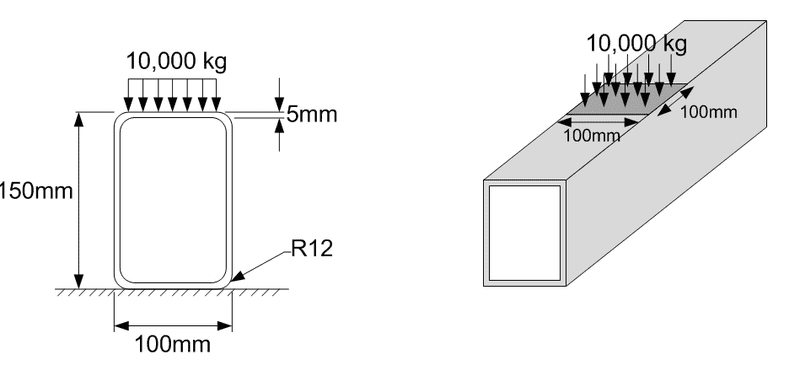
Work%20image.png
 
Engineering news on Phys.org
You probably need to do some finite element stress analysis. I can't think of a way of simplifying it. Maybe someone else can.

Chet
 
Hi Colnago,

I'm no structural engineering expert but I would start with a shear stress calculation. Check the following link under the heading 'Beam shear' for an equation:

http://en.wikipedia.org/wiki/First_moment_of_area#Statical_moment_of_area

The equation is usually used for simply supported beams, rather than one which is supported throughout it's whole length but I think it is still valid. Maybe someone else could confirm.
 
Assuming we are talking about a local failure here and not a larger beam failure.

I see two possible local failures:
1) the horizontal face failing by bending
2) the vertical faces failing by buckling or crippling

You would have to make an assumption about the effective width of each face. You could come up with a less conservative design with FEM but probably not worth the effort practically.
 

Similar threads

  • · Replies 9 ·
Replies
9
Views
19K
  • · Replies 5 ·
Replies
5
Views
2K
Replies
3
Views
4K
  • · Replies 23 ·
Replies
23
Views
7K
Replies
4
Views
4K
Replies
6
Views
3K
  • · Replies 14 ·
Replies
14
Views
11K
  • · Replies 3 ·
Replies
3
Views
6K
  • · Replies 5 ·
Replies
5
Views
6K
  • · Replies 4 ·
Replies
4
Views
10K