LaTeX document compilation failing

7 replies · 2K views · last reply
mattlfang
Messages
28
Reaction score
8
I really struggle the get the Latex working for some reason, so I attached my attempted solution in another picture.
 
Attachments
  • Diagram of a circle resting on a horizontal ground line, with a thin vertical rod standing on its center point C and ending at a labeled point B at the top.
    image_2021-11-07_083522.png
    2 KB · Views: 179
  • Typeset text of kinetic energy T and potential energy V expressions for a pendulum-type system, with T + V = m2gl and a note that dx/dt = 0 when theta = 90 degrees and thetadot = sqrt(3g/2l).
    image_2021-11-07_090115.png
    12.8 KB · Views: 172
The velocity of the center of mass of the (wheel + stick) system is initially zero. For the center of mass to be moving in the horizontal direction after the stick is horizontal, there must have been a horizontal force that acted (or continues to act) on it. What is that force and where is it coming from?

To fix your LaTeX problem, bracket your expressions between two ## symbols on each side, not just one.
 
kuruman said:
The velocity of the center of mass of the (wheel + stick) system is initially zero. For the center of mass to be moving in the horizontal direction after the stick is horizontal, there must have been a horizontal force that acted (or continues to act) on it. What is that force and where is it coming from?

To fix your LaTeX problem, bracket your expressions between two ## symbols on each side, not just one.
But there is friction? so the momentum is not conserved in the horizontal direction?
 
Imagine the wheel riding on two rails with a gap between them that allows the stick to fall through and swing around. What would the motion of the system look like if there is no energy loss?
 
kuruman said:
Imagine the wheel riding on two rails with a gap between them that allows the stick to fall through and swing around. What would the motion of the system look like if there is no energy loss?

sorry, I don't quite understand this "the wheel riding on two rails with a gap between them that allows the stick to fall through and swing around" part? I don't fully understand what this system looks like?

I start to suspect when people say "Rolling Without Slipping", it implies that momentum is conserved (the change to the momentum can be ignored), despite having a frictional force?
 
mattlfang said:
sorry, I don't quite understand this "the wheel riding on two rails with a gap between them that allows the stick to fall through and swing around" part? I don't fully understand what this system looks like?

I start to suspect when people say "Rolling Without Slipping", it implies that momentum is conserved (the change to the momentum can be ignored), despite having a frictional force?
When people say "rolling without slipping" they mean that the point on the wheel that is in contact with the surface is instantaneously at rest relative to all points on the surface. In other words, the points that are in contact do not move relative to each other. When there is slipping, the points in contact move relative to each other.

The figure below shows what I am asking you to imagine. In the front view, the stick falls so that its free end moves out of the screen. In the side view, the free end rotates clockwise in the plane of the screen.

Front view and side view diagram of a yellow disc hanging from a thin vertical string, resting on a grey horizontal surface with two grey legs visible in the front view.
 
kuruman said:
When people say "rolling without slipping" they mean that the point on the wheel that is in contact with the surface is instantaneously at rest relative to all points on the surface. In other words, the points that are in contact do not move relative to each other. When there is slipping, the points in contact move relative to each other.

The figure below shows what I am asking you to imagine. In the front view, the stick falls so that its free end moves out of the screen. In the side view, the free end rotates clockwise in the plane of the screen.

View attachment 291923

Ok, I believe I get what you are trying to convey with your example. But I am not sure if exactly addresses my concerns.

You are basically suggesting a model *similar* to below. A pendulum attached to a block that's freely sliding without friction on a rail. I agree in this case, conservation of momentum applies because no forces are exerted on the system. We see this kind of models a lot, if we just google "block rail pendulum"

But what I don't understand is if you replace this block with a wheel that's "rolling without slipping". Then there is a horizontal static friction exerted on your wheel? Then conservation of momentum doesn't apply?

Unless "rolling without slipping" usually entails we can ignore the friction?

Diagram of a pendulum hanging from a block m1 that slides on a horizontal rail, with angle theta from the vertical and bob m2 at the lower end.
 
mattlfang said:
Unless "rolling without slipping" usually entails we can ignore the friction?
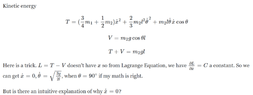
You cannot ignore friction when you have rolling without slipping. If you put a wheel on a frictionless incline, it will slide down just like a block without rolling. In this case, the angular speed ##\omega## about the axis of the wheel is zero. If the wheel is rolling down without slipping, then and only then the angular speed is related to the speed of the center of mass of the wheel by ##V_{\text{cm}}=\omega~R.## There is also the intermediate case of rolling with slipping in which case ##V_{\text{cm}}<\omega~R.##

The wheel-on-rails setup is dissimilar to your pendulum in that it is inverted. You will gain some insight if you describe qualitatively what happens to the wheel + stick system on rails if the stick swings down past the horizontal position and then back up through a full 360°.