Layman explanation of some simple EM equations

Click For Summary
SUMMARY

This discussion focuses on the interpretation of Maxwell's equations, particularly in the context of electromagnetic fields and currents in conductors. Participants explore the relationship between the magnetic vector potential, current density, and the role of electrical conductivity (σ) as the reciprocal of resistivity (ρ). The equations referenced are derived from COMSOL Multiphysics, emphasizing their application in time-varying simulations. Key concepts such as the curl and divergence of fields are also discussed, highlighting their relevance to Faraday's law and the cross product in electromagnetic theory.

PREREQUISITES
  • Understanding of Maxwell's equations
  • Familiarity with electromagnetic fields and potentials
  • Basic knowledge of vector calculus, including curl and divergence
  • Experience with COMSOL Multiphysics for simulation purposes
NEXT STEPS
  • Study the derivation and implications of Maxwell's equations in detail
  • Learn about the role of the magnetic vector potential in electromagnetic theory
  • Explore the application of curl and divergence in electromagnetic field analysis
  • Investigate the use of COMSOL Multiphysics for simulating electromagnetic phenomena
USEFUL FOR

Students and professionals in physics and engineering, particularly those interested in electromagnetism, electrical engineering, and simulation software like COMSOL Multiphysics.

tim9000
Messages
866
Reaction score
17
So its been a while since I studied maxwells equations, anyway:
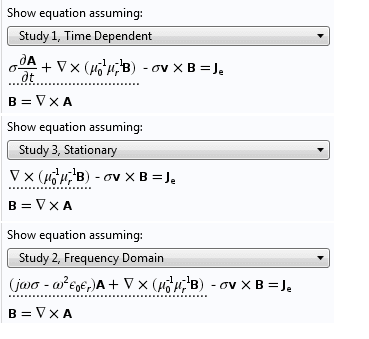
equations.png

So From my ignorant perspective, trying to derive conceptual meaning from these, I can see that the time dependent study there is some conductivity x the partial differential of the magnetic vector potential plus the cross product of mu*B which is H minus SOMETHING? equals the electron current density.

I don't really remember what the magnetic vector potential is (well, that is to say, I remember not really understanding it when I tried learning about it in the first place), or the last term...or what the cross product of H is.
I'm at a similar loss regarding the Frequeny Domain study.

To be honest all I really remember about the cross product is that it is perpendicular to the two vectors being multiplied.If anyone can offer a more indepth explanation of these formulas in English, I mean some maths is fine, but for a layman, that'd be great.

Cheers!
 
Physics news on Phys.org
These might help

 
  • Like
Likes sophiecentaur
MexChemE said:
These might help


Thanks for the reply, the second vid was a good refresher about curl (and to a lesser extent divergence), The first one didn't tell me anything I didn't already remember, but it made me try and wonder how Faraday's law might fit into those equations? (given that it has a current and cross product of B in it too).
But I'm still none the wiser about what the 'v' is in that equation (velocity?) or what the curl of H, cross product of Bxv and partial derivetive of A have to do with current density??

Cheers!
 
So am I to assume that these equations aren't a modification/application of one specific Maxwell equation??
 
What is the context of those equations? Where did you see them?

They seem to have something to do with electric and magnetic fields and electric currents in conductors. σ is the usual symbol for electrical conductivity, which is the reciprocal of resistivity: σ = 1/ρ.
 
jtbell said:
What is the context of those equations? Where did you see them?

They seem to have something to do with electric and magnetic fields and electric currents in conductors. σ is the usual symbol for electrical conductivity, which is the reciprocal of resistivity: σ = 1/ρ.
Yeah, they're from Comsol Multiphysics, depending on if you're simulating something that varies over time etc.
 

Similar threads

  • · Replies 2 ·
Replies
2
Views
2K
  • · Replies 2 ·
Replies
2
Views
2K
  • · Replies 2 ·
Replies
2
Views
1K
  • · Replies 6 ·
Replies
6
Views
2K
  • · Replies 32 ·
2
Replies
32
Views
4K
  • · Replies 5 ·
Replies
5
Views
3K
Replies
2
Views
2K
  • · Replies 3 ·
Replies
3
Views
1K
  • · Replies 2 ·
Replies
2
Views
2K
  • · Replies 2 ·
Replies
2
Views
2K