Lenovo Server Thermal Power Dissipation Data

  • Thread starter Thread starter Saladsamurai
  • Start date Start date
  • Tags Tags
    Data Server
Click For Summary
SUMMARY

The discussion centers on the lack of publicly available thermal power dissipation data for Lenovo servers, particularly in comparison to competitors like Dell and HP, which provide Energy Star Power and Performance Data Sheets. The user seeks specific thermal information, including airflow at delta T and power dissipation under varying loads. Despite Lenovo's claims of meeting Energy Star requirements, the absence of supporting documentation raises concerns about transparency. The suggestion is made to directly inquire with Lenovo to clarify their data availability.

PREREQUISITES
  • Understanding of thermal management concepts in server environments.
  • Familiarity with Energy Star certification standards.
  • Knowledge of airflow dynamics and thermal performance metrics.
  • Experience with data collection methods for server specifications.
NEXT STEPS
  • Research Lenovo server specifications and inquire about thermal data availability.
  • Explore Energy Star certification requirements for server manufacturers.
  • Learn about airflow measurement techniques in data centers.
  • Investigate alternative sources for thermal performance data on servers.
USEFUL FOR

IT professionals, data center managers, and procurement specialists looking for reliable thermal performance data on Lenovo servers for informed decision-making.

Saladsamurai
Messages
3,009
Reaction score
7
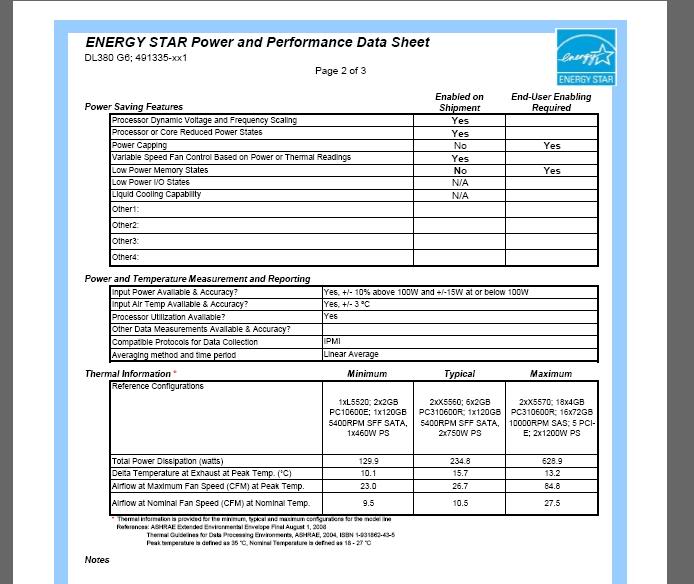
I am looking for thermal power dissipation data on Lenovo servers. A lot of the big companies like Dell and HP have Energy Star Power and Performance Data Sheets like this:
Perf.jpg


I cannot for the life of me find anything like this for Lenovo Servers. They claim to have servers that meet E Star requirements, but they don't seem to back up the claims (at least publicly).

I specifically need the info under "Thermal Information" (i.e. airflow at delta T, power dissipation as a function of loading, etc...)

Anyone have any ideas to collect this data?

You would think that they would want this stuff to be accessible.
 
Computer science news on Phys.org
I know it might seem like a silly question but - have you asked them? if they can't/won't provide the data - you've at least eliminated them them as a potential supplier!
 

Similar threads

  • · Replies 15 ·
Replies
15
Views
3K
  • · Replies 3 ·
Replies
3
Views
1K
Replies
1
Views
3K
  • · Replies 2 ·
Replies
2
Views
2K
  • · Replies 1 ·
Replies
1
Views
3K
  • · Replies 19 ·
Replies
19
Views
15K
  • · Replies 2 ·
Replies
2
Views
4K
  • · Replies 3 ·
Replies
3
Views
2K
  • · Replies 1 ·
Replies
1
Views
2K
Replies
7
Views
3K