Discussion Overview
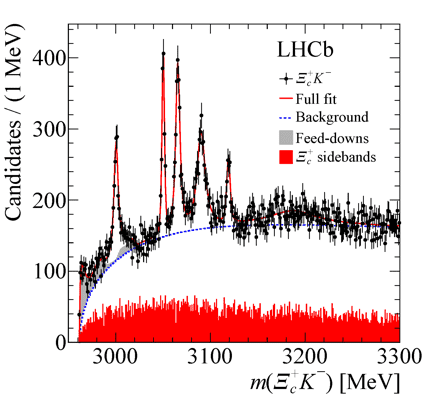
The discussion revolves around the recent observation of five new excited hadrons by the LHCb experiment, focusing on their implications for particle physics, particularly in the context of quantum chromodynamics (QCD) and baryon spectroscopy. Participants explore the significance of these findings and their potential connections to beyond the standard model (BSM) theories.
Discussion Character
- Exploratory
- Technical explanation
- Conceptual clarification
- Debate/contested
- Mathematical reasoning
Main Points Raised
- One participant notes the observation of five new particles with significant decay peaks, suggesting they are excited states of the ##\Omega_c^0## baryon.
- Another participant questions whether these excited hadrons can constrain BSM models or if their significance is limited to confirming existing theories.
- A different viewpoint emphasizes that the findings may enhance understanding of QCD at low energies, arguing that predictions for excited states are often inaccurate and do not necessarily indicate BSM physics.
- One participant discusses the relevance of mass differences over absolute masses in understanding the effects of quark mass, suggesting that the LHCb should make detailed mass data public.
- A participant raises concerns about the uncertainty in mass measurements, providing specific ranges for statistical and systematic uncertainties and questioning if a ~2% uncertainty is too large.
- Another participant expresses admiration for LHCb's consistent discoveries, acknowledging that while not all findings are revolutionary, they contribute to the field.
- One participant, working on the quark model for charmed baryons, anticipates that the new states will be negative parity states and expresses hope for positive results in their research.
Areas of Agreement / Disagreement
Participants express a range of views regarding the implications of the new particles, with some focusing on their potential to inform QCD and others questioning their relevance to BSM theories. There is no consensus on the significance of the uncertainty in mass measurements, as opinions vary on its impact on research outcomes.
Contextual Notes
Participants highlight limitations related to the accuracy of predictions for excited states and the dependence on specific assumptions regarding mass measurements. The discussion reflects ongoing uncertainties in the field without resolving them.
Who May Find This Useful
Researchers and students interested in particle physics, quantum chromodynamics, baryon spectroscopy, and the implications of new particle discoveries in the context of theoretical models.