Explaining 2.2 x 10⁻⁶ m Range Calculation

  • Thread starter Thread starter hidemi
  • Start date Start date
  • Tags Tags
    Calculation Range
Click For Summary
SUMMARY

The discussion centers on calculating the ruling separation for a diffraction grating when light of wavelength 550 nm is incident normally. The correct range of ruling separations is derived from the conditions for the 6th and 7th order lines, resulting in a range of 3.30 µm (3.30 x 10⁻⁶ m) to 3.85 µm (3.85 x 10⁻⁶ m). The original question posed was flawed, as it incorrectly stated the number of visible lines. The participants clarified that the number of primary maxima is always odd due to the presence of the 0-th order line.

PREREQUISITES
  • Understanding of diffraction grating principles
  • Knowledge of the wavelength of light (550 nm)
  • Familiarity with the sine function and its inverse
  • Ability to perform calculations involving angles and wavelengths
NEXT STEPS
  • Learn about the diffraction grating equation: d = nλ/sin(θ)
  • Explore the concept of order of maxima in diffraction patterns
  • Study the implications of light wavelength on diffraction patterns
  • Investigate the use of spreadsheets for calculating angles in diffraction
USEFUL FOR

Students and educators in physics, optical engineers, and anyone involved in the study of wave optics and diffraction phenomena.

hidemi
Messages
206
Reaction score
36
Homework Statement
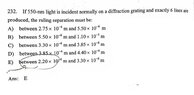
If 550-nm light is incident normally on a diffraction grating and exactly 6 lines are produced, the ruling separation must be:

The answer is between 2.20 ´ 10-6 m and 3.30 ´ 10-6 m
Relevant Equations
d·sin(θ) = n·λ
I get one of the ranges by calculating:

sin(90°) = 1
d·sin(θ) = d × 1 = d = n·λ
d = 6 × 550-nm = 3,300 nm = 3.3 microns = 3.3 × 10⁻⁶ m

But, how can I get the other range of 2.2 × 10⁻⁶ m

Could anyone explain it to me? Thanks
 
Physics news on Phys.org
hidemi said:
Homework Statement:: If 550-nm light is incident normally on a diffraction grating and exactly 6 lines are produced, the ruling separation must be:
There can’t be ‘exactly 6 lines’ because there is a single 0-th order central line and pairs of higher order lines (symmetrical about centre). So there is an odd number of lines in total. For example, if the highest order line is 6 (n=6), there are exactly 2*6+1 = 13 lines visible.

Have you stated the question correctly?
 
  • Like
Likes   Reactions: Charles Link
In general, the number of primary maxima will be odd, because of the ## m=0 ##, with ## m=\pm 1 ##, and ## m=\pm 2 ##, etc. I think the question needs additional clarification. Perhaps someone else has an idea of what it is referring to.
 
Steve4Physics said:
There can’t be ‘exactly 6 lines’ because there is a single 0-th order central line and pairs of higher order lines (symmetrical about centre). So there is an odd number of lines in total. For example, if the highest order line is 6 (n=6), there are exactly 2*6+1 = 13 lines visible.

Have you stated the question correctly?
There isn't any typo. The picture of the original question is as attached.
 

Attachments

  • 1.jpeg
    1.jpeg
    35.6 KB · Views: 238
I tried to solve it assuming there are orders up to and including ## m=5 ##. I can also see how they got the 3.3 but not the 2.2. I think they need to do their homework more carefully. The question is flawed.
 
  • Like
Likes   Reactions: Steve4Physics
hidemi said:
There isn't any typo. The picture of the original question is as attached.
The question is wrong (as already noted by @Charles Link and myself). And the so-called correct answer can't be correct because the limits of the ruling-separation range are 4λ and 6λ, which makes no sense.

I believe the question should be:

Light of wavelngth 550nm is incident normally on a diffraction grating. The highest order lines visible are the 6th-order. What is the possible range of the ruling-separations?

To answer this we consider the 2 limiting conditions.

a)The ruling-separation gives the 6th order line at θ = 89.9999999999º (but call it 90º!) which is just visible.

b)The ruling-separation gives the 7th order line at θ = 90º (you can’t actually see a line if θ = 90º). Note that the 6th order lines would now be visible at some angle smaller than 90º.

Using the amended question I get the answer C) in your list.

From what text-book (or other source) is the question?
 
  • Like
Likes   Reactions: Charles Link
Steve4Physics said:
The question is wrong (as already noted by @Charles Link and myself). And the so-called correct answer can't be correct because the limits of the ruling-separation range are 4λ and 6λ, which makes no sense.

I believe the question should be:

Light of wavelngth 550nm is incident normally on a diffraction grating. The highest order lines visible are the 6th-order. What is the possible range of the ruling-separations?

To answer this we consider the 2 limiting conditions.

a)The ruling-separation gives the 6th order line at θ = 89.9999999999º (but call it 90º!) which is just visible.

b)The ruling-separation gives the 7th order line at θ = 90º (you can’t actually see a line if θ = 90º). Note that the 6th order lines would now be visible at some angle smaller than 90º.

Using the amended question I get the answer C) in your list.

From what text-book (or other source) is the question?
It's from class, and I'm not sure where the professor extracted from.
One of the answer C is above the limit of 3.3e-6, so I wonder if I misunderstood what you meant.
 
hidemi said:
One of the answer C is above the limit of 3.3e-6, so I wonder if I misunderstood what you meant.
There is no upper limit of 3.3e-6 m. Remember the original question is completel wrong - it is nonsense.

I’m saying answer C) is the answer to a different question:

Light of wavelength 550nm is incident normally on a diffraction grating. The highest order lines visible are the 6th-order. What is the possible range of the ruling-separations?

##n\lambda= dsin\thetaθ## gives ##d = \frac{n\lambda}{sin\theta}##

If the 6th order is just visible, that means ##\theta = 89.99999999º##.
This corresponds to a line-spacing ##d = \frac {6\lambda}{sin(89.99999999º)} = 6\lambda##.

If the 7th order is just invisible that means ##\theta = 90º##.
This corresponds to a line-spacing ##d = \frac {7\lambda}{sin(90º)} = 7\lambda##.
(In this case the 6th order would easily be visible – you can work out, it is at 59º.)

Therefore the line-spacing (d) must be between ##6\lambda## and ##7\lambda##.

##d = 6 \times 550\times 10^{-9} m = 3.30\times 10^-6 m##.
##d = 7 \times 550\times 10^{-9} m = 3.85\times 10^-6 m##.
 
Steve4Physics said:
There is no upper limit of 3.3e-6 m. Remember the original question is completel wrong - it is nonsense.

I’m saying answer C) is the answer to a different question:

Light of wavelength 550nm is incident normally on a diffraction grating. The highest order lines visible are the 6th-order. What is the possible range of the ruling-separations?

##n\lambda= dsin\thetaθ## gives ##d = \frac{n\lambda}{sin\theta}##

If the 6th order is just visible, that means ##\theta = 89.99999999º##.
This corresponds to a line-spacing ##d = \frac {6\lambda}{sin(89.99999999º)} = 6\lambda##.

If the 7th order is just invisible that means ##\theta = 90º##.
This corresponds to a line-spacing ##d = \frac {7\lambda}{sin(90º)} = 7\lambda##.
(In this case the 6th order would easily be visible – you can work out, it is at 59º.)

Therefore the line-spacing (d) must be between ##6\lambda## and ##7\lambda##.

##d = 6 \times 550\times 10^{-9} m = 3.30\times 10^-6 m##.
##d = 7 \times 550\times 10^{-9} m = 3.85\times 10^-6 m##.
Thanks for the response.
I wonder how about the orders lie in between 0 < theta < 90?
 
  • #10
hidemi said:
I wonder how about the orders lie in between 0 < theta < 90?
I don't understand the question. What you can try is this:

Pick a value for d.
Work out the angle for each order using
##\theta = sin^{-1}(\frac {n\lambda }{d})## for n=0, 1, 2, 3, ...

You will then see exactly where each order lies in the range 0≤θ<90º.

You can repeat this for a different value of d and see what difference it makes,

(If you can use a spreadsheet, this is very quick/easy to do.)
 
  • Like
Likes   Reactions: Charles Link and hidemi
  • #11
I
Steve4Physics said:
I don't understand the question. What you can try is this:

Pick a value for d.
Work out the angle for each order using
##\theta = sin^{-1}(\frac {n\lambda }{d})## for n=0, 1, 2, 3, ...

You will then see exactly where each order lies in the range 0≤θ<90º.

You can repeat this for a different value of d and see what difference it makes,

(If you can use a spreadsheet, this is very quick/easy to do.)
I see, Thank you/.
 
  • Like
Likes   Reactions: Steve4Physics and Charles Link

Similar threads

  • · Replies 3 ·
Replies
3
Views
2K
  • · Replies 18 ·
Replies
18
Views
3K
Replies
4
Views
2K
Replies
26
Views
2K
Replies
15
Views
2K
  • · Replies 2 ·
Replies
2
Views
1K
Replies
2
Views
3K
  • · Replies 6 ·
Replies
6
Views
4K
  • · Replies 2 ·
Replies
2
Views
5K
  • · Replies 14 ·
Replies
14
Views
3K