Light reflection in length contracted system

Click For Summary
The discussion centers on the behavior of light reflection in systems experiencing length contraction due to motion. When a light beam hits a mirror perpendicularly in a stationary frame, it returns to the source, but in a moving frame, the geometry appears skewed, leading to different expected reflection paths. The participants emphasize the importance of using Lorentz transformations to accurately depict the light's path in moving frames, highlighting that the perceived geometry is frame-dependent. There is a debate about whether the shape of a moving apparatus can be equated to its rest frame shape, with arguments made regarding the relativity of simultaneity and the nature of physical reality. Ultimately, the conversation seeks to reconcile intuitive understandings of light reflection with the complexities introduced by relativistic effects.
Ookke
Messages
172
Reaction score
0
Light beam hits the mirror perpendicularly and returns to the source (left picture).

The same system in horizontal motion (right picture) is skewed due to length contraction so that both beam and mirror are at higher angle. Because the beam returns to source in the system's rest frame, it must do that in any other frame. So the beam returns the same path that is drawn with solid red line, although it might be expected that the light is reflected to direction pointed by thin dotted red line.

Contrastingly, let's have a system that has the shape of right picture in its own rest frame. In this case, the light reflects so that it follows the thin dotted line. I find this distinction strange, because light reflection should depend only on the geometry. The geometry is exactly the same in both cases.
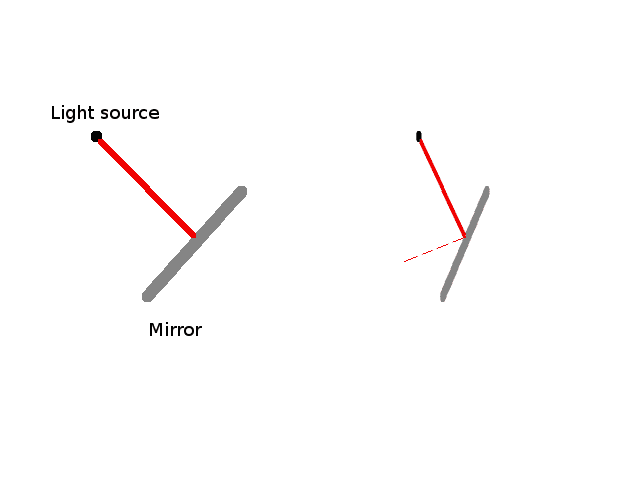
light_and_mirror.png
 
Physics news on Phys.org
Ookke said:
Because the beam returns to source in the system's rest frame, it must do that in any other frame. So the beam returns the same path that is drawn with solid red line
But relative to this second frame the source is moving, so the beam doesn't return on the same path.
 
DrGreg said:
But relative to this second frame the source is moving, so the beam doesn't return on the same path.
It's not the same path in space, but I meant that relative to the source the light travels at certain angle to certain distance, reflects and returns in the same angle. The whole system (source and mirror) are moving.
 
Ookke said:
Light beam hits the mirror perpendicularly and returns to the source (left picture).

The same system in horizontal motion (right picture) is skewed due to length contraction so that both beam and mirror are at higher angle. Because the beam returns to source in the system's rest frame, it must do that in any other frame. So the beam returns the same path that is drawn with solid red line, although it might be expected that the light is reflected to direction pointed by thin dotted red line.

If you want to see what a scenario looks like in a frame moving with respect to your defining frame, you need to use the Lorentz Transformation process, you can't just guess and hope to get it right.

Also, although for your defining scenario, you can get away with a single diagram, because our minds can image a flash of light (you don't want to use a beam or it will be impossible to depict for the moving frame) propagating from the source to the mirror and back, you need to make a series of diagrams at equal increments of time, like the frames of a movie. This means that you can't just take all the events in the defining scenario at one particular time and transform them to the moving frame and show them on a diagram as a snapshot, instead, you have to find a set of events that all occur at the same time in each new successive transformed frame. It's kind of a complicated process but I have done it for you.

To start with, I've taken your image of the frame where the apparatus is stationary, assigned coordinates to the light source, the ends of the mirror and the reflection point on the mirror. Then I made five snapshots showing the progress of the red light flash from its source to the mirror and back:

MovingDiagonalMirror2.PNG
MovingDiagonalMirror3.PNG


MovingDiagonalMirror4.PNG


MovingDiagonalMirror5.PNG


MovingDiagonalMirror6.PNG

I'm not going to show you all the transformation processes are the values of the events. Instead, I'm just going to show you an image with 5 diagrams that I have taken from your frame where the apparatus is moving. I hope this make sense to you:

MovingDiagonalMirror7.PNG

To interpret this correctly, you must imagine just one of the five mirrors and one of the five red flashes as occurring at the same time. For example, it looks like the second red flash is almost hitting the first mirror but that is not the case. It's the second contracted dot at the top (the light source), the second red dot which is part way down, and the second mirror which all go together. Once you figure it out, you can see how the red flash propagates in a straight line towards the center of the mirror and then propagates back up again in a straight line to its source.

Admittedly, an animation would be a lot better but I hope this suffices.

Ookke said:
Contrastingly, let's have a system that has the shape of right picture in its own rest frame. In this case, the light reflects so that it follows the thin dotted line. I find this distinction strange, because light reflection should depend only on the geometry. The geometry is exactly the same in both cases.

You can't just take the image of a moving apparatus that is length contracted, not to mention having relativity of simultaneity applied to it, and "construct" an "equivalent" apparatus at rest and think that it should behave in any particular manner.
 
Thanks George for your thorough reply.

ghwellsjr said:
our minds can image a flash of light (you don't want to use a beam or it will be impossible to depict for the moving frame) propagating from the source to the mirror and back
Agreed. We don't even need continuous beam, because the angle is of interest. In fact, we could use some object e.g. ball that bounces back from wall and its speed doesn't need to be "relativistic" at all. I just wanted to use light and mirror for simplicity and familiarity.

ghwellsjr said:
Once you figure it out, you can see how the red flash propagates in a straight line towards the center of the mirror and then propagates back up again in a straight line to its source.
I think I got it. Here is the same idea drawn with 5 mirrors, which represent the system in different instances of time (looked from outside, the system is moving and length contracted).

propagating.png

ghwellsjr said:
You can't just take the image of a moving apparatus that is length contracted
Why not? If we accept that the contracted object "really" has the shape it's calculated to have, we can visualize it and in principle even take a picture of it. Or construct an object at rest that has the same shape and size.

ghwellsjr said:
"construct" an "equivalent" apparatus at rest and think that it should behave in any particular manner.
Right, at least in this example the result doesn't seem to be equivalent. When we look the moving system from outside, it seems to me that the pulse reflection follows the shape that the object has in its own rest frame instead of the shape that it has in the frame where we are looking from. If all frames are equivalent, why rest frame should be preferred?
 
You didn't draw the diagrams correctly. This one shows the path of the light flash in the frame in which the apparatus is moving:

MovingDiagonalMirror8.PNG

Keep in mind, that in none of these diagrams can an observer or camera see what we have drawn. Lengths of objects are established by a convention, not just by observation or measurement or appeal to reality. I had to do a lot of work to determine the correct positioning of the different "snapshots" of the apparatus, mainly to determine the simultaneity of their events.

I challenge you to determine the coordinates of the events for the endpoints and midpoints of the snapshots of the mirrors and the coordinates of the light source and the light flash in the above diagram. Maybe then you will understand why you cannot claim that the shape of the apparatus that we see on a diagram is related to reality. Both the rest frame of the apparatus and the frame in which it is moving are equally valid in describing its shape but that shape is established by the frame we use to define our coordinates, not be a physical reality. Coordinates are not a physical reality.
 
ghwellsjr said:
You can't just take the image of a moving apparatus that is length contracted [..]
Keep in mind, that in none of these diagrams can an observer or camera see what we have drawn. Lengths of objects are established by a convention, not just by observation or measurement or appeal to reality. I had to do a lot of work to determine the correct positioning of the different "snapshots" of the apparatus, mainly to determine the simultaneity of their events. [..]
In principle (but hardly in practice) a CCD camera with extreme specifications that is set up very near to the mirror certainly should be able "see" an image like you have drawn, for the simple reason that the camera will be designed to interpret data coming from different pixels in accordance with the simultaneity convention. In such extreme cases, the picture produced by a camera thus includes interpretation. Regretfully I only hinted at this in an earlier thread:
https://www.physicsforums.com/threads/light-clock-problem.643225/#post-4112363

Also, nice drawings! :)
 
Last edited:
Ookke said:
Light beam hits the mirror perpendicularly and returns to the source (left picture).

The same system in horizontal motion (right picture) is skewed due to length contraction so that both beam and mirror are at higher angle. Because the beam returns to source in the system's rest frame, it must do that in any other frame. So the beam returns the same path that is drawn with solid red line, although it might be expected that the light is reflected to direction pointed by thin dotted red line.

Contrastingly, let's have a system that has the shape of right picture in its own rest frame. In this case, the light reflects so that it follows the thin dotted line. I find this distinction strange, because light reflection should depend only on the geometry. The geometry is exactly the same in both cases.

View attachment 75432
George showed you how to construct correctly using the Lorentz transformations. However it's not needed to calculate the events. Your first drawing is erroneous because you used a rule of optics that is valid for non-moving mirrors only. In order to find the correct angle of reflection in an intuitive way, you can construct the angle of reflection with Huygens' method* - and you will find that it works out perfectly. Of course, you need to account for length contraction in the way you already did in your first drawings, as well as with motion of the mirror as explained by George. You only need a drafting compass and a ruler. :)

* if you don't know it, see for an explanation https://en.wikipedia.org/wiki/Huygens–Fresnel_principle
 
Last edited:
ghwellsjr said:
This one shows the path of the light flash in the frame in which the apparatus is moving:
Now I hopefully get it. You mean the light flash actual path in this frame. I tried to draw only how pulse moves "relative" to the apparatus in this frame.

ghwellsjr said:
I challenge you to determine the coordinates of the events for the endpoints and midpoints of the snapshots of the mirrors and the coordinates of the light source and the light flash in the above diagram. Maybe then you will understand why you cannot claim that the shape of the apparatus that we see on a diagram is related to reality.
I'm somewhat familiar with relativity of simultaneity and aware that if there are clocks in different parts of apparatus and the clocks are synced in the rest frame, they are not in sync in a frame where apparatus is moving. For example, if we set apparatus length in x-dimension 1 units in its own rest frame, and look in a frame where apparatus is moving 0.9c to right, the time difference between front and rear is 0.9 units. So if we take a picture e.g. using a camera that is wide enough to cover the whole apparatus that is moving, the different parts of the picture would have clocks showing different time. So the moving object is not "concrete" or "touchable" in the sense that objects we handle usually are.
 
  • #10
harrylin said:
In order to find the correct angle of reflection in an intuitive way, you can construct the angle of reflection with Huygens' method* - and you will find that it works out perfectly.
The intuitive understanding is exactly what I'm looking for. I'm convinced enough that the pulse returns to the source in every frame, because otherwise there would be a contradiction, but I'm just unable to see why it would reflect into this kind of surprising direction in a frame where the apparatus is moving.
 
  • #11
Ookke said:
The intuitive understanding is exactly what I'm looking for. I'm convinced enough that the pulse returns to the source in every frame, because otherwise there would be a contradiction, but I'm just unable to see why it would reflect into this kind of surprising direction in a frame where the apparatus is moving.
Here is a paper that illustrates the construction method: http://arxiv.org/abs/physics/0409014v3

It is mostly discussing the Doppler effect. The same author published another paper that is more to the point, but I don't know if you can easily obtain it (you can write me a message): http://scitation.aip.org/content/aapt/journal/ajp/72/10/10.1119/1.1778390

By similarly constructing with a length contracted mirror at an angle, you should be able to find the correct result for your particular question. If it is problematic, inputting your efforts here will likely trigger new responses. Just don't expect others to do all the work for you. ;)
 
Last edited:
  • #12
harrylin said:
Just don't expect others to do all the work for you. ;)
I'm a bit lazy sometimes, but I'm trying to improve ;)

PDF downloaded successfully. Thanks!
 

Similar threads

Replies
15
Views
2K
  • · Replies 6 ·
Replies
6
Views
3K
  • · Replies 51 ·
2
Replies
51
Views
5K
  • · Replies 18 ·
Replies
18
Views
2K
  • · Replies 36 ·
2
Replies
36
Views
3K
  • · Replies 15 ·
Replies
15
Views
3K
  • · Replies 6 ·
Replies
6
Views
2K
  • · Replies 5 ·
Replies
5
Views
1K
  • · Replies 5 ·
Replies
5
Views
2K
  • · Replies 2 ·
Replies
2
Views
1K