Limit involving delta-epsilon proof help

  • Thread starter Thread starter ZPlayer
  • Start date Start date
  • Tags Tags
    Limit Proof
Click For Summary
SUMMARY

The limit of the expression x² * sin²(y) / (x² + 2y²) as (x,y) approaches (0,0) is definitively 0, proven using the delta-epsilon method. The approach involves selecting a small epsilon value, such as 0.1, and determining if the expression remains less than epsilon when (x,y) is within delta of (0,0). This iterative process helps confirm the correctness of the chosen delta. The discussion emphasizes the importance of validating the delta selection through testing with smaller epsilon values.

PREREQUISITES
  • Understanding of limits in calculus
  • Familiarity with the delta-epsilon definition of limits
  • Basic knowledge of trigonometric functions, specifically sine
  • Ability to manipulate algebraic expressions
NEXT STEPS
  • Study the delta-epsilon definition of limits in depth
  • Practice solving limits using the delta-epsilon method
  • Explore the behavior of trigonometric functions near zero
  • Learn about multivariable limits and their applications
USEFUL FOR

Students studying calculus, mathematics educators, and anyone seeking to understand the delta-epsilon method for proving limits in multivariable functions.
ZPlayer
Messages
35
Reaction score
0
Hi, Everyone,

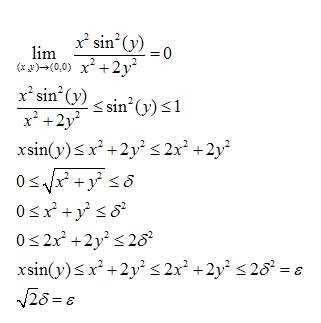
Problem asks to prove that limit of x^2 * sin^2 (y) / (x^2 + 2* y^2) as (x,y) approach (0,0) is 0 using delta-epsilon method. I think I solved it below. Let me know if I am write or wrong.

Thanks.

2yni3no.jpg
 
Physics news on Phys.org
I am sorry for the previous post. The solution I have arrived at is actually below.
2rcy7n9.jpg
 
Something easy you can do is pick some numbers to see if it works. Pick a value for epsilon that's fairly small, such as 0.1. Now pick a point (x, y) that is within delta (= epsilon) of (0,0). Is the value of your first expression less than epsilon?

Now pick a smaller number for epsilon, such as 0.01, and repeat the process as above. This doesn't prove that you have selected the right value of delta, but if you find that the process doesn't give the results you want, then you know you haven't found the right delta.
 
I understand your explanation. However, I would appreciate it if you could go over the logic of my solution and answer the question conclusively (i.e. to the best of your knowledge) if my solution is correct or not. Thank you for your time and effort.
 

Similar threads

  • · Replies 31 ·
2
Replies
31
Views
2K
  • · Replies 9 ·
Replies
9
Views
4K
Replies
19
Views
2K
  • · Replies 5 ·
Replies
5
Views
2K
  • · Replies 3 ·
Replies
3
Views
2K
  • · Replies 9 ·
Replies
9
Views
3K
  • · Replies 14 ·
Replies
14
Views
2K
  • · Replies 13 ·
Replies
13
Views
4K
  • · Replies 5 ·
Replies
5
Views
5K
  • · Replies 10 ·
Replies
10
Views
2K