Limit Points & Closure in a Topological Space .... Singh, Theorem 1.3.7

Click For Summary
SUMMARY

The discussion centers on Tej Bahadur Singh's proof of Theorem 1.3.7 in "Elements of Topology," specifically regarding the closure of sets in a topological space. The theorem establishes that if a set \( U \) is contained in the complement of \( A \cup A' \), then \( A \cup A' \) is closed. This follows from the definitions of open sets and neighborhoods as outlined in Definitions 1.3.3 and 1.3.6. The conclusion drawn is that the closure \( \overline{A} \) is a subset of \( A \cup A' \), supported by Proposition 1.3.4 and Theorem 1.3.5.

PREREQUISITES
  • Understanding of topological spaces as defined in Definition 1.3.3
  • Familiarity with the concept of open sets and neighborhoods from Definition 1.3.6
  • Knowledge of closure properties as described in Proposition 1.3.4
  • Comprehension of the implications of Theorem 1.3.5 regarding set inclusions
NEXT STEPS
  • Study the implications of Definition 1.3.3 on the structure of topological spaces
  • Explore the properties of open sets and neighborhoods in detail as per Definition 1.3.6
  • Investigate the proofs and applications of Proposition 1.3.4 in various topological contexts
  • Examine Theorem 1.3.5 to understand its role in set closure and inclusions
USEFUL FOR

Mathematicians, students of topology, and educators seeking a deeper understanding of the foundational concepts in topological spaces, particularly those related to closures and open sets.

Math Amateur
Gold Member
MHB
Messages
3,920
Reaction score
48
TL;DR
I am reading Tej Bahadur Singh: Elements of Topology, CRC Press, 2013 and am focused on the notions of limit points and closure in a topological space ... and I need help with understanding Singh's proof of Theorem 1.3.7 ...
I am reading Tej Bahadur Singh: Elements of Topology, CRC Press, 2013 ... ... and am currently focused on Chapter 1, Section 1.2: Topological Spaces ...

I need help in order to fully understand Singh's proof of Theorem 1.3.7 ... (using only the definitions and results Singh has established to date ... see below ... )

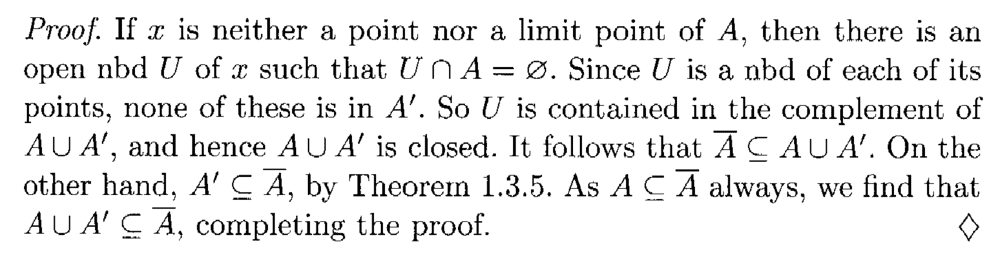
Theorem 1.3.7 reads as follows:

Singh - 1 - Theorem 1.3.7 ... PART 1 ... .png

Singh - 2 - Theorem 1.3.7 ... PART 2 ... .png


In the above proof by Singh we read the following:

" ... ... So ##U## is contained in the complement of ##A \cup A'##, and hence ##A \cup A'## is closed. It follows that ##\overline{A} \subseteq A \cup A'## ... ... "My question is as follows:

Why does ##U## being contained in the complement of ##A \cup A'## imply that ##A \cup A'## is closed ... and further why then does it follow that ##\overline{A} \subseteq A \cup A'## ... ... Help will be appreciated ...

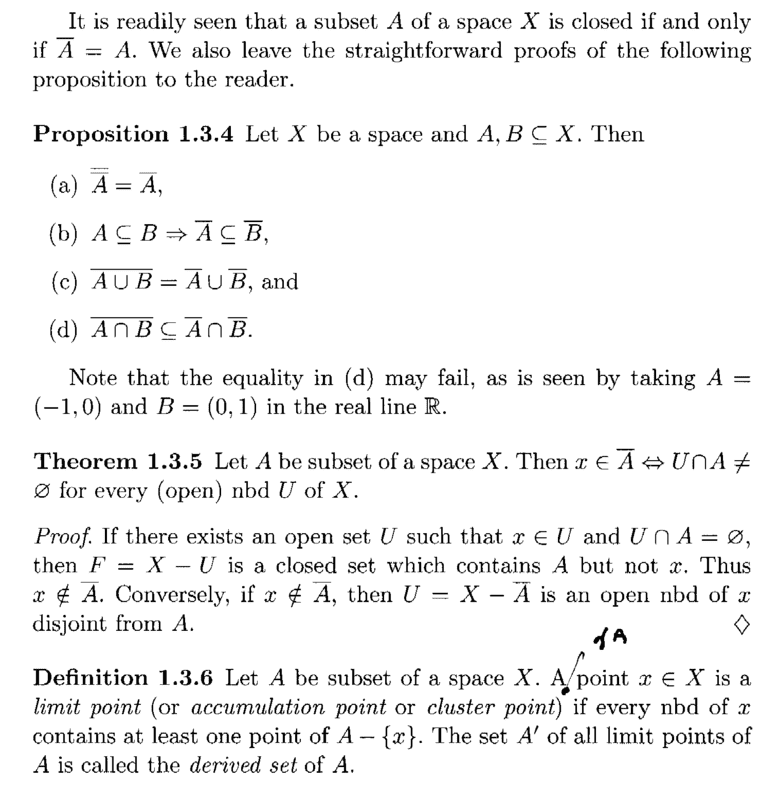
Peter==========================================================================================It is important that any proof of the above remarks only rely on the definitions and results Singh has established to date ... namely Definition 1.3.3, Proposition 1.3.4, Theorem 1.3.5 and Definition 1.3.6 ... which read as follows ... :
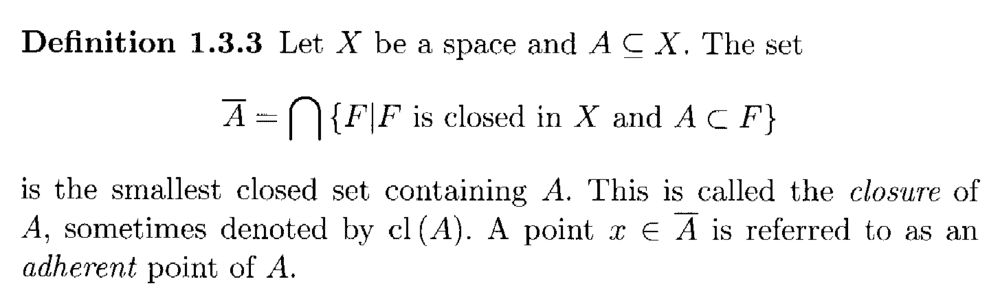
Singh - 1 - Defn 1.3.3, Propn 1.3.4, Theorem 1.3.5, Defn 1.3.6 ... PART 1 ... .png

Singh - 2 - Defn 1.3.3, Propn 1.3.4, Theorem 1.3.5, Defn 1.3.6 ... PART 2 ... .png

Hope that helps ...

Peter
 
Physics news on Phys.org
Let ##Z=A\cup A'.## Showing that every element of ##X\setminus Z## has an open neighborhood disjoint from ##Z## means that ##X\setminus Z## is open, that is, ##Z## is closed.

For your second question, we know ##A\subseteq A\cup A'##. Taking closures of both sides gives ##\overline{A}\subseteq \overline{A\cup A'}=A\cup A.'## I am using the fact that if ##B\subseteq C,## then ##\overline{B}\subseteq\overline{C}.##
 
Last edited:
  • Like
Likes   Reactions: Math Amateur
Infrared said:
Let ##Z=A\cup A'.## Showing that every element of ##X\setminus Z## has an open neighborhood disjoint from ##Z## means that ##X\setminus Z## is open, that is, ##Z## is closed.

For your second question, we know ##A\subseteq A\cup A'##. Taking closures of both sides gives ##\overline{A}\subseteq \overline{A\cup A'}=A\cup A.'## I am using the fact that if ##B\subseteq C,## then ##\overline{B}\subseteq\overline{C}.##
Thanks for the help Infrared ... but can you help further ...

In showing ##Z=A\cup A'## is closed you write ... "Showing that every element of ##X\setminus Z## has an open neighborhood disjoint from ##Z## means that ##X\setminus Z## is open, that is, ##Z## is closed."

Can you explain homework this follows from the definitions and results Singh has established to date (which are Definition 1.3.3, Proposition 1.3.4, Theorem 1.3.5 and Definition 1.3.6 details of which are shown in my post ... note that the only relevant definitions and results Singh has established up to this point are the definition of a topology ... and hence an open set ... and the definition of a neighbourhood ... )

Hope you can help further ...

Peter
 
The argument you quoted shows that for every ##x\in X\setminus Z##, there is an open set ##U_x\subset X\setminus Z## that contains ##x##. So we can write ##X\setminus Z=\bigcup_{x\in X\setminus Z} U_x.## This is a union of open sets, so ##X\setminus Z## is open. This means ##Z## is closed.
 
Last edited:
  • Like
Likes   Reactions: Math Amateur
Thanks Infrared ...

Really appreciate your help...

Peter
 

Similar threads

  • · Replies 5 ·
Replies
5
Views
2K
  • · Replies 2 ·
Replies
2
Views
2K
  • · Replies 14 ·
Replies
14
Views
2K
  • · Replies 2 ·
Replies
2
Views
2K
  • · Replies 2 ·
Replies
2
Views
2K
  • · Replies 2 ·
Replies
2
Views
2K
  • · Replies 2 ·
Replies
2
Views
2K
  • · Replies 2 ·
Replies
2
Views
2K
  • · Replies 2 ·
Replies
2
Views
2K
  • · Replies 8 ·
Replies
8
Views
3K