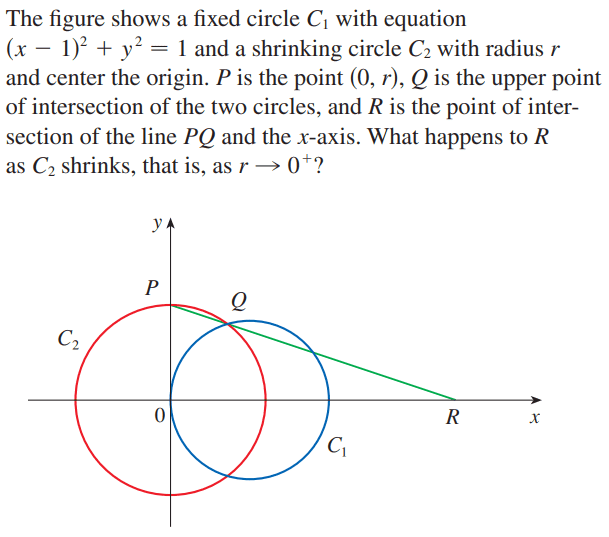
Limit problem involving two circles and a line

Click For Summary
SUMMARY

The discussion centers on solving a limit problem involving two circles and a line, specifically the coordinates of point R as the radius of the left circle approaches zero. The equations of the circles are defined as C_1: (x - 1)^2 + y^2 = 1 and C_2: x^2 + y^2 = r^2. The coordinates of point Q are derived as Q=(r^2/2, (r/2)√(4-r^2)), which are essential for determining the coordinates of point R. The participants emphasize the necessity of using Q's coordinates either explicitly or implicitly to solve for R.

PREREQUISITES
  • Understanding of circle equations in Cartesian coordinates.
  • Familiarity with limit calculations in calculus.
  • Knowledge of linear equations and slope-intercept form.
  • Ability to manipulate algebraic expressions involving square roots.
NEXT STEPS
  • Explore the derivation of coordinates for point Q in various scenarios.
  • Study the implications of limit behavior as r approaches zero in calculus.
  • Learn how to derive the equation of a line given two points in a coordinate system.
  • Investigate implicit versus explicit functions in mathematical contexts.
USEFUL FOR

Mathematicians, calculus students, and educators seeking to deepen their understanding of geometric problems involving limits and coordinate systems.

member 731016
Homework Statement
Please see below
Relevant Equations
Please see below
For this problem,
1681963648890.png

The limiting position of R is (4,0). However, I am trying to solve this problem using a method that is different to the solutions. So far I have got,

##C_1: (x - 1)^2 + y^2 = 1##
##C_2: x^2 + y^2 = r^2##

To find the equation of PQ,
## P(0,r) ## and ##R(R,0) ##
## y = \frac{r(x - R)}{-R} ##
Then solve for ## R ## to get,

##R = \frac{rx}{r - y}##
##R = \frac{rx}{r - \sqrt{r^2 + x^2}} ##
##R = \lim_{r \rightarrow 0^+} \frac{rx}{r - \sqrt{r^2 + x^2}} = 0 ##

Can someone please give guidance to what I have done wrong?

Many thanks!
 
Physics news on Phys.org
What did you get as coordinates for ##Q##?
 
  • Like
Likes   Reactions: member 731016
fresh_42 said:
What did you get as coordinates for ##Q##?
Thank you for your reply @fresh_42! I missed up finding the coordinates of ##Q## in my original attempt.

But according to the solutions,
1681980177755.png

However, I am curious how to solve this problem without using Q's coordinates.

Many thanks!
 
You need the equation for the line ##\overline{PQ}## which is defined by ##Q## so you definitely need the coordinates for ##Q## somehow; if not explicitly then implicitly. Say the straight is ##y=mx+b.## Then ##R## has the coordinates ##R=(-\frac{b}{m},0).## We finally need to solve ##\lim_{r \to 0^+} \frac{-b}{m}.##

I do not see how to get there without ##m## and ##b## that are determined by ##P## and ##Q.##
 
  • Like
Likes   Reactions: member 731016
Hint for the limit calculation:

a) Show that the quotient is greater than ##2## for ##0<r < 2.##
b) Set the quotient equal to ##L## and solve for ##r^2.##
c) Show what happens to ##L## if ##r \rightarrow 0.##
 
  • Like
Likes   Reactions: member 731016
fresh_42 said:
You need the equation for the line ##\overline{PQ}## which is defined by ##Q## so you definitely need the coordinates for ##Q## somehow; if not explicitly then implicitly. Say the straight is ##y=mx+b.## Then ##R## has the coordinates ##R=(-\frac{b}{m},0).## We finally need to solve ##\lim_{r \to 0^+} \frac{-b}{m}.##

I do not see how to get there without ##m## and ##b## that are determined by ##P## and ##Q.##
Thank you for your replies @fresh_42!

I think part of my confusion is that I think that the line ##\overline{PQ} = \overline{PR}##. Do you please know why they are different?

I also think I wrongly wrote ##R## as ##R(R,0)##, because I was thinking that the distance from the origin to point ##R## is ##R##. I now think that is incorrect because the problem only specifies the point as ##R##. Do you please know whether that is the only reason why we cannot assume that ##R(R,0)##?

Many thanks!
 
fresh_42 said:
You need the equation for the line ##\overline{PQ}## which is defined by ##Q## so you definitely need the coordinates for ##Q## somehow; if not explicitly then implicitly. Say the straight is ##y=mx+b.## Then ##R## has the coordinates ##R=(-\frac{b}{m},0).## We finally need to solve ##\lim_{r \to 0^+} \frac{-b}{m}.##

I do not see how to get there without ##m## and ##b## that are determined by ##P## and ##Q.##
Sorry, do you please know what it means to find the coordinates of ##Q## explicitly or implicitly?

Would finding the coordinates of ##Q## explicitly translate to find ##Q## as a function of some variables, for example ##R=(-\frac{b}{m},0)## like you wrote?

And finding coordinates of ##Q## implicitly would translate to ##Q## as a function of some other variables?

Many thanks!
 
ChiralSuperfields said:
Thank you for your replies @fresh_42!

I think part of my confusion is that I think that the line ##\overline{PQ} = \overline{PR}##. Do you please know why they are different?
They are not. ##P## and ##R## change when the left circle shrinks. They, and ##Q##, depend on its radius ##r.##
ChiralSuperfields said:
I also think I wrongly wrote ##R## as ##R(R,0)##, because I was thinking that the distance from the origin to point ##R## is ##R##.
That is both true. ##R=(R,0).## A better notation would be ##R=(R(r),0)## as the coordinate changes with ##r.##
ChiralSuperfields said:
I now think that is incorrect because the problem only specifies the point as ##R##. Do you please know whether that is the only reason why we cannot assume that ##R(R,0)##?

Many thanks!

You are almost done. You correctly calculated ##Q=\left(\dfrac{r^2}{2}\, , \,\dfrac{r}{2}\sqrt{4-r^2}\right).##

The rest is not so difficult. The equation for a line given by points ##A=(x_a,y_a)## and ##B=(x_b,y_b)## is
$$
\dfrac{y-y_a}{x-x_a}=\dfrac{y_b-y_a}{x_b-x_a}
$$
So calculate this expression with ##A=P## and ##B=Q,## bring it into the form ##y=m\cdot x+ b## and calculate ##R=(x_0,0)=(x_0,m\cdot x_0+b),## i.e. 0=m\cdot x_0+b## or ##x_0=-\dfrac{b}{m}=R(r).##

This gives you the ##x##-coordinate of the point ##R## as a function of ##r,## the radius of the left circle.
Then proceed along the lines in post #5 in order to find the limit mentioned in post #4.
 
  • Like
Likes   Reactions: member 731016
ChiralSuperfields said:
Sorry, do you please know what it means to find the coordinates of ##Q## explicitly or implicitly?
You have computed the coordinates of ##Q##. Correctly calculated them! So you can work with these formulas, which would be an explicit use.

We need the information hidden in the position of ##Q## because it defines our problem. We need ##Q.## If you do not want to use the coordinates, the result of your calculation, then you have to use ##Q## otherwise. That would be an implicit use since you had to use the definition of ##Q## without calculating it. Such usage is called implicit use since you avoid the explicit solution. I have no idea how to do that and consider it unnecessary especially as you do have the coordinates already. I just answered your idea of doing it without knowing the coordinates.

E.g. The point ##R## is implicitly given. We know how to construct it since we have a description of the algorithm, but we do not know the explicit coordinates, yet.

Calculate them next: ##R=\left(-\dfrac{b}{m},0\right).## What are ##m## and ##b## as a function of ##r##?


ChiralSuperfields said:
Would finding the coordinates of ##Q## explicitly translate to find ##Q## as a function of some variables, for example ##R=(-\frac{b}{m},0)## like you wrote?

And finding coordinates of ##Q## implicitly would translate to ##Q## as a function of some other variables?

Many thanks!
 
  • Like
Likes   Reactions: member 731016

Similar threads

  • · Replies 3 ·
Replies
3
Views
1K
  • · Replies 19 ·
Replies
19
Views
2K
  • · Replies 7 ·
Replies
7
Views
2K
  • · Replies 14 ·
Replies
14
Views
2K
Replies
4
Views
2K
  • · Replies 1 ·
Replies
1
Views
2K
Replies
3
Views
2K
  • · Replies 8 ·
Replies
8
Views
2K
  • · Replies 9 ·
Replies
9
Views
2K