DiamondV
- Messages
- 103
- Reaction score
- 0
Hi,
so I am just starting to learn differential equations and we were told that you have to put the equation into
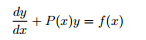 this form.
In one of the examples in my lecture notes, which says
"Solve (x^2-9)dy/dx+xy=0, x>3" He then says we need to rearrange this into the form given above, so he does this by dividing across by x^2-9 and gets this.
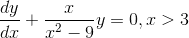
I understand that if you divide 0 by x^2-9 you get 0 but that still isn't a function of x
Now if you compare the form we put the equation into and the required form you will notice that

My issue is with the f(x). How is 0 a function of x? Arent we meant to have a function of x on the right as part of the required format?
so I am just starting to learn differential equations and we were told that you have to put the equation into
In one of the examples in my lecture notes, which says
"Solve (x^2-9)dy/dx+xy=0, x>3" He then says we need to rearrange this into the form given above, so he does this by dividing across by x^2-9 and gets this.
I understand that if you divide 0 by x^2-9 you get 0 but that still isn't a function of x
Now if you compare the form we put the equation into and the required form you will notice that
My issue is with the f(x). How is 0 a function of x? Arent we meant to have a function of x on the right as part of the required format?