CGandC
- 326
- 34
Summary:: x
Question:

Book's Answer:
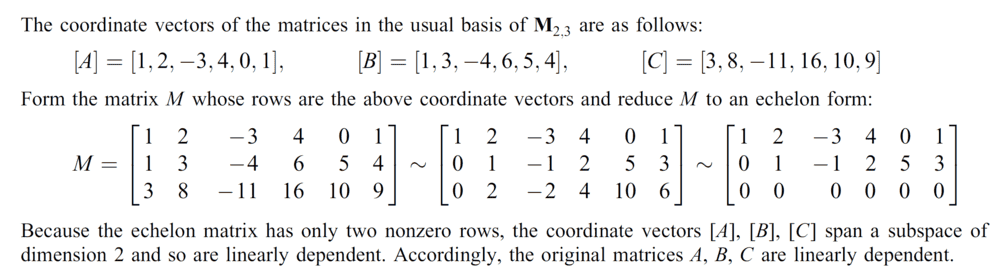
My attempt:
The coordinate vectors of the matrices w.r.t to the standard basis of ## M_2(\mathbb{R}) ## are:
##
\lbrack A \rbrack = \begin{bmatrix}1\\2\\-3\\4\\0\\1 \end{bmatrix} , \lbrack B \rbrack = \begin{bmatrix}1\\3\\-4\\6\\5\\4 \end{bmatrix} , \lbrack C \rbrack = \begin{bmatrix} 3\\8\\-11\\16\\10\\9 \end{bmatrix}
##
Putting these coordinate vectors in a matrix ( representing a homogeneous system of equations ):## \begin{bmatrix}
1 & 1 & 3 & | 0 \\
2 & 3 & 8 & | 0 \\
-3 & -4 & -11 & | 0 \\
4 & 6 & 16 & | 0 \\
0 & 5 & 10 & | 0 \\
1 & 4 & 9 & | 0 \\
\end{bmatrix} ##
After many row operations I get the matrix:
## \begin{bmatrix}
1 & 0 & 0 & | 0 \\
0 & 1 & 0 & | 0 \\
0 & 0 & 1 & | 0 \\
0 & 0 & 0 & | 0 \\
0 & 0 & 0 & | 0 \\
0 & 0 & 0 & | 0 \\
\end{bmatrix} ##
[Moderator's note: moved from a technical forum.]
Clearly we have 3 leading coefficients, three of them in the first 3 rows, therefore the coordinate vectors ## \lbrack A \rbrack , \lbrack B \rbrack , \lbrack C \rbrack ## are linearly independent, therefore the matrices ## A , B , C ## are linearly independent.
Why am I getting a contradiction to the real answer ( that ## A , B , C ## are linearly dependent )? How I could've a-priori known to represent the coordinate vectors as rows?
Is there a connection to column and row spaces?
Question:
Book's Answer:
My attempt:
The coordinate vectors of the matrices w.r.t to the standard basis of ## M_2(\mathbb{R}) ## are:
##
\lbrack A \rbrack = \begin{bmatrix}1\\2\\-3\\4\\0\\1 \end{bmatrix} , \lbrack B \rbrack = \begin{bmatrix}1\\3\\-4\\6\\5\\4 \end{bmatrix} , \lbrack C \rbrack = \begin{bmatrix} 3\\8\\-11\\16\\10\\9 \end{bmatrix}
##
Putting these coordinate vectors in a matrix ( representing a homogeneous system of equations ):## \begin{bmatrix}
1 & 1 & 3 & | 0 \\
2 & 3 & 8 & | 0 \\
-3 & -4 & -11 & | 0 \\
4 & 6 & 16 & | 0 \\
0 & 5 & 10 & | 0 \\
1 & 4 & 9 & | 0 \\
\end{bmatrix} ##
After many row operations I get the matrix:
## \begin{bmatrix}
1 & 0 & 0 & | 0 \\
0 & 1 & 0 & | 0 \\
0 & 0 & 1 & | 0 \\
0 & 0 & 0 & | 0 \\
0 & 0 & 0 & | 0 \\
0 & 0 & 0 & | 0 \\
\end{bmatrix} ##
[Moderator's note: moved from a technical forum.]
Clearly we have 3 leading coefficients, three of them in the first 3 rows, therefore the coordinate vectors ## \lbrack A \rbrack , \lbrack B \rbrack , \lbrack C \rbrack ## are linearly independent, therefore the matrices ## A , B , C ## are linearly independent.
Why am I getting a contradiction to the real answer ( that ## A , B , C ## are linearly dependent )? How I could've a-priori known to represent the coordinate vectors as rows?
Is there a connection to column and row spaces?