What is the output of a logic gate when one input is not connected?

Click For Summary
SUMMARY

The output of a logic gate with one unconnected input can vary based on the logic family used, but it is critical to avoid leaving inputs floating. Floating inputs can lead to unpredictable behavior, increased power consumption, and noise generation, particularly in CMOS gates. To mitigate these issues, always use pull-up or pull-down resistors to ensure stable logic levels. In the context of RS flip-flops, understanding the state changes when a mechanical switch is connected is essential for proper circuit design.

PREREQUISITES
  • Understanding of digital logic concepts
  • Familiarity with logic gate types, specifically OR and NOR gates
  • Knowledge of CMOS technology and its implications
  • Basic circuit design principles, including the use of pull-up and pull-down resistors
NEXT STEPS
  • Research the implications of floating inputs in CMOS logic design
  • Learn about pull-up and pull-down resistor configurations in digital circuits
  • Study the operation and design of RS flip-flops
  • Explore switch debouncing techniques in digital electronics
USEFUL FOR

Students in IT and electronics programs, digital logic designers, and engineers working with CMOS technology will benefit from this discussion.

r731
Messages
40
Reaction score
6
Hello,

I'm currently studying a course in digital logic. The course is included in my IT program. And I have not taken a course in electronics yet; I will later.

My question basically is: what is the output of a logic gate given that one input is neither connected to a high voltage nor connected to ground? (That is, the input is not connected to anything.) And why?
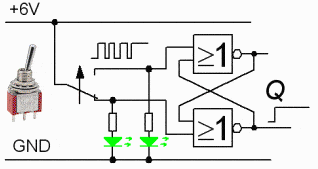
debounceSR_large.gif


Tomorrow I'm having a lab, where I will connect a mechanical switch to a latch.
Thanks in advance.
 
Engineering news on Phys.org
In general case the output will be set at high state or at low state or somewhere between these two states. It all be depend on the logic family you are actually be using. And this is why we should never leave unused inputs floating. And always use a pull-up or pull-down resistors.
 
The power supplies to the logic gates are implicit and so not usually shown. In this case the supplies are assumed to be GND = 0V and +6V. Since four gates, each with two inputs and one output, are all in each package, they can share the two power supply pins. That makes 3*4 + 2 = 14 pins on the IC.

The “>=1” gate is an OR gate, but it has an inverted output, so it is a NOR gate.
The circuit shown is an RS flipflop. If you follow the logic state through the circuit, then flip the switch and watch the new state develop, you will understand why this circuit is called a switch de-bounce circuit.
 
r731 said:
My question basically is: what is the output of a logic gate given that one input is neither connected to a high voltage nor connected to ground? (That is, the input is not connected to anything.) And why

It is generally considered a design error to leave logic inputs floating. Especially with CMOS gates, floating inputs can cause problems with increased power consumption and noise generation. Always tie off unused logic inputs. :smile:
 
The “green” light emitting diodes in the OP diagram may be a problem because they prevent the input voltage being pulled hard down to zero.
If the LEDs are included then there should be another pull-down resistor in parallel with each (Resistor–LED) pair.
 
Most likely this can only be answered by an "old timer". I am making measurements on an uA709 op amp (metal can). I would like to calculate the frequency rolloff curves (I can measure them). I assume the compensation is via the miller effect. To do the calculations I would need to know the gain of the transistors and the effective resistance seen at the compensation terminals, not including the values I put there. Anyone know those values?

Similar threads

  • · Replies 29 ·
Replies
29
Views
4K
  • · Replies 6 ·
Replies
6
Views
3K
  • · Replies 2 ·
Replies
2
Views
8K
  • · Replies 16 ·
Replies
16
Views
4K
  • · Replies 1 ·
Replies
1
Views
1K
Replies
3
Views
3K
  • · Replies 13 ·
Replies
13
Views
2K
  • · Replies 23 ·
Replies
23
Views
5K
  • · Replies 26 ·
Replies
26
Views
17K
  • · Replies 8 ·
Replies
8
Views
6K