[LOGIC] Proof by Induction in Peano Arithmetic

Click For Summary
The discussion revolves around using Peano Arithmetic axioms to prove a statement via induction, specifically addressing the base case of y = S0. The user encounters difficulty in the induction step, questioning the choice of y and whether it should be a successor. Another participant points out that induction is typically used to prove statements for all natural numbers, suggesting that the approach may not be valid beyond the base case. There is also a debate on the formality required for the proof, with a preference for a mathematical rather than logical presentation. The conversation concludes with uncertainty about how to proceed without induction, hinting at the possibility of deriving a contradiction.
Firepanda
Messages
425
Reaction score
0
I have to do the following using these axioms PA1-7, the others below it are previously proved results I can use too.

[Sa] means the successor of a.
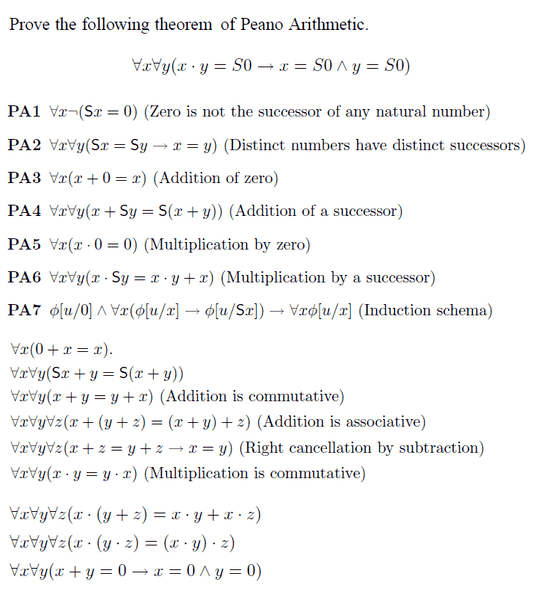
263c5ee.png
Base Case: y = S0

x.S0 = S0

→ x.0 + x = S0

→ 0 + x = S0

→ x = S0 & y=S0

Now the induction step is usually y=a to y=Sa, however this does not work here, I assume I need to take a new y and it's successor to proceed. Would anyone know how to proceed and which y to take?

Thanks
 
Physics news on Phys.org
Firepanda said:
Now the induction step is usually y=a to y=Sa, however this does not work here, I assume I need to take a new y and it's successor to proceed. Would anyone know how to proceed and which y to take?

Why are you inducting here? You usually only use induction when you are trying to show that something is true for all natural numbers. So while your base case holds, any other case you try will fail.

How formally does this proof have to be done. If you are using the Peano axioms, then presumably you are taking a course in mathematical logic or something of the like, so it it alright to write the proof out in ordinary mathematical language?
 
Yeah we are advised to do this proof 'mathematically' rather than 'logically' (i.e not by natural deductions using rules of inference)

Here is an example proof, all the others have been done via the induction schema so I assumed this one was to be done that same way too

155gqcl.png


If not then I have no idea how to do it without induction for those axioms

I agree with what you're saying, it doesn't make sense that this holds for any other case other than S0, but then how do I show this?

Unless I derive some contradiction using PA1, and hence I can derive anything from that contradiction..

Thanks
 
Question: A clock's minute hand has length 4 and its hour hand has length 3. What is the distance between the tips at the moment when it is increasing most rapidly?(Putnam Exam Question) Answer: Making assumption that both the hands moves at constant angular velocities, the answer is ## \sqrt{7} .## But don't you think this assumption is somewhat doubtful and wrong?

Similar threads

  • · Replies 9 ·
Replies
9
Views
2K
  • · Replies 3 ·
Replies
3
Views
1K
Replies
1
Views
1K
Replies
3
Views
2K
  • · Replies 3 ·
Replies
3
Views
2K
  • · Replies 10 ·
Replies
10
Views
943
Replies
2
Views
1K
  • · Replies 1 ·
Replies
1
Views
1K
  • · Replies 2 ·
Replies
2
Views
2K
  • · Replies 19 ·
Replies
19
Views
3K