Undergrad Lyapunov Stability for a nonlinear system

Click For Summary
SUMMARY

This discussion focuses on the Lyapunov stability of nonlinear systems, specifically examining the stability of coupled systems represented by differential equations such as ##\dot{x} = y## and ##\dot{y} = -4x##. The key conclusion is that the local stability of a nonlinear system can be inferred from the eigenvalues of its linearization, provided the eigenvalues do not lie on the imaginary axis. A linear system is asymptotically stable if all eigenvalues have real parts less than zero, while instability occurs if any eigenvalue has a real part greater than zero. The discussion also highlights the utility of the determinant and trace of the matrix in determining stability.

PREREQUISITES
  • Understanding of Lyapunov stability concepts
  • Familiarity with linear systems represented by differential equations
  • Knowledge of eigenvalues and eigenvectors
  • Basic concepts of linear algebra, particularly determinants and traces
NEXT STEPS
  • Study the principle of linearized stability in nonlinear systems
  • Learn how to compute eigenvalues and eigenvectors for matrices
  • Explore the use of the determinant and trace in stability analysis
  • Investigate higher-order normal forms for systems with eigenvalues on the imaginary axis
USEFUL FOR

Mathematicians, control engineers, and students studying dynamical systems who are interested in understanding the stability of nonlinear systems through linearization techniques.

Arman777
Insights Author
Gold Member
Messages
2,163
Reaction score
191
I am trying to understand attracting, Liapunov stable, asymptotically stable for given coupled system. I don't have any Liapunov function. Just two coupled systems such as

##\dot{x} = y##, ##\dot{y} = -4x##

or sometimes normal systems

##\dot{x} = -x##, ##\dot{y} = -5y##
How can I approach to this problem. Do I have to find the eigenvalues and then eigenvectors, write the solution etc or can it be determined just by looking at the eigenvalues ?

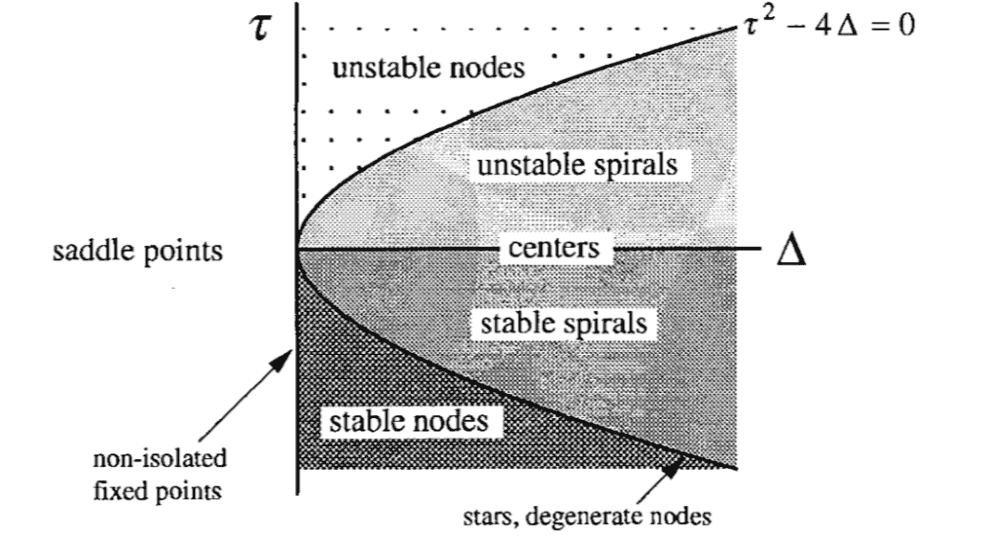
Or is it useful to use this diagram ?
[![enter image description here][1]][1]
I guess it can be determined from
##\lambda_{1,2} = \frac{1}{2} (\tau \pm \sqrt{\tau^2 - 4\Delta})##
##\tau = \lambda_1 + \lambda_2## and ##\Delta = \lambda_1 \lambda_2##

This is a new subject to me so I am kind of confused.
1574177776853.png
 
Physics news on Phys.org
The linear systems you write down are of the form ##\dot{x}(t) = Ax(t)## for some real, constant ##n \times n## matrix ##A##. Given the title of this topic, I assume that these systems arise as linearizations (at a zero equilibrium, for simplicity) of nonlinear autonomous ODEs.

The basic theorem (sometimes known as the "principle of linearized stability") about this situation says that the local (in)stability of the original, nonlinear system can be inferred from the (in)stability of its linearization, provided that ##A## does not have spectrum (eigenvalues) on the imaginary axis.

In turn, a linear system of the form ##\dot{x}(t) = Ax(t)## is asymptotically stable if all eigenvalues have real parts strictly less than zero, and unstable if there is at least one eigenvalue with real part strictly greater than zero. If there are eigenvalues on the imaginary axis, then conclusions from the linear system do not (in general) carry over to the nonlinear system. (In this case, one may proceed to calculate a higher order "normal form".)

The diagram you show is for linear systems in the particular case ##n = 2##. In this case, you can express the eigenvalue pair (and especially the real parts) in terms of the determinant ##\Delta## and trace ##\tau## of ##A##. Some people find the ##(\Delta,\tau)##-plane a useful aid for stability considerations, but I think it is often easier to consider the eigenvalues directly.
 

Similar threads

  • · Replies 3 ·
Replies
3
Views
2K
  • · Replies 9 ·
Replies
9
Views
3K
  • · Replies 2 ·
Replies
2
Views
1K
  • · Replies 2 ·
Replies
2
Views
4K
  • · Replies 5 ·
Replies
5
Views
2K
  • · Replies 4 ·
Replies
4
Views
2K
  • · Replies 7 ·
Replies
7
Views
2K
Replies
2
Views
980
  • · Replies 4 ·
Replies
4
Views
3K
  • · Replies 17 ·
Replies
17
Views
4K