M 6.6 Quake SSW of New Zealand and huge T-phase

  • Thread starter Thread starter davenn
  • Start date Start date
Click For Summary
SUMMARY

The M6.6 earthquake that occurred on July 11, 2017, 198 km NW of Auckland Island, New Zealand, produced a significant T-phase event, the largest recorded by the user's seismic system. The earthquake's depth was 10.0 km, and the T-phase waves arrived approximately 18 minutes after the P wave. T-phase waves travel through the SOFAR channel in the ocean, acting as a waveguide, and are distinct from surface waves, which are responsible for structural damage during earthquakes. This discussion highlights the unique characteristics of T-phase waves and their propagation mechanisms.

PREREQUISITES
  • Understanding of seismic wave types, specifically P, S, and T-phase waves.
  • Familiarity with the SOFAR channel and its role in underwater acoustics.
  • Basic knowledge of seismic recording equipment and geophones.
  • Awareness of earthquake mechanics and their impact on wave propagation.
NEXT STEPS
  • Research the properties and characteristics of T-phase waves in seismic studies.
  • Explore the role of the SOFAR channel in underwater acoustics and its implications for seismic wave propagation.
  • Study the differences between P, S, and surface waves in earthquake dynamics.
  • Investigate the impact of geological features on seismic wave behavior, particularly in coastal regions.
USEFUL FOR

Seismologists, geophysicists, and anyone interested in understanding the complexities of seismic wave propagation and the effects of underwater channels on earthquake signals.

davenn
Science Advisor
Gold Member
Messages
9,715
Reaction score
11,716
hi everyone

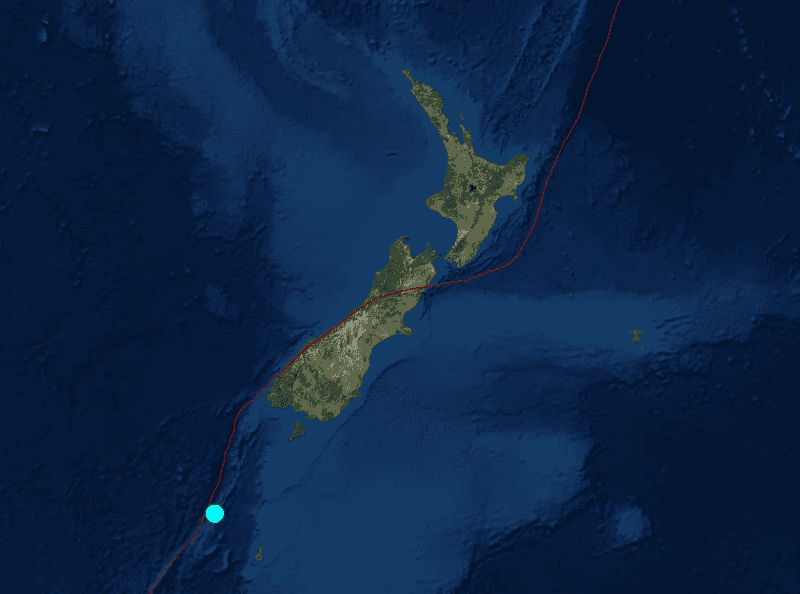
this evening a sizeable and shallow M6.6 quake SSW of the South Is. of NZ has produced
the largest T-phase event I have so far recorded on my seismic system

M 6.6 - 198km NW of Auckland Island, New Zealand

Time: 2017-07-11 07:00:01 (UTC)
Location: 49.546°S 164.031°E
Depth: 10.0 km

Location map
upload_2017-7-11_22-3-38.png


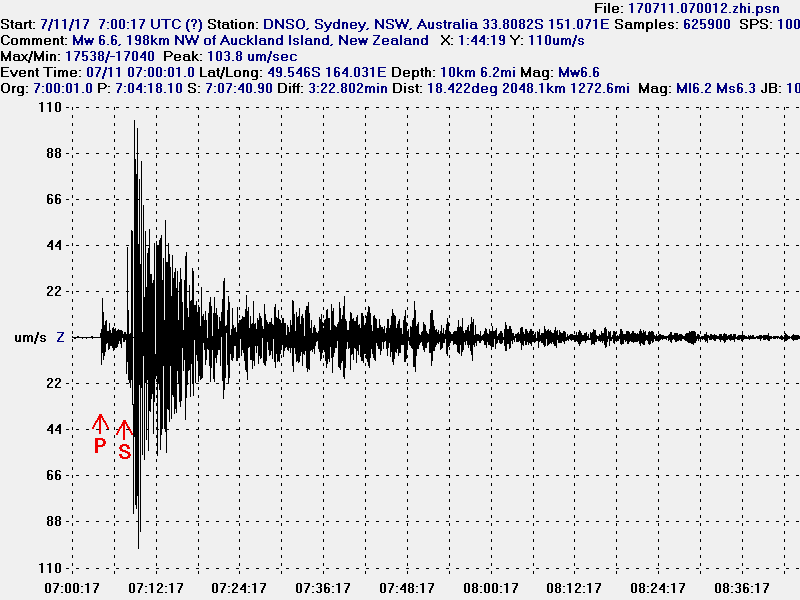
Long period seismogram

170711.070012.zhi.gif


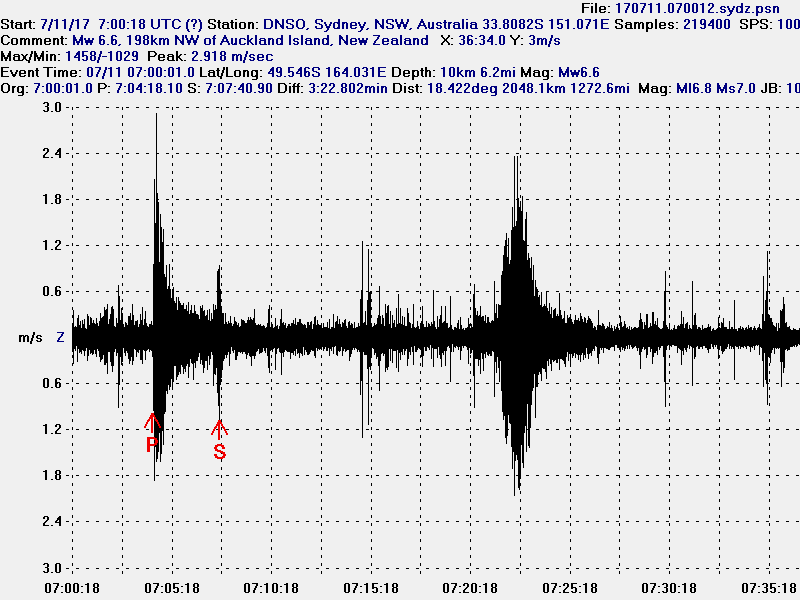
one of the short period sensors, a 4.5 Hz geophone
this shows the labelled P and S wave arrivals followed by the very large amplitude T-phase wave arrival at around 07:22 UT
170711.070012.sydz.gif


I have shared a number of posts showing recordings of T-phase events over recent years
but this one, to coin a phrase, blows all of them out of the water"

As a reminder and also info to new comers to my posts
The T-phase waves are ones that leave the seafloor at a point roughly above the quake focus and
then travel through a deep sea path till, as in this case, they hit the continental shelf offshore of the east coast of Australia and then travel the last ~ 15 km through the ground to my recording equipment.
The T waves travel much slower than the P and S waves and hence the considerable delay in their arrival, in this case, some 18 minutes after the P wave arrival.

Regards
Dave
 
Last edited:
  • Like
Likes   Reactions: 1oldman2 and fresh_42
Earth sciences news on Phys.org
THis is interesting. Do you have a reference for T-waves as in an educational video or article?

T-waves are surface waves right?

I tried to find one but kept turning up only P and S wave demos.

http://www.colorado.edu/physics/phys2900/homepages/Marianne.Hogan/waves.html

and this cool high school teacher video which talks about surface waves:


No hobbits were injured in this earthquake right?
 
hi ya

jedishrfu said:
THis is interesting. Do you have a reference for T-waves as in an educational video or article?

will look up again ... had supplied in posts in days gone bye ... will find them

jedishrfu said:
T-waves are surface waves right?

no, they are waves that travel in the SOFAR Channel at depth in the sea

https://en.wikipedia.org/wiki/SOFAR_channel

here's a thread I did back in 2013 on T-phase events ( there are a couple of others as well)

https://www.physicsforums.com/threads/seismic-t-waves.729045/

jedishrfu said:
No hobbits were injured in this earthquake right?

nope :smile: well out in the southern oceanDave
 
Last edited:
Wow, the I didn't know the SOFAR could be the channel of earthquake waves but of course it makes sense since they are acoustic.
 
  • Like
Likes   Reactions: davenn
Does the SOFAR collect and amplify the T signal?

Does this then cause greater surface damage?
 
jedishrfu said:
Wow, the I didn't know the SOFAR could be the channel of earthquake waves but of course it makes sense since they are acoustic.

yes, an interesting condition. I personally only became aware of T-phase waves around 5 years ago when I first started seeing these burst of signal arriving on the seismo short period sensors well after the P, S and surface waves had arrived. It was with discussions with fellow amateur seismologists that we discovered the existence of T-phase waves.

jedishrfu said:
Does the SOFAR collect and amplify the T signal?

The T waves start as the P wave, at the focus of the quake, which is a longitudinal compressional wave ( same as sound) at the seafloor water boundary, they then propagate as a sound wave in water within the SOFAR channel that just acts as a waveguide, like a RF microwave waveguide. Actually a better analogy would be an atmospheric ducting waveguide that happens along coast lines and can produce low attenuation paths for ~ 100 MHz and up.
Once the T waves hit the continental shelf, they again become P waves and their speed has been observed to increase.

from WIKI...
Tropospheric ducting of radio and television signals is relatively common during the summer and autumn months, and is the result of change in the refractive index of the atmosphere at the boundary between air masses of different temperatures and humidity's. Using an analogy, it can be said that the denser air at ground level slows the wave front a little more than does the rare upper air, imparting a downward curve to the wave travel.

Ducting can occur on a very large scale when a large mass of cold air is overrun by warm air. This is termed a temperature inversion, and the boundary between the two air masses may extend for 1,000 miles (1,600 km) or more along a stationary weather front.

Temperature inversions occur most frequently along coastal areas bordering large bodies of water. This is the result of natural onshore movement of cool, humid air shortly after sunset when the ground air cools more quickly than the upper air layers. The same action may take place in the morning when the rising sun warms the upper layers.

From what I am aware, the SOFAR channel is produced by similar processes within the ocean ... differing layers of water temperature and density.

I am not sure if "collect" is the right word ( maybe it is) but if the sound waves in the water enter the channel at the correct angle, they will get trapped in the channel and propagated at reasonably low attenuation

Amplified, no, I don't see a mechanism that would cause that. Just lower attenuation than compared through the ground path

jedishrfu said:
Does this then cause greater surface damage?

no, because of their overall small amplitude, I doubt that they would cause any damage, probably wouldn't even be felt.
It's the surface waves of an earthquake that causes the damage. Their low frequency and rolling motions is what buildings cannot handle.

cheers
Dave
 
Last edited:
A location / info diagram

distance of quake from me 2000km
T-waves have been recorded from quakes on the South Island of NZ and on the coast on the west side and to the south
I have never ( as yet) seen T waves from earthquakes in the Kermadecs, Tongan and up into the Fiji region ( all north of the North Island of New Zealand).
Discussions with others has at this time have surmised that the seafloor ridge extending NW 'ward from the west coast of NZ may be blocking the SOFAR channel

T-phase info.JPG
 

Similar threads

  • · Replies 1 ·
Replies
1
Views
2K
  • · Replies 8 ·
Replies
8
Views
3K
  • · Replies 2 ·
Replies
2
Views
4K
Replies
9
Views
5K
  • · Replies 7 ·
Replies
7
Views
8K
  • · Replies 6 ·
Replies
6
Views
6K
  • · Replies 21 ·
Replies
21
Views
4K
  • · Replies 1 ·
Replies
1
Views
2K