M 7.1 just offshore NE Nth Isl, New Zealand

  • Thread starter Thread starter davenn
  • Start date Start date
Click For Summary

Discussion Overview

The discussion centers on the M7.1 earthquake that struck just offshore of the East Cape of New Zealand on September 2, 2016. Participants explore the seismic event's characteristics, its potential causes, and the implications of tsunami warnings issued in response. The conversation includes technical details about the earthquake's depth, aftershocks, and comparisons to other seismic activities in the region.

Discussion Character

  • Exploratory
  • Technical explanation
  • Debate/contested
  • Experimental/applied

Main Points Raised

  • Some participants note that the earthquake was preceded by a M5.8 quake, suggesting a possible connection between the two events.
  • There are concerns regarding the timing of the tsunami warning issued by the Ministry of Civil Defence & Emergency Management, which was delayed by 80 minutes after the quake.
  • One participant describes the earthquake's characteristics, suggesting it may have involved oblique-normal faulting near the Pacific and Australian plate boundary.
  • Another participant mentions that the USGS has indicated the earthquake is likely an intraplate event within the subducting Pacific slab rather than an interplate thrust earthquake.
  • Participants discuss the likelihood of aftershocks continuing for up to two years, with expectations of diminishing magnitude and frequency over time.
  • There is mention of a potential for a stronger earthquake greater than magnitude 8 in the region, although this remains speculative.

Areas of Agreement / Disagreement

Participants express a range of views regarding the earthquake's characteristics and implications, with no clear consensus on the causes or the adequacy of the tsunami warning response. The discussion remains unresolved on several technical aspects.

Contextual Notes

Some participants reference the depth and focal mechanisms of the earthquakes, indicating that initial reports may have changed. There are also mentions of the limitations of current understanding regarding aftershock patterns and the potential for future seismic activity.

davenn
Science Advisor
Gold Member
Messages
9,724
Reaction score
11,804
People across the North Island of NZ and areas across the nthrn half of the South Island had a shaky awakening this morning at 04:37 NZST, Fri 02 Sept 2016, 16:37 UT, 01 Sept 2016.

The M7.1 struck just off shore of the East Cape of NZ . A tsunami warning was issued but was soon cancelled. This event was preceeded by a M 5.8 on Thursday morning
http://www.sydneystormcity.com/seismograms.htm

http://earthquake.usgs.gov/earthquakes/eventpage/us10006jbi#executive
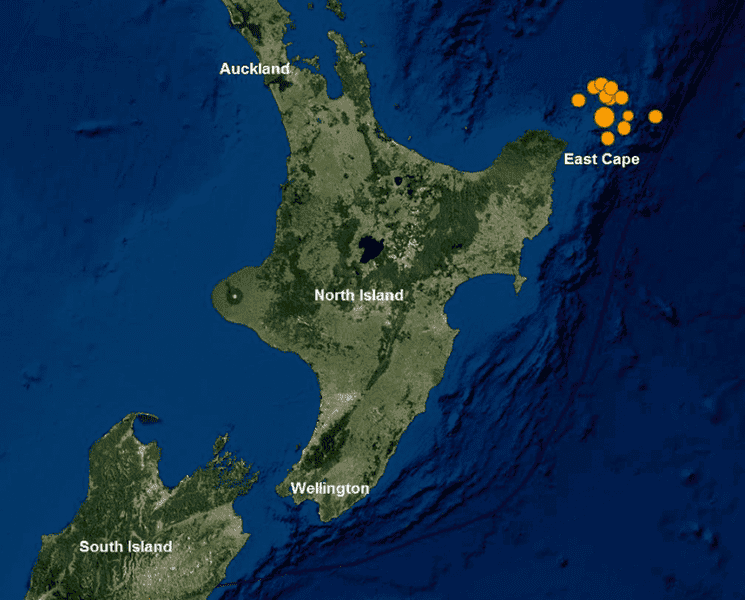
upload_2016-9-2_7-55-44.png


This event is likely the result of the subduction of the Pacific Plate seafloor under the Australian plate.
The plate boundary is roughly defined by the red line on the above mapcheers
Dave
 
Last edited:
  • Like
Likes   Reactions: 1oldman2
Earth sciences news on Phys.org
Was woken up by this earthquake, living at the bottom of the North Island.

Concerning, though:
The Ministry of Civil Defence & Emergency Management's request for the broadcasting of a tsunami warning was not sent out until 80 minutes after the quake. By then the main tsunami wave - measuring 30cm - had already hit sections of the east coast.
http://www.stuff.co.nz/national/838...ct-quickly-enough-to-todays-severe-earthquake

http://www.stuff.co.nz/national/838...s-tvs-and-pictures-flying-people-to-the-hills
 
  • Like
Likes   Reactions: davenn
That's pretty shocking huh !

At your distance, I would have expected a real good rolling motion
 
davenn said:
The M7.1 struck just off shore of the East Cape of NZ . A tsunami warning was issued but was soon cancelled. This event was preceeded by a M 5.8 on Thursday morning
I noticed the 5.8 Mag yesterday, and I was wondering if something might follow it.

M5.8 - 188km NNE of Gisborne, New Zealand
http://earthquake.usgs.gov/earthquakes/eventpage/us10006j5q#executive
2016-08-31 22:04:35 UTC
37.208°S, 179.125°E
22.4 km depth

USGS puts the 7.1 Mag at a depth of 19 km.

Tonga, Vanuatu and New Guinea have some 5+ mag earthquakes, and there was a 6.7 mag off New Guinea coast
M6.7 - 39km E of Namatanai, Papua New Guinea
http://earthquake.usgs.gov/earthquakes/eventpage/us10006iy0#executive
2016-08-31 03:11:36 UTC
3.691°S, 152.788°E
499.1 km depth
 
Astronuc said:
USGS puts the 7.1 Mag at a depth of 19 km.

I see they have changed it ... they did have it a bit deeper initially

Astronuc said:
and there was a 6.7 mag off New Guinea coast
M6.7 - 39km E of Namatanai, Papua New Guinea

recorded that one quite well between a couple of failures of my recording system. The data logger fed into the PC via the RS232 port which failed a couple of days ago. Really weird symptoms ( mouse just moving randomly over the screen opening various windows etc) causing me to initially not suspect the com port.
Unplugging the datalogger stopped the problem. Installed a USB to RS232 adaptor and relabelled RS232 to COM10 and the adaptor to COM 1 and all go again.

The 6.7 showed an almost perfect thrust focal mechanism, with just a hint of oblique slip.

upload_2016-9-2_12-15-53.png
Today's 7.1 NZ event, I initially thought may have been the same style ( as I commented in my first post).
The USGS are saying it's more likely an event within the subducting slab, rather than on the interplate boundary zone

upload_2016-9-2_12-19-57.png


Tectonic Summary
The September 1, 2016 M 7.1 earthquake northeast of Gisborne, New Zealand occurred as the result of shallow oblique-normal faulting near the plate boundary between the Pacific and Australia plates. Preliminary focal mechanism solutions indicate oblique rupture occurred on either a steep dipping, southwest striking normal fault, or on a shallow dipping, north-northeast striking fault. The Pacific plate begins its westward subduction beneath the Australia plate at the Kermadec and Hikurangi trenches, 65 km to the east of this event, with a velocity of about 47 mm/yr. The depth, location and focal mechanism of the earthquake all indicate this is most likely an intraplate event within the subducting Pacific slab, rather than being an interplate thrust earthquake on the overlying subduction zone interface.
Dave
 
Last edited:
StevieTNZ said:

Yeah, a M 5.7 GNS ( 5.8 USGS) is a respectable quake in its own right
Yup, aftershocks will continue for quite some time, dropping off in both magnitude and numbers.
Pretty common with large and shallow events ... aka the 7.1 west of Christchurch and the closer to the city ones.
5 - 6 years later the event number is still well above background seismicity levelsDave
 

Similar threads

  • · Replies 6 ·
Replies
6
Views
4K
  • · Replies 2 ·
Replies
2
Views
3K