guay
- 9
- 0
Magnet dropped down a copper tube experiment (magnetic braking?)
Experiment: what is the effect of the # of magnets on the time of drop through the pipe?
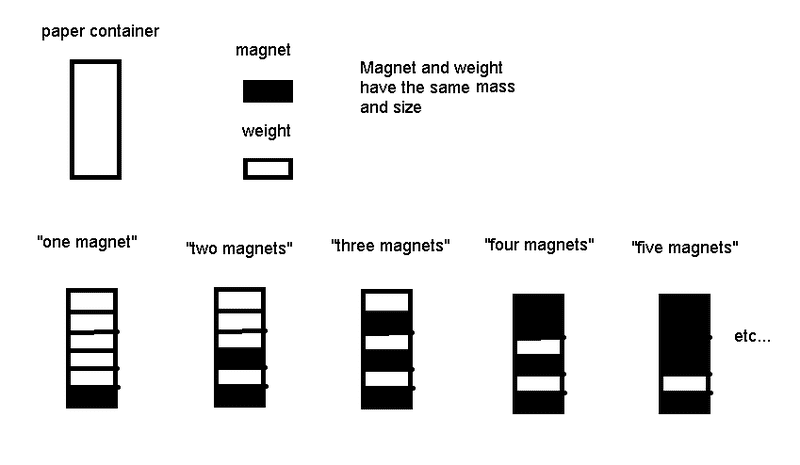
Magnets are placed in a paper cylinder container
- "one magnet" is 1 magnet and 5 weights (mass of 1 magnet and 1 weight is equal)
- "two magnets" is 1 magnet, 1 weight, 1 magnet, 3 weights etc...
See picture
Not too sure since we didn't learn the magnetism unit, but I suppose some standard kinematics equations might be useful.
Some research that I did...
Faraday's law: a change in magnetic flux induces a current in a loop of conducting material
Lenz's law: the induced current flows so that it opposes the change in magnetic flux by creating its own magnetic field
Oersted's law: when electricity passes through a wire, it produces magnetism
Motor principle: when a current-carrying conductor is located in an external magnetic field perpendicular to the conductor, the conductor experiences a force perpendicular to itself and to the external magnetic field
Eddy current: electric currents induced within conductors by a changing magnetic field in the conductor
Magnetic braking: When a magnet is dropped down a conducting pipe, eddy currents are induced in the pipe, and these retard the descent of the magnet
Another topic relevant IMO is the relationship of ferromagnetic pipes vs non-ferromagnetic pipes.
My explanation:
When a magnet moves down the copper pipe it creates a current in the copper, this current creates a magnetic field that pulls on the magnet as it moves, this is b/c the magnetic field is generated to keep the flux from changing.
Update: due to Oersted's principle, when a charge moves through a wire, it sets up a magnetic field, which is in Concentric loops around the wire, in turn Faraday's law states that an emf is induced around the current carrying loop, that is like a conductor. If there is a change in flux, Lenz's Law tells us that the induced current produces a magnetic field which opposes the change in flux. The reason why the magnet goes down slowly is a results of the eddy currents that are produced due to Lenz's law and this process is known as magnetic braking.
----------------------------------------------------------------------------------------------
My hypothesis is that an increase in # of magnets will cause an increase in time of drop. However, my explanation for this is a bit hazy as I am having a bit of trouble connecting all the laws. Please help me explain this phenomenon and check if my understanding is correct thus far. Also, will something cool happen at "four magnets" (see pic)? Since 2 magnets will be touching. Will that cause a change in magnetism? Will there be a steep rise on the # vs time graph?
Anyway, I will be doing the actual experiment tomorrow and will update with results and new findings. Thank you for your help!
Homework Statement
Experiment: what is the effect of the # of magnets on the time of drop through the pipe?
Magnets are placed in a paper cylinder container
- "one magnet" is 1 magnet and 5 weights (mass of 1 magnet and 1 weight is equal)
- "two magnets" is 1 magnet, 1 weight, 1 magnet, 3 weights etc...
See picture
Homework Equations
Not too sure since we didn't learn the magnetism unit, but I suppose some standard kinematics equations might be useful.
The Attempt at a Solution
Some research that I did...
Faraday's law: a change in magnetic flux induces a current in a loop of conducting material
Lenz's law: the induced current flows so that it opposes the change in magnetic flux by creating its own magnetic field
Oersted's law: when electricity passes through a wire, it produces magnetism
Motor principle: when a current-carrying conductor is located in an external magnetic field perpendicular to the conductor, the conductor experiences a force perpendicular to itself and to the external magnetic field
Eddy current: electric currents induced within conductors by a changing magnetic field in the conductor
Magnetic braking: When a magnet is dropped down a conducting pipe, eddy currents are induced in the pipe, and these retard the descent of the magnet
Another topic relevant IMO is the relationship of ferromagnetic pipes vs non-ferromagnetic pipes.
My explanation:
When a magnet moves down the copper pipe it creates a current in the copper, this current creates a magnetic field that pulls on the magnet as it moves, this is b/c the magnetic field is generated to keep the flux from changing.
Update: due to Oersted's principle, when a charge moves through a wire, it sets up a magnetic field, which is in Concentric loops around the wire, in turn Faraday's law states that an emf is induced around the current carrying loop, that is like a conductor. If there is a change in flux, Lenz's Law tells us that the induced current produces a magnetic field which opposes the change in flux. The reason why the magnet goes down slowly is a results of the eddy currents that are produced due to Lenz's law and this process is known as magnetic braking.
----------------------------------------------------------------------------------------------
My hypothesis is that an increase in # of magnets will cause an increase in time of drop. However, my explanation for this is a bit hazy as I am having a bit of trouble connecting all the laws. Please help me explain this phenomenon and check if my understanding is correct thus far. Also, will something cool happen at "four magnets" (see pic)? Since 2 magnets will be touching. Will that cause a change in magnetism? Will there be a steep rise on the # vs time graph?
Anyway, I will be doing the actual experiment tomorrow and will update with results and new findings. Thank you for your help!
Last edited: