Magnetic Dipole Field from a Loop of Wire

Click For Summary
SUMMARY

The discussion focuses on understanding the magnetic dipole field generated by a loop of wire, specifically analyzing the equation β = ∇xA = (m / (4⋅π⋅R³)) ⋅ (2⋅cos(θ) r + sin(θ) θ). The user expresses confusion regarding the orientation of the field lines, noting a perceived 90-degree shift in the expected behavior of the magnetic field as θ varies. Key insights reveal that the user must consider the geometry of the loop and the distinction between plotting magnetic field lines versus the magnetic field strength. The conversation emphasizes the importance of accurately modeling the magnetic field in relation to the loop's geometry.

PREREQUISITES
  • Understanding of magnetic dipole theory
  • Familiarity with vector calculus, specifically curl operations
  • Proficiency in MATLAB for plotting magnetic fields
  • Knowledge of magnetic field line representation and density concepts
NEXT STEPS
  • Explore the derivation of the magnetic dipole field from a finite loop of wire
  • Learn how to visualize magnetic fields using MATLAB
  • Study the differences between magnetic field lines and magnetic field strength
  • Investigate the impact of loop geometry on magnetic field distribution
USEFUL FOR

Physicists, electrical engineers, and students studying electromagnetism who seek to deepen their understanding of magnetic fields generated by current-carrying loops.

bcerge1
Messages
3
Reaction score
0
I am trying to understand the magnetic dipole field via loop of wire.
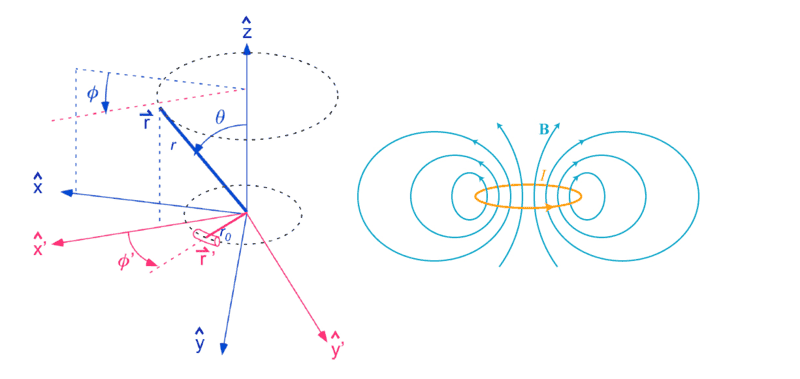
coord.PNG


The above pictures show how this problem is typically setup and how the field lines are typically shown.
The math is messy but every textbook yields the following:

β = ∇xA = (m / (4⋅π⋅R3)) ⋅ (2⋅cos(θ) r + sin(θ) θ)

The issue I am having is seeing how the above equation yields the field lines from the above picture.
If θ is referenced from the Z axis, and the loop of wire is on the X-Y axis, in my mind the field lines are 90 degrees shifted. In other words, when θ=0, the radial component is at it's max straight up the Z-axis, and as θ approaches π/2 the radial component approaches 0. The above picture shows that β is max at π/2 and not 0. In Matlab I plotted a few different Radii for all θ = 0 to 2π and Φ=0:
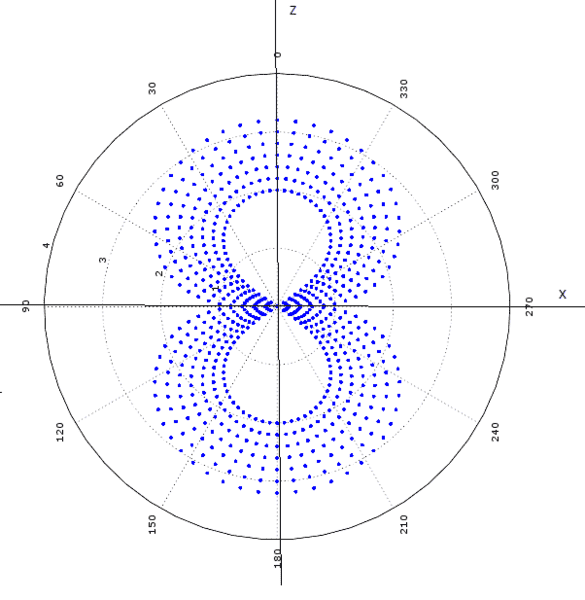
Polar  Plot.PNG


This picture is 90 degrees shifted from how I think it should be. Can someone help me understand this? Why does the equation not align up with the way the typical picture is shown? Am I incorrect in assuming the Z-axis is perpendicular to loop? Am i missing something? Am i not even close? D:

 
Physics news on Phys.org
Hello bc, :welcome:
bcerge1 said:
I plotted a few different Radii
What are Radii ? If I connect the dots in one way, I get the field lines from the picture at the top right (*). Perpendicular to those are the lines of constant |B| .

(*) but that picture has a non-zero size loop, the picture you made is for an infinitesimally small loop.
 
If i understand the equation correctly, the magnitude of the equation is the m / (4⋅π⋅R3). the R is the distance from the wire to the point of the B field being measured. I suppose its not technically a 'radius', rather a distance. The plot i created was for 7 different R values for θ = 0 to 2π.

I think where I am going wrong is trying to visualize the field coming the origin (infinitesimally small point at (0,0,0)) and not from a point on the wire. In other words, i might need to model the equation to include the geometry of the loop?
 
The strength of B is how tightly packed the magnetic flux lines are (density of the flux), rather than distance from the origin. So at pi/2, the lines are spaced far apart, while at 0 they are more dense.
 
So is plotting the magnetic field lines (upper right hand corner picture) different than plotting the B field?
 
Plotting the B field can be done two ways: follow the field lines (that's the usual way) or connect points with the same field strength.
 

Similar threads

  • · Replies 28 ·
Replies
28
Views
3K
  • · Replies 1 ·
Replies
1
Views
2K
  • · Replies 16 ·
Replies
16
Views
2K
  • · Replies 2 ·
Replies
2
Views
16K
  • · Replies 5 ·
Replies
5
Views
2K
  • · Replies 2 ·
Replies
2
Views
2K
  • · Replies 1 ·
Replies
1
Views
1K
  • · Replies 10 ·
Replies
10
Views
1K
  • · Replies 5 ·
Replies
5
Views
2K
  • · Replies 8 ·
Replies
8
Views
2K