Ampere's Law For Static Magnetic Field

  • Context: Undergrad 
  • Thread starter Thread starter BlackMelon
  • Start date Start date
  • Tags Tags
    Ampere's law Curl
BlackMelon
Messages
43
Reaction score
7
Hi there!

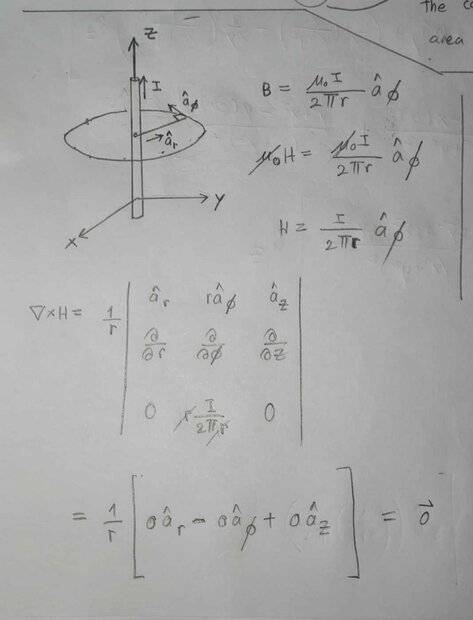
Please refer to the picture below. I would like to understand the equation Curl(H) = J, where H is the magnetic field intensity and J is the current density. So, I inspect a simple problem.
There is a wire carrying current I in the z-axis direction. a_r, a_phi, and a_z are the unit vectors in the directions of the radius, the tangential line, and z-axis, respectively.

So, from H = I/(2*pi*r)a_phi. I take the curl of this vector (in cylindrical coordinate) and got 0. How does this relate to the current density?

Best
BlackMelon
1695964252946.jpeg
 
Physics news on Phys.org
The field you've written down is the field outside a current carrying wire. What would you expect for the current density outside a wire?
 
Ibix said:
The field you've written down is the field outside a current carrying wire. What would you expect for the current density outside a wire?
Oh well it's zero. That was the silly of me LOL. Thank you very much.

By the way, I have analyzed the inside of the wire H = I*r/(2*pi*R^2) a_phi.
where r is the radius from the center of the wire to the point of interest. R is the radius of the wire. And got the correct answer:
J = curl (H) = I/(pi*R^2) a_z

1695975871845.png
 
  • Like
Likes   Reactions: Dale and Ibix
Adding more information to my previous comment, here is how I calculate the current density inside the wire using curl(H) = J
1696130017446.png
 
  • Like
Likes   Reactions: Dale
The solution in local form is indeed given by using the magnetostatic Maxwell equations as follows:
$$\vec{\nabla} \cdot \vec{B}=0, \quad \vec{\nabla} \times \vec{B}=\mu_0 \vec{j}.$$
We have given
$$\vec{j}=\begin{cases}\frac{I}{\pi R^2} \vec{e}_z &\text{for} \quad \rho \leq R \\ 0 &\text{for} \quad \rho>R. \end{cases}$$
To solve this equations it's most simple to make the ansatz
$$\vec{B}=B(\rho) \vec{e}_{\varphi}.$$
Using the formula for the curl in cylinder coordinates you get
$$\vec{\nabla} \times \vec{B}=\frac{1}{\rho} \partial_{\rho} (\rho B) \vec{e}_z.$$
From this you get for ##\rho<R:##
$$\partial_{\rho} (\rho B)=\frac{\mu_0 I}{\pi R^2} \rho.$$
This can be immediately integrated to
$$B(\rho)=\frac{\mu_0 I}{2 \pi R^2}\rho + \frac{C}{\rho},$$
where ##C## is an integration constant. Since there's no singularity at ##\rho=0##, you get ##C=0##, i.e.,
$$B(\rho)=\frac{\mu_0 I}{2 \pi R^2}\rho \quad \text{for} \quad \rho<R.$$
For ##\rho \geq R## you have
$$\partial_{\rho} (\rho B)=0 \; \rightarrow \; B=\frac{B_0}{\rho} \quad \text{with} \quad B_0=\text{const}.$$
Now, at ##\rho=R##, ##B## must be continuous, which gives
$$B(\rho)=\frac{\mu_0 I}{2 \pi \rho} \quad \text{for} \quad \rho \geq R.$$
One should also check that ##\vec{\nabla} \cdot \vec{B}=0##, which however is already seen easily to be fufilled by the initial general ansatz.
 
  • Like
Likes   Reactions: BlackMelon
vanhees71 said:
The solution in local form is indeed given by using the magnetostatic Maxwell equations as follows:
$$\vec{\nabla} \cdot \vec{B}=0, \quad \vec{\nabla} \times \vec{B}=\mu_0 \vec{j}.$$
We have given
$$\vec{j}=\begin{cases}\frac{I}{\pi R^2} \vec{e}_z &\text{for} \quad \rho \leq R \\ 0 &\text{for} \quad \rho>R. \end{cases}$$
To solve this equations it's most simple to make the ansatz
$$\vec{B}=B(\rho) \vec{e}_{\varphi}.$$
Using the formula for the curl in cylinder coordinates you get
$$\vec{\nabla} \times \vec{B}=\frac{1}{\rho} \partial_{\rho} (\rho B) \vec{e}_z.$$
From this you get for ##\rho<R:##
$$\partial_{\rho} (\rho B)=\frac{\mu_0 I}{\pi R^2} \rho.$$
This can be immediately integrated to
$$B(\rho)=\frac{\mu_0 I}{2 \pi R^2}\rho + \frac{C}{\rho},$$
where ##C## is an integration constant. Since there's no singularity at ##\rho=0##, you get ##C=0##, i.e.,
$$B(\rho)=\frac{\mu_0 I}{2 \pi R^2}\rho \quad \text{for} \quad \rho<R.$$
For ##\rho \geq R## you have
$$\partial_{\rho} (\rho B)=0 \; \rightarrow \; B=\frac{B_0}{\rho} \quad \text{with} \quad B_0=\text{const}.$$
Now, at ##\rho=R##, ##B## must be continuous, which gives
$$B(\rho)=\frac{\mu_0 I}{2 \pi \rho} \quad \text{for} \quad \rho \geq R.$$
One should also check that ##\vec{\nabla} \cdot \vec{B}=0##, which however is already seen easily to be fufilled by the initial general ansatz.
Thank you very much for the explanation :)
 

Similar threads

  • · Replies 3 ·
Replies
3
Views
1K
Replies
8
Views
2K
  • · Replies 15 ·
Replies
15
Views
3K
  • · Replies 14 ·
Replies
14
Views
3K
  • · Replies 3 ·
Replies
3
Views
2K
  • · Replies 13 ·
Replies
13
Views
2K
  • · Replies 27 ·
Replies
27
Views
3K
  • · Replies 23 ·
Replies
23
Views
3K
  • · Replies 2 ·
Replies
2
Views
2K
  • · Replies 0 ·
Replies
0
Views
2K