SUMMARY
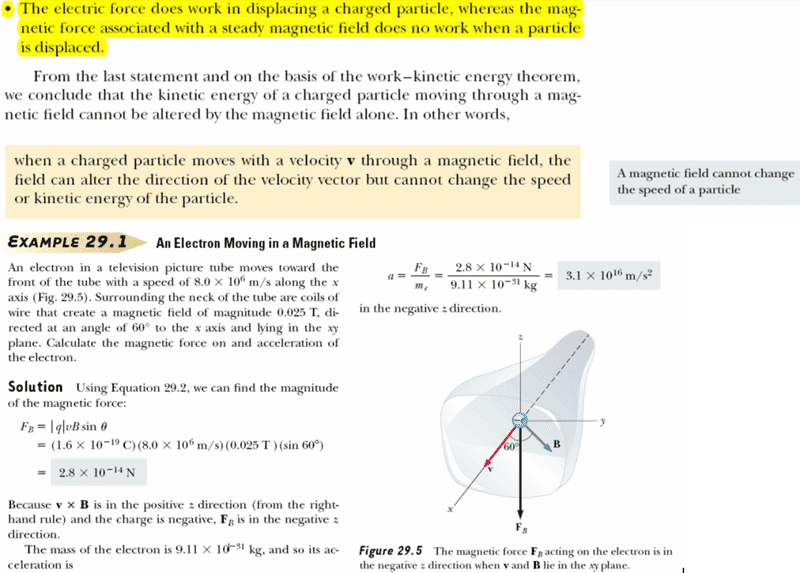
The discussion centers on the behavior of an electron in a magnetic field, specifically regarding its acceleration and speed. It is established that while the electron's velocity changes due to acceleration in the negative z direction, its speed remains constant because the force acting on it is always perpendicular to its direction of motion. Consequently, the kinetic energy (KE) of the electron does not increase, as indicated by the work-energy principle where the angle theta is π/2, resulting in zero work done.
PREREQUISITES
- Understanding of classical mechanics principles, particularly Newton's laws of motion.
- Familiarity with electromagnetic theory, specifically the Lorentz force law.
- Knowledge of vector components and their implications in motion.
- Basic grasp of kinetic energy and work-energy theorem.
NEXT STEPS
- Study the Lorentz force law and its applications in particle motion.
- Explore the concept of centripetal acceleration in magnetic fields.
- Learn about the relationship between work, force, and energy in physics.
- Investigate the effects of magnetic fields on charged particles in different contexts.
USEFUL FOR
Physics students, educators, and professionals in fields related to electromagnetism and particle dynamics will benefit from this discussion.