Magnetic field from rectangular current loop

Click For Summary

Homework Help Overview

The discussion revolves around calculating the magnetic field produced at a specific point by a rectangular current loop, focusing on the application of the Biot-Savart law. Participants are attempting to understand the contributions of each segment of the loop to the total magnetic field at the center of the rectangle.

Discussion Character

  • Exploratory, Mathematical reasoning, Assumption checking

Approaches and Questions Raised

  • Participants discuss dividing the loop into segments and calculating the magnetic field contributions from each segment. There are mentions of integrating the contributions and using the right-hand rule to determine the direction of the magnetic field. Some participants express confusion about the integration process and seek clarification on the setup.

Discussion Status

The discussion is ongoing, with participants sharing their attempts and seeking further guidance. Some have provided partial calculations and insights, while others express frustration and request additional resources or assistance. There is a mix of approaches being explored, but no consensus has been reached on a definitive method or solution.

Contextual Notes

Participants note the complexity of the problem and the need for calculus to integrate the magnetic field contributions. There are references to specific assumptions about the geometry of the loop and the behavior of the magnetic field at point P, as well as the challenge of finding similar problems in textbooks.

ovoleg
Messages
93
Reaction score
0
Another doozie for me. I have been trying this one for 3 days now. I will give my first born for help to this one :rolleyes:
---------------
Calculate the magnitude and direction of the magnetic field produced at point P in Fig. 28.52 by the current I in the rectangular loop. (Point P is at the center of the rectangle.) (Hint: The gap on the left-hand side where the wires enter and leave the rectangle is so small that this side of the rectangle can be taken to be a continuous wire with length b.)
Diagram
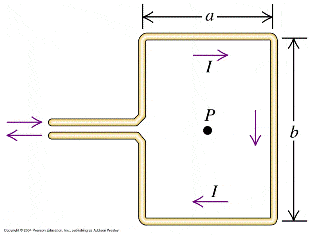
38649?db=v4net.gif

-----------

I am using law of Biot and Savart(dB=(mu*I*dl x r)/(4pi*r^2))

I took the lines into four parts and started calculating what the magnetic field parts would be and then summ'ed them as by right hand rule the field will be into the page.

B1 is the left side, B2 is the top, B3 is the right and B4 is the bottom.

B3=B1=Mu*I*b/(Pi*a*sqrt(a^2+b^2))
B4=B2=Mu*I*a/(pi*b*sqrt(a^2+b^2))

Btotal=B4+B3+B2+B1=2Mu*I*b/(Pi*a*sqrt(a^2+b^2))+2Mu*I*a/(pi*b*sqrt(a^2+b^2))

Can anyone please help me?
 
Last edited by a moderator:
Physics news on Phys.org
ovoleg said:
Another doozie for me. I have been trying this one for 3 days now. I will give my first born for help to this one :rolleyes:
---------------
Calculate the magnitude and direction of the magnetic field produced at point P in Fig. 28.52 by the current I in the rectangular loop. (Point P is at the center of the rectangle.) (Hint: The gap on the left-hand side where the wires enter and leave the rectangle is so small that this side of the rectangle can be taken to be a continuous wire with length b.)
Diagram
38649?db=v4net.gif

-----------

I am using law of Biot and Savart(dB=(mu*I*dl x r)/(4pi*r^2))

I took the lines into four parts and started calculating what the magnetic field parts would be and then summ'ed them as by right hand rule the field will be into the page.

B1 is the left side, B2 is the top, B3 is the right and B4 is the bottom.

B3=B1=Mu*I*b/(Pi*a*sqrt(a^2+b^2))
B4=B2=Mu*I*a/(pi*b*sqrt(a^2+b^2))

Btotal=B4+B3+B2+B1=2Mu*I*b/(Pi*a*sqrt(a^2+b^2))+2Mu*I*a/(pi*b*sqrt(a^2+b^2))

Can anyone please help me?
You must *integrate* over the infinitesimal B fields produced by each little section of the wires. There is no wayto avoid using calculus here. Unfortunately I have to leave..hopefully someone will guide you through this
 
Last edited by a moderator:
I can only pray :(

I tried integrating along that wire.

Thanks anyone who can assist :)

Remember newborn might be ugly but he will work like a slave!
 
What about this?

B1=mu*I*a/8*pi*Integral[ dy/((a/2)^2+y^2)^(3/2) ] from 0 to b

b1=b3=mu*I*b/(pi*a*sqrt(a^2+4b^2))

b2=b4 = mu*I*b/8pi*Integral[ dy/((a/2)^2+y^2)^(3/2) ] from 0 to a

b1+b2+b3+b4 = (2*mu_0*b)/(pi*a*sqrt(a^2+4b^2))+(2*mu_0*a)/(pi*b*sqrt(4a^2+b^2))

Anyone? I've looked through four physics books and I can't find a problem similar to this. The only thing I find is the one about the circle but the distance from point P is always the same(radius) so it doesn't help me one bit.

Extra love to anyone who can help :) must try to get done by tommorow afternoon
 
Last edited:
Anyone? :)
 
At this point I give up, anyone know an online resource I can find that will tell me the magnetic field generated by diffent types of loops?
 
I tried (2*mu_0*b)/(pi*a*sqrt(a^2+4b^2)) and (2*mu_0*a)/(pi*b*sqrt(4a^2+b^2)) separately and they do not work

Anyone able to help out?
 
Alrighty I got it! I am ummm, :zzz: :zzz: now but I got it done...

Okay for anyone that might have this come up again.

This is how you would do it.

1. First take each line as a segment and calculate the field from that line individually.

Using dB=mu*I*dl x r/(4pi*r^2) we can calculate this value

dB= mu*I*dl*sin(theta)/(4pi*r^2)

sin(theta) = x/(sqrt(x^2+y^2) (depending on the orientation then it obviously varies what you use for x, I just switches the axis around to make the problem simpler but you could definitely have a defined axis and then proceed with the integration).

Since we can use the law of superposition in magnetism and magnetic fields, we calculate each on individually.

So evaluating the top and bottom bar with length a we will get

integral(dB)= mu*I*b/8pi * Integral( ((b/2)^2+y^2)^(3/2) from -a/2 to a/2)

evaluating the right hand integral we will get

B=mu*a/(b*pi*sqrt(a^2+b^2)) Remember b and I are constant in this integral so we take that outside of the integral.

B2=B4 = mu*a/(b*pi*sqrt(a^2+b^2))

Follow the same procedure for B1=B4 we will get

B= mu*b/(a*pi*sqrt(a^2+b^2))

and by right hand rule we will see that the field goes into the page from all of the lines so we would add up all the fields generated by each line segment(superposition) to find the magnetic field from the rectangular current loop.

The answer in all its glory : 2mu_0*I*b/(pi*a*sqrt(a^2+b^2)) + 2mu_0*I*a/(pi*b*sqrt(a^2+b^2))
 
http://www.webassign.net/www20/symImages/e/d/cf616f271f8a831a8ec00210690644.gif

Isn't it pretty?
 
Last edited by a moderator:
  • #10
yes it is
 

Similar threads

Replies
4
Views
1K
Replies
1
Views
2K
  • · Replies 8 ·
Replies
8
Views
2K
Replies
4
Views
2K
Replies
1
Views
1K
Replies
4
Views
3K
Replies
8
Views
3K
Replies
8
Views
2K
Replies
8
Views
1K
Replies
7
Views
2K