Magnetic field of moving charges

Click For Summary
SUMMARY

The forum discussion centers on the experimental measurement of magnetic fields produced by mechanically moving charges, specifically addressing the validity of established equations in this context. Participants highlight that moving a solid object with a net charge, such as a 1µC charge at 1 km/s, generates a detectable magnetic field of approximately 10nT at a distance of 10cm, although this is not feasible as a DIY experiment. References to electron beams and their associated magnetic fields are discussed, with suggestions that linear accelerators can produce significant beam currents, allowing for measurement using a Hall probe. The conversation also touches on the beam-beam effect observed in colliders, emphasizing the complexity of measuring these magnetic fields directly.

PREREQUISITES
  • Understanding of electromagnetic theory and the Lorentz force law
  • Familiarity with particle accelerators and their operational principles
  • Knowledge of Hall probes and their application in measuring magnetic fields
  • Basic concepts of charge movement and its effects on magnetic fields
NEXT STEPS
  • Research the principles of electromagnetic fields generated by moving charges
  • Explore the functionality and applications of Hall probes in experimental physics
  • Investigate the beam-beam effect in particle colliders, particularly in the context of CERN's LHC
  • Examine experimental setups for measuring magnetic fields produced by electron beams
USEFUL FOR

This discussion is beneficial for physicists, electrical engineers, and students interested in experimental physics, particularly those focused on electromagnetism and particle physics applications.

samueljun
Messages
8
Reaction score
0
Hi! I wonder if there was any experimental measurement of magnetic field produced by mechanically moving charges.

In principle the equation is well known.
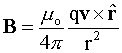
Image378.gif
(1)

But is there any experimental proof of this equation? I know it can be reformulated into this.

wire.h1.gif
(2)

My question is "Is there any experimental proof of Eq. (1)?"

I guest particle accelerator level experiment would create detectable magnetic field. I read lightning magnetise things, but it is not a direct measurement.

Please let me know if there is any DIY level experiment of measuring magnetic field by mechanical movement of charges. If it is not possible, could anyone explain why?

Thank you in advance!
 
Physics news on Phys.org
What do you count as mechanical movement? Is an electron beam okay? In that case: not hard to detect.

Moving a solid object with a net charge produces tiny magnetic fields. Moving a 1µC charge by 1 km/s (that is a bullet) leads to a field of ~10nT at a distance of 10cm. Detectable, but not as DIY experiment.
 
  • Like
Likes   Reactions: samueljun
mfb said:
What do you count as mechanical movement? Is an electron beam okay? In that case: not hard to detect.

Moving a solid object with a net charge produces tiny magnetic fields. Moving a 1µC charge by 1 km/s (that is a bullet) leads to a field of ~10nT at a distance of 10cm. Detectable, but not as DIY experiment.

Thank you mfb. Could you give me any reference that measures magnetic field of electron beam? I see only articles of electron beam deflected by magnetic field.
By the way, I found this article.
http://educate-yourself.org/cn/ElectronBeamMagneticField.pdf
This says that magnetic field is not due to the eq. 1 of my post but to intrinsic magnetic moment.
What do you think about this argument?
 
I'm not aware of dedicated measurements (they probably exist, but searching for them is basically impossible, you get spammed with results of deflecting a beam with external fields), but some linear accelerators can produce beam currents larger than 100 mA. A simple hall probe next to the beam would be sufficient.

In colliders, the electromagnetic field of one beam has a significant impact on the other beam. This is called beam-beam effect and https://lhc-beam-beam.web.cern.ch/lhc-beam-beam/CERNpapers_beambeam.html.
 
  • Like
Likes   Reactions: samueljun
mfb said:
I'm not aware of dedicated measurements (they probably exist, but searching for them is basically impossible, you get spammed with results of deflecting a beam with external fields), but some linear accelerators can produce beam currents larger than 100 mA. A simple hall probe next to the beam would be sufficient.

In colliders, the electromagnetic field of one beam has a significant impact on the other beam. This is called beam-beam effect and https://lhc-beam-beam.web.cern.ch/lhc-beam-beam/CERNpapers_beambeam.html.

Many thanks to mfb. I wonder if the water drop levitating (orbiting) effect of Kelvin Generator can be the example of magnetic field formation by mechanically moving charge. Otherwise it is so strange... Please have a look at the videos.


Kelvin dropper experiment is easy to set up. The reason for water drop splashing is charged water repulsion. But orbiting around the ring with static electricity is not easy to explain. The only way is that the magnetic field direction changes with time so that the electric field is induced.

I look forward to your great opinion!
 
Orbiting around the ring is exactly what you would expect with a simple quasistatic electric attraction.
 
  • Like
Likes   Reactions: samueljun

Similar threads

  • · Replies 5 ·
Replies
5
Views
1K
  • · Replies 7 ·
Replies
7
Views
2K
  • · Replies 17 ·
Replies
17
Views
3K
  • · Replies 3 ·
Replies
3
Views
2K
  • · Replies 8 ·
Replies
8
Views
2K
  • · Replies 1 ·
Replies
1
Views
851
  • · Replies 7 ·
Replies
7
Views
2K
Replies
152
Views
7K
  • · Replies 9 ·
Replies
9
Views
2K
  • · Replies 26 ·
Replies
26
Views
13K