Magnetic Fields & Forces on Conductors

Click For Summary
SUMMARY

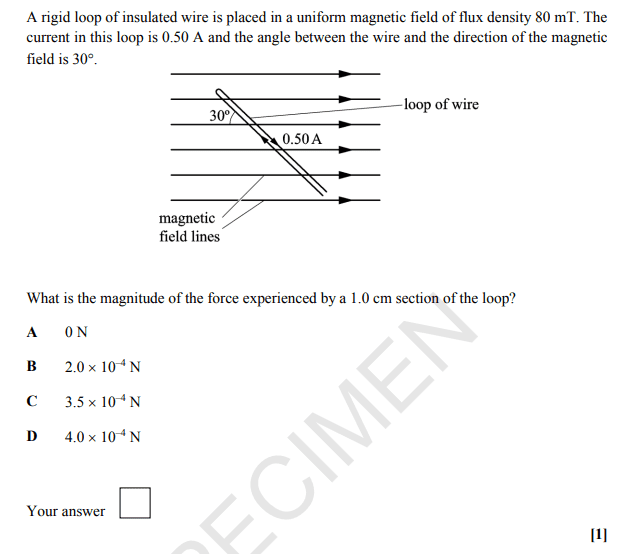
The discussion centers on the calculation of the force on a current-carrying wire in a magnetic field, specifically addressing a question from a physics paper. The correct answer is option A - 0N, as the net force on a section of the loop, which includes both outgoing and returning wires, is zero due to opposing forces. The formula used, F = BIL sin(θ), was applied incorrectly by the original poster, who did not account for the loop's configuration. The torque on the loop is also minimal due to the small lever arm created by the close proximity of the wires.

PREREQUISITES
  • Understanding of magnetic fields and forces on conductors
  • Familiarity with the formula F = BIL sin(θ)
  • Knowledge of torque and its calculation in physics
  • Basic concepts of current-carrying loops in magnetic fields
NEXT STEPS
  • Study the principles of electromagnetic force on conductors in magnetic fields
  • Learn about torque calculations in current-carrying loops
  • Explore the implications of wire configurations on net forces in magnetic fields
  • Investigate the effects of varying angles (θ) in magnetic force calculations
USEFUL FOR

Students studying physics, educators teaching electromagnetism, and anyone interested in understanding the forces acting on conductors in magnetic fields.

Jimmy87
Messages
692
Reaction score
19
Homework Statement
Multiple Choice Question
Relevant Equations
F = BIL sin (θ)
Hi,

Here is a multiple choice question I am stuck with and would appreciate some guidance:
1581548360038.png
The mark scheme for this paper says it is option A - 0N. I didn't get that at all. If a current carrying wire is in a magnetic field with some component perpendicular to the field then how can it be zero?! I got option B by doing

F = BIL sin (θ) where θ is the angle between B and I.
F = (0.08T x 0.5A x 0.01m) sin (30) = 2.0 x 10⁻⁴ N (to 2 sig figs)

Have I missed something?

Thanks.
 
Physics news on Phys.org
The wording of the problem is not particularly clear. It asks for the force on a section of the loop, not the force on a section of the wire. A section of the loop might be interpreted as containing two sections of the wire.
 
  • Like
Likes   Reactions: Jimmy87
In my opinion this is almost deceptively tricky. However note that they said “1cm section of the loop”, not “1cm section of the wire”. I believe they mean you to understand that a “section of the loop” includes both wires. While there is indeed a force on the outgoing and returning wires, the forces on each are in opposite directions. The net force is zero. There would be a torque on the loop, but the wires are close together making the lever arm small, so the torque is also small.
 
  • Like
Likes   Reactions: Jimmy87
Cutter Ketch said:
In my opinion this is almost deceptively tricky. However note that they said “1cm section of the loop”, not “1cm section of the wire”. I believe they mean you to understand that a “section of the loop” includes both wires. While there is indeed a force on the outgoing and returning wires, the forces on each are in opposite directions. The net force is zero. There would be a torque on the loop, but the wires are close together making the lever arm small, so the torque is also small.

Thanks. Wow that’s crazy! I see what you mean now. The resultant force on a section of the LOOP is zero. That’s mean ☹️. They should have at least but loop in bold font.

Thanks guys.
 

Similar threads

Replies
2
Views
1K
  • · Replies 3 ·
Replies
3
Views
2K
Replies
4
Views
1K
Replies
12
Views
3K
Replies
10
Views
2K
  • · Replies 2 ·
Replies
2
Views
2K
Replies
1
Views
2K
Replies
16
Views
1K
Replies
34
Views
2K