Magnetic Fields & Forces on Conductors

Click For Summary

Homework Help Overview

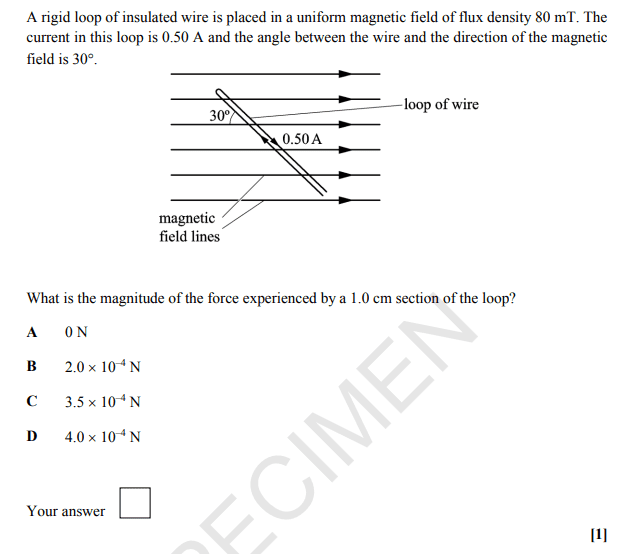
The discussion revolves around a multiple choice question related to the forces acting on a current-carrying wire placed in a magnetic field. Participants are exploring the implications of the question's wording, particularly regarding the interpretation of a "section of the loop" versus a "section of the wire." The subject area involves concepts of magnetic fields and forces on conductors.

Discussion Character

  • Conceptual clarification, Assumption checking

Approaches and Questions Raised

  • Participants are questioning the clarity of the problem's wording and its implications for calculating forces. There is discussion about whether the force should be considered on the entire loop or just a section of the wire, and how this affects the net force calculation.

Discussion Status

Some participants have provided insights into the interpretation of the question, suggesting that the forces on different sections of the loop may cancel each other out, leading to a net force of zero. There is recognition of the potential for confusion in the problem's phrasing, but no explicit consensus has been reached.

Contextual Notes

Participants note that the question specifies a "1cm section of the loop," which may imply a need to consider multiple wires and their opposing forces. This raises questions about the assumptions made in the original poster's calculations.

Jimmy87
Messages
692
Reaction score
19
Homework Statement
Multiple Choice Question
Relevant Equations
F = BIL sin (θ)
Hi,

Here is a multiple choice question I am stuck with and would appreciate some guidance:
1581548360038.png
The mark scheme for this paper says it is option A - 0N. I didn't get that at all. If a current carrying wire is in a magnetic field with some component perpendicular to the field then how can it be zero?! I got option B by doing

F = BIL sin (θ) where θ is the angle between B and I.
F = (0.08T x 0.5A x 0.01m) sin (30) = 2.0 x 10⁻⁴ N (to 2 sig figs)

Have I missed something?

Thanks.
 
Physics news on Phys.org
The wording of the problem is not particularly clear. It asks for the force on a section of the loop, not the force on a section of the wire. A section of the loop might be interpreted as containing two sections of the wire.
 
  • Like
Likes   Reactions: Jimmy87
In my opinion this is almost deceptively tricky. However note that they said “1cm section of the loop”, not “1cm section of the wire”. I believe they mean you to understand that a “section of the loop” includes both wires. While there is indeed a force on the outgoing and returning wires, the forces on each are in opposite directions. The net force is zero. There would be a torque on the loop, but the wires are close together making the lever arm small, so the torque is also small.
 
  • Like
Likes   Reactions: Jimmy87
Cutter Ketch said:
In my opinion this is almost deceptively tricky. However note that they said “1cm section of the loop”, not “1cm section of the wire”. I believe they mean you to understand that a “section of the loop” includes both wires. While there is indeed a force on the outgoing and returning wires, the forces on each are in opposite directions. The net force is zero. There would be a torque on the loop, but the wires are close together making the lever arm small, so the torque is also small.

Thanks. Wow that’s crazy! I see what you mean now. The resultant force on a section of the LOOP is zero. That’s mean ☹️. They should have at least but loop in bold font.

Thanks guys.
 

Similar threads

Replies
2
Views
1K
  • · Replies 3 ·
Replies
3
Views
2K
Replies
4
Views
1K
Replies
12
Views
3K
Replies
10
Views
2K
  • · Replies 2 ·
Replies
2
Views
2K
Replies
1
Views
2K
Replies
16
Views
2K
Replies
34
Views
2K