Discussion Overview
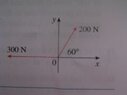
The discussion revolves around calculating the magnitude and angle of the resultant force from multiple vectors. Participants explore methods for determining vector components, summing forces, and finding angles, with a focus on both conceptual understanding and mathematical application.
Discussion Character
- Homework-related
- Mathematical reasoning
- Technical explanation
- Debate/contested
Main Points Raised
- Some participants express difficulty in finding the components of the forces involved, particularly the x and y components.
- There are suggestions to break down vectors into components using trigonometric functions, with references to "SOH CAH TOA" for right triangles.
- One participant proposes using the law of cosines and the parallelogram law as an alternative method for finding the resultant force's magnitude.
- Discussions arise regarding the correct approach to calculating angles, with some using arcsine and others suggesting tangent based on the components.
- Participants debate the necessity of simplifying trigonometric values before calculations, with differing opinions on the impact of using LaTeX for clarity.
- There are multiple calculations presented for the resultant force's magnitude and angle, with some participants arriving at different values and methods.
- One participant mentions the importance of considering the direction of the resultant vector and how to express it in terms of cardinal directions.
Areas of Agreement / Disagreement
Participants generally agree on the need to calculate vector components and resultant forces, but there is no consensus on the best method for finding angles or the necessity of simplifying trigonometric expressions. Multiple competing views on the calculations and interpretations of results remain unresolved.
Contextual Notes
Some calculations rely on specific assumptions about the angles and directions of the forces, and there are unresolved mathematical steps regarding the use of trigonometric functions for angle determination. The discussion also highlights varying levels of comfort with mathematical notation and presentation.