Mapping Points on the Bloch Sphere

Click For Summary
SUMMARY

This discussion focuses on mapping discrete points on the Bloch sphere, specifically limiting the ranges of theta and phi to specified intervals (theta_1, theta_2) and (phi_1, phi_2). The user seeks to understand whether this limitation will result in actual mapping to new points or merely alter the probabilities of qubit states collapsing to 0 or 1. The conversation highlights the use of spherical harmonics and orthonormal functions to achieve this mapping, while also considering the implications on qubit observation and state collapse.

PREREQUISITES
  • Understanding of Bloch sphere representation in quantum mechanics
  • Knowledge of spherical coordinates and their application in quantum states
  • Familiarity with qubit state collapse and probability distributions
  • Experience with orthonormal functions and their role in quantum mechanics
NEXT STEPS
  • Research spherical harmonics in quantum mechanics for mapping techniques
  • Explore the implications of density matrices on qubit state representation
  • Study the mathematical foundations of orthonormal functions in quantum state manipulation
  • Investigate alternative methods for qubit state mapping and probability alteration
USEFUL FOR

Quantum physicists, quantum computing researchers, and students studying quantum mechanics who are interested in qubit representation and manipulation on the Bloch sphere.

captainhampto
Messages
12
Reaction score
0
Hey guys,

I'm attempting to map some discrete points on the surface of the Bloch sphere:
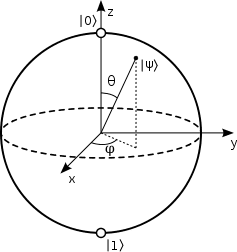
237px-Bloch_spheresvg.png


For instance, the full spectrum of ranges for variable theta is 0 < theta < pi. However, my goal is to limit that range from some theta_1 < theta < theta_2. I was going to use a spherical harmonic technique to limit the ranges, but my question is this:

If I do succeed in limiting the ranges, will this actually map to these new points (theta_1 and theta_2) or will it simply alter the probability of the qubit represented by the Bloch sphere to collapsing to either basis state of 0 or 1?

My main goal is to have some value between theta_1 and theta_2 arise from this technique so that I do not get the full spectrum of 0 to pi. If a better technique exists I would be most obliged to learn of it.

If any further clarification is needed, please do not hesitate to post a response, as perhaps I am leaving out some detail that is crucial. Either way, thanks and looking forward to some responses.
 
Physics news on Phys.org
To map from where to where? And why is mapping a point from one set to another set a problem?
 
To map from some point on the sphere denoted by spherical coordinations (theta_1, phi_1) to (theta_2, ph_2).

where instead of the full range:

0 <= theta <= 180
0 <= phi <= 360

the ranges are limited by some theta_1, theta_2, phi_1, and phi_2:

theta_1 <= theta <= theta_2
phi_1 <= phi <= phi_2

I have a pretty good idea of how to limit the ranges, basically by creating a set of new functions which are orthonormal over the set of new value ranges.

I suppose my main question is that, using these new functions on the sphere, when the qubit is observed will it collapse to some point on the sphere? Or will it simply alter the probability of the qubit collapsing to either state.

Or, perhaps if I am making this too complex. Basically, if there is a cleaner method for obtaining some value between the ranges of

theta_1 <= theta <= theta_2
phi_1 <= phi <= phi_2

when the qubit collapses, that is what I am after.

Thanks again, and I hope this clears up some of my intent. If not, I really do not mind trying to clear up more if you or anyone else is still not following my reasoning. (I apologize if so)
 
I don't know if this will help or not, but every pure state of a qubit is described by the density matrix

\rho(\mathbf{n})=\frac{1}{2}(I+\mathbb{\sigma}\cdot\mathbf{n})

where \mathbf{n} is the unit vector.

It follows that

\mbox{Tr }(\sigma_3\rho(\mathbf{n}))=\cos(\theta)
 
Last edited:
So, one can select a region on the Bloch sphere simply by restricting the ranges of expectation values of, say, \sigma_3 and \sigma_1.
 
Thanks a lot for the help arkajad. I will certainly give your approach a shot. Thanks again.
 

Similar threads

  • · Replies 2 ·
Replies
2
Views
2K
  • · Replies 2 ·
Replies
2
Views
2K
  • · Replies 2 ·
Replies
2
Views
2K
  • · Replies 1 ·
Replies
1
Views
3K
  • · Replies 4 ·
Replies
4
Views
3K
  • · Replies 2 ·
Replies
2
Views
3K
  • · Replies 4 ·
Replies
4
Views
4K
  • · Replies 20 ·
Replies
20
Views
1K
  • · Replies 9 ·
Replies
9
Views
2K
  • · Replies 20 ·
Replies
20
Views
2K