Markov chain on state {1, 2, 3, 4, 5, 6 , 7}

Join the discussion
Ask a follow-up here, or get your own question answered by working scientists, mathematicians and engineers — people, not an autocomplete.
Real named experts · corrections over time · the nuance an AI answer skips
4 replies · 2K views
Janji
Messages
5
Reaction score
0
Member warned that some effort must be shown
Homework Statement
Let's suppose the chain starts at state 1. The distribution of the number of times that the chain returns to state 1 is geometric and the parameter would be 1/4.
Relevant Equations
In the long run, what fraction of the time does the chain spend in state 3?
I need this for a programming project. Could you help?
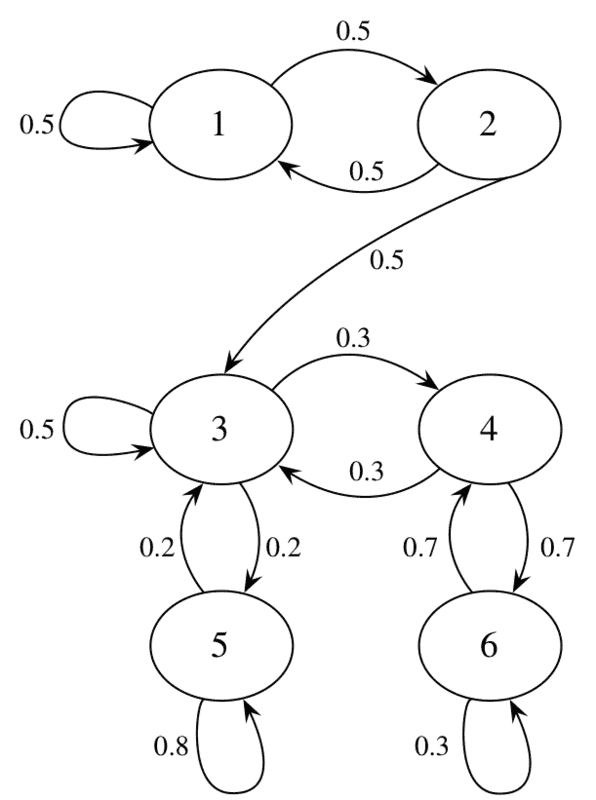
7_reducible.png
 
Last edited by a moderator:
on Phys.org
What have you tried? What do you mean formally with "in the long run"?
 
Math_QED said:
What have you tried? What do you mean formally with "in the long run"?
In the long run (n→∞):
 
Janji said:
Homework Statement:: Let's suppose the chain starts at state 1. The distribution of the number of times that the chain returns to state 1 is geometric and the parameter would be 1/4.
Relevant Equations:: In the long run, what fraction of the time does the chain spend in state 3?

I need this for a programming project. Could you help?View attachment 260957
The diagram can be represented by a transition matrix. For this problem it is a 6 x 6 sparse matrix; i.e., most of the entries are 0 since many transitions aren't defined. To find the long-term behavior, you look at ##\lim_{n \to \infty}A^n##, where A is the transition matrix.

Janji said:
The distribution of the number of times that the chain returns to state 1 is geometric and the parameter would be 1/4.
It's been many years since I've done problems like this -- I don't know how this information fits into the problem.
 
Janji said:
The distribution of the number of times that the chain returns to state 1 is geometric and the parameter would be 1/4.
Is that given or something to be proved? If given it would seem redundant - all the info is in the initial state and the diagram.
Janji said:
In the long run, what fraction of the time does the chain spend in state 3?
You must show some attempt.
Can you see how simplify the state diagram in respect of this question?