Drain Brain
- 143
- 0
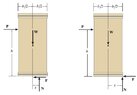
I just want to know the correct mathematical workings of why the box will tip over when distance x of the normal force from the center line is b/2.
what I know is when $\sum M$ about the point of application of the normal force is zero, the box will not tip over.
so, mathematically $W\frac{b}{2}=Ph$
it means that when $x\le\frac{b}{2}$ the box will not tip over. is that correct?
What if the point of application of the normal force is at the center line (i.e x=0)? and What if $x>\frac{b}{2}$?
can you show me mathematically what will happen? Thanks!
what I know is when $\sum M$ about the point of application of the normal force is zero, the box will not tip over.
so, mathematically $W\frac{b}{2}=Ph$
it means that when $x\le\frac{b}{2}$ the box will not tip over. is that correct?
What if the point of application of the normal force is at the center line (i.e x=0)? and What if $x>\frac{b}{2}$?
can you show me mathematically what will happen? Thanks!