Mathematical Proof of Kepler's First Law of Orbits

Click For Summary
SUMMARY

This discussion focuses on deriving the equation for elliptical orbits as related to Kepler's First Law, specifically the formula p = a(1-e²), where p is the semi-latus rectum, a is the semi-major axis, and e is the eccentricity. Participants recommend resources such as "Analytical Mechanics" by Fowles and Cassiday and "Foundations of Astrophysics" by Ryden and Peterson for deeper understanding. Additionally, online resources, including Wikipedia articles on Kepler's laws and the ellipse, are suggested for further exploration of the topic.

PREREQUISITES
  • Understanding of elliptical orbits and their properties
  • Familiarity with Kepler's laws of planetary motion
  • Basic knowledge of polar coordinates and equations
  • Mathematical proficiency in algebra and geometry
NEXT STEPS
  • Study "Analytical Mechanics" by Fowles and Cassiday for derivations of orbital equations
  • Explore "Foundations of Astrophysics" by Ryden and Peterson for astrophysical context
  • Research online resources detailing the derivation of Kepler's laws from Newton's laws
  • Examine the polar form of the ellipse through Wikipedia's dedicated article
USEFUL FOR

Students in mathematics and physics, particularly those studying classical mechanics and astrophysics, will benefit from this discussion as it provides foundational insights into orbital mechanics and mathematical proofs related to Kepler's First Law.

Memocyl
Messages
3
Reaction score
0
Hello friends (I hope :biggrin:),

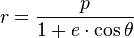
For a maths project I am working on, I need to be able to prove the equation for an elliptical orbit, related to Kepler's first law:
b115356a043a8d816886221bdd807dfb.png
and p = a(1-e2) (or should be as p can be replaced by that value)

Where:
r = distance from sun to any point on the orbit
p = semi latus rectrum
a = semi-major axis
e = eccentricity
θ = true anomaly (angle between a and r anticlockwise I think)

Can someone please help me to understand where these equations come from and also confirm that I have got my current facts straight?

Regards,
Memocyl
 
Astronomy news on Phys.org
Have you looked in classical mechanics and/or astrophysics books?
 
George Jones said:
Have you looked in classical mechanics and/or astrophysics books?
I haven't been able to come by any at the moment that help me derive the equation itself, which is what I don't understand. However, if you could name me any books that do that would be exceptionally helpful :smile:

Thank you
Memocyl
 
Examples at the level of about second-year university include "Analytical Mechanics" by Fowles and Cassiday, and "Foundations of Astrophysics" by Ryden and Peterson. I haven't looked, but I suspect that derivations of Kepler's first law also can be found on-line. Just Google "Kepler's first law".
 
George Jones said:
Examples at the level of about second-year university include "Analytical Mechanics" by Fowles and Cassiday, and "Foundations of Astrophysics" by Ryden and Peterson. I haven't looked, but I suspect that derivations of Kepler's first law also can be found on-line. Just Google "Kepler's first law".
I have tried online but to no avail unfortunately, apart from it bringing me here actually :biggrin:. Thank you very much though, I shall look for those books as soon as possible.

Regards
Memocyl
 
Memocyl said:
Hello friends (I hope :biggrin:),

For a maths project I am working on, I need to be able to prove the equation for an elliptical orbit, related to Kepler's first law:

b115356a043a8d816886221bdd807dfb.png
and p = a(1-e2) (or should be as p can be replaced by that value)

Where:
r = distance from sun to any point on the orbit
p = semi latus rectrum
a = semi-major axis
e = eccentricity
θ = true anomaly (angle between a and r anticlockwise I think)

Can someone please help me to understand where these equations come from and also confirm that I have got my current facts straight?

Regards,
Memocyl
There's plenty of material online which derives Kepler's laws from different perspectives.

Look at:
https://en.wikipedia.org/wiki/Kepler's_laws_of_planetary_motion (check out the bibliography at the end of the article)

https://en.wikipedia.org/wiki/Ellipse (for details of the equation of the ellipse in polar form)

http://www.grputland.com/2013/12/self-contained-derivation-of-keplers-laws-from-Newtons-laws.html
 

Similar threads

  • · Replies 2 ·
Replies
2
Views
1K
Replies
3
Views
2K
  • · Replies 3 ·
Replies
3
Views
2K
  • · Replies 1 ·
Replies
1
Views
1K
  • · Replies 6 ·
Replies
6
Views
2K
  • · Replies 10 ·
Replies
10
Views
6K
  • · Replies 3 ·
Replies
3
Views
2K
  • · Replies 9 ·
Replies
9
Views
2K
  • · Replies 1 ·
Replies
1
Views
2K
  • · Replies 1 ·
Replies
1
Views
2K