Matrix with repeated eigenvalues is diagonalizable....?

Click For Summary
Matrices with repeated eigenvalues can be diagonalizable if they have enough independent eigenvectors. The discussion highlights that having distinct eigenvalues guarantees diagonalizability, but the converse is not always true. A matrix can be diagonalizable even with repeated eigenvalues, as demonstrated by an example where a matrix with eigenvalues 1, 5, 5, 5 produces independent eigenvectors. The key condition for diagonalizability is the existence of a complete set of independent eigenvectors, not merely the presence of eigenvalues. Therefore, while repeated eigenvalues can complicate diagonalization, they do not inherently prevent it if the necessary conditions are met.
kostoglotov
Messages
231
Reaction score
6
MIT OCW 18.06 Intro to Linear Algebra 4th edt Gilbert Strang

Ch6.2 - the textbook emphasized that "matrices that have repeated eigenvalues are not diagonalizable".

Q4pbi33.jpg

imgur: http://i.imgur.com/Q4pbi33.jpg

and
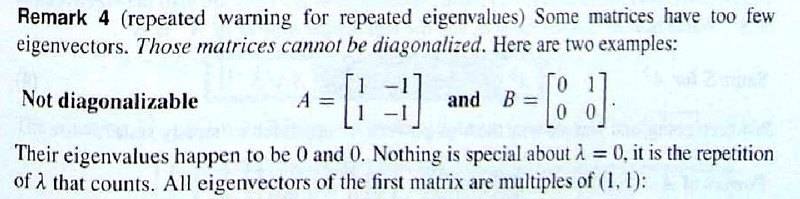
RSOmS2o.jpg

imgur: http://i.imgur.com/RSOmS2o.jpg

Upon rereading...I do see the possibility to interpret this to mean that fewer than n independent eigenvectors leads to an undiagonalizable matrix...that n-all different eigenvalues ensures n-independent eigenvectors...leaving open the possibility of n-independent eigenvectors with repeated eigenvalues...? Yes, no?

Because the second worked example shows a matrix with eigenvalues 1,5,5,5, and the use of diagonalization of that matrix, and Matlab is quite happy to produce a matrix of n-independent eigenvectors from this matrix.

The matrix in question is 5*eye(4) - ones(4);

What is the actual rule, because I don't feel clear on this.
 
Physics news on Phys.org
If all n eigenvalues are distinct, then the matrix is diagonalizable. However, the converse is not true. There are matrices that are diagonalizable even if their eigenvalues are not distinct, as your example clearly shows.
 
Diagonalizable means per definition that you can find a basis of eigenvectors. If all eigenvalues exist in the underlying field or ring and there are as many as the dimension is, there is clearly a basis of eigenvectors. This condition is sufficient but not necessary since diag(1,...,1) is diagonalized with just one (repeated) eigenvalue 1. A necessary condition is that the characteristic polynomial det(A-t*id) of a matrix A has only linear factors (which may be repeated, e.g. det(id - t*id) = (1-t)^dimension ). i.e. all zeros of the characteristic polynomial exist in the underlying field or ring. Those zeros are exactly the eigenvalues.

Ps: You have still to find a basis of eigenvectors. The existence of eigenvalues alone isn't sufficient. E.g.
0 1
0 0
is not diagonalizable although the repeated eigenvalue 0 exists and the characteristic po1,0lynomial is t^2. But here only (1,0) is a eigenvector to 0.
 
Last edited:
  • Like
Likes kostoglotov
I am studying the mathematical formalism behind non-commutative geometry approach to quantum gravity. I was reading about Hopf algebras and their Drinfeld twist with a specific example of the Moyal-Weyl twist defined as F=exp(-iλ/2θ^(μν)∂_μ⊗∂_ν) where λ is a constant parametar and θ antisymmetric constant tensor. {∂_μ} is the basis of the tangent vector space over the underlying spacetime Now, from my understanding the enveloping algebra which appears in the definition of the Hopf algebra...

Similar threads

  • · Replies 33 ·
2
Replies
33
Views
2K
  • · Replies 2 ·
Replies
2
Views
5K
Replies
9
Views
2K
  • · Replies 4 ·
Replies
4
Views
6K
  • · Replies 1 ·
Replies
1
Views
2K
  • · Replies 3 ·
Replies
3
Views
4K
  • · Replies 9 ·
Replies
9
Views
3K
  • · Replies 3 ·
Replies
3
Views
3K
  • · Replies 2 ·
Replies
2
Views
1K
Replies
1
Views
3K